
Mobile App Development Contract Checklist: IP, Source Code and Handover Clauses to Insist On
You found a development partner, the quote looks fair, and you’re ready to start. Then a 20-page contract lands in your inbox. Before you sign, slow down for a moment, because a handful of clauses decide whether you truly own the app you’re paying for.
A solid mobile app development contract should transfer all custom code and designs to you through a written, present-tense IP assignment, keep the source code in a repository you own from day one, disclose every open source and third-party component, and list exactly what the developer hands over at the end: code, store accounts, signing keys, credentials, documentation and transition support.
In this blog, we are going to present a checklist that walks you through each clause in plain English, flags the wording that should worry you, and shows what a clean handover looks like for US businesses.
Why Your Mobile App Development Contract Matters More Than the Code
Most app disputes don’t start with bad code. They start with a vague sentence nobody questioned at signing. When something goes wrong, the contract becomes the only map anyone follows.
A few numbers show why the details matter:
- 52% of projects experienced scope creep or uncontrolled scope changes in PMI’s 2018 Pulse of the Profession research, up from 43% five years earlier.
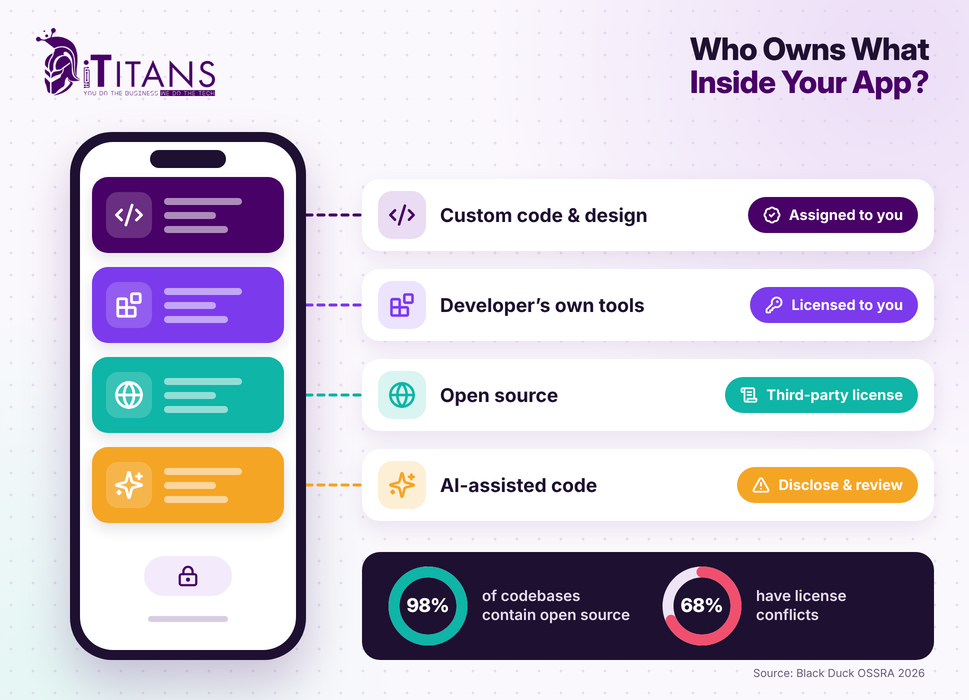
- 98% of codebases audited for Black Duck’s 2026 OSSRA report contained open source, and 68% had license conflicts, the highest rate in the report’s history.
- Only 54% of organizations evaluate AI-generated code for IP and licensing risk, according to Black Duck’s summary of the same research.
Put simply, your app will almost certainly contain code you didn’t commission, partly written by tools nobody fully audits. Your app development agreement has to account for that reality.
A quick note before we dig in: this guide shares general information for US businesses, not legal advice. For anything high-stakes, ask a US-licensed technology attorney to review your final draft. An hour of legal review costs far less than rebuilding an app you can’t legally touch.
Who Owns Your App by Default?
Here’s the part that surprises most founders. Under US copyright law, the person or company that writes the code usually owns it, even if you paid for every line. Payment alone doesn’t transfer ownership.
Federal law says a transfer of copyright ownership isn’t valid unless it’s in writing and signed by the owner, under 17 U.S.C. § 204(a). No signed document, no transfer. That’s why intellectual property rights clauses sit at the heart of every software development contract.
Why “Work Made for Hire” Language Often Falls Short
Many templates lean on a single phrase: “work made for hire.” It sounds airtight, but it has real limits.
- Employees: Code an employee writes as part of the job belongs to the employer automatically.
- Outside contractors: A commissioned work only counts as a work made for hire if it fits one of nine categories, and both parties sign a written agreement saying so, as the US Copyright Office explains in Circular 30.
- The catch: Those categories cover things like translations, compilations and contributions to collective works. Custom app code rarely fits cleanly into any of them.
If your contract relies only on that phrase, you could end up without clear title. The fix is simple: pair it with an explicit backup assignment.
The California Wrinkle Most Templates Miss
This is the detail generic checklists skip. If you hire an individual freelancer and the agreement calls the work “made for hire,” California can treat you as that person’s employer for unemployment insurance purposes under Unemployment Insurance Code § 686. Labor Code § 3351.5(c) applies a parallel rule for workers’ compensation.
So a clause meant to protect your IP can quietly create insurance obligations you never budgeted for. That’s why employment lawyers often recommend a straight assignment for individual contractors instead. Incorporated agencies are a different situation, so confirm your setup with counsel.
“Hereby Assigns” Beats “Will Assign”
Tiny wording changes carry real weight. “Developer will assign” is a promise to transfer rights later. “Developer hereby assigns” transfers them now, including future work the moment it’s created.
Courts have drawn exactly this line. In the Stanford v. Roche dispute, the Federal Circuit treated “agree to assign” as a mere promise and “do hereby assign” as an immediate transfer.
The Supreme Court’s 2011 decision relied partly on that reading. It was a patent case, but IP lawyers apply the same drafting lesson to software.
IP Clauses to Insist On in Your App Development Agreement
Treat these six clauses as your non-negotiables. If a vendor pushes back on any of them, ask why, and get the answer in writing.
1. A Present-Tense IP Assignment Clause
Your IP assignment clause should cover everything created for your project, not just “the app.” List the deliverables broadly:
- Source code and compiled builds
- UI designs, wireframes, icons and graphics
- Database schemas, APIs and technical documentation
- Test scripts, build scripts and configuration files
Use “hereby assigns” wording. Then add a “further assurances” line that obliges the developer to sign any extra paperwork you need to register or enforce your rights later.
2. A Clear Line Between Custom Work and Background IP
Good developers reuse proven tools and code they built before your project. That’s normal, and it saves you money. The trouble starts when the contract stays silent about it.
Insist on:
- A written list of pre-existing (background) components used in your app
- A perpetual, irrevocable, royalty-free, worldwide license to use, modify and transfer that background IP as part of your app
- The right to keep using it if you switch vendors or sell your company
Without that license, an investor’s or buyer’s due diligence team will flag your app as a risk.
3. Open Source Licenses Disclosure
Open source isn’t the problem. Undisclosed open source is. Some licenses, like GPL and AGPL, carry “copyleft” terms that can require you to release your own source code if you distribute or host the software in certain ways.
Ask for:
- A dependency list or software bill of materials (SBOM) showing every library and its license
- Written approval before the developer adds any copyleft component
- A warranty that the code complies with all open source licenses it uses
4. AI-Generated Code Disclosure
Most developers now use AI coding assistants, and that’s fine when a skilled human reviews the output. The legal catch: the US Copyright Office concluded in January 2025 that prompts alone don’t make someone an author, so purely AI-generated material may not qualify for copyright protection.
Your contract should require the developer to:
- Disclose meaningful use of AI tools on your project
- Review, test and take responsibility for all AI-assisted code
- Keep your confidential code and data out of AI tools that train on user inputs
If AI-written code has already gotten away from you, this breakdown of what it costs to rescue an AI-built app helps you plan the cleanup.
5. Subcontractor and Employee IP Agreements
A developer can only assign what it owns. If an agency uses freelancers or offshore subcontractors, each person needs a signed IP agreement with the agency first. Otherwise, you inherit a gap in your chain of title.
Add a clause that:
- Requires written IP assignments from every employee and subcontractor who touches your project
- Requires your written consent before any work gets subcontracted
- Lets you request copies of those agreements on demand
Working with a distributed team? These tips on how to hire offshore developers without getting burned cover more vetting steps.
6. IP Warranties and Indemnity
Warranties put the developer’s promises on record. Ask the developer to warrant that the work is original or properly licensed, doesn’t infringe anyone’s patents, copyrights or trade secrets, and hasn’t been licensed to anyone else.
Then back it with an indemnity. If a third party sues you over infringing code the developer supplied, the developer covers your defense costs and damages. Check that the liability cap doesn’t quietly cancel this protection, since many vendors cap total liability at fees paid.
Source Code Clauses That Keep You in Control
Source code ownership on paper means very little if you can’t actually reach the code. These clauses turn ownership into control you can use.
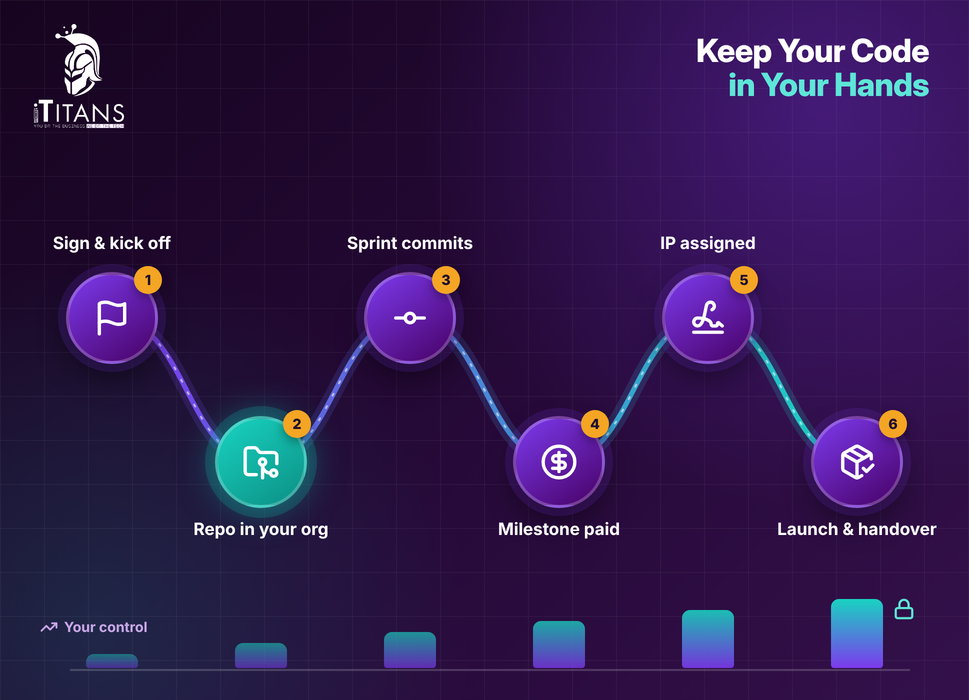
Repository Ownership From Day One
Create the GitHub, GitLab or Bitbucket organization under your company’s account before development starts. Then add the developer’s team as collaborators.
This one move changes everything:
- You see progress in real time through commits
- You never have to “request” your own code
- You can revoke access instantly if the relationship ends
Require commits to your repository at least at the end of every sprint, not just at launch.
Complete, Buildable Code Delivery
“Source code” should mean everything another qualified developer needs to build, run and deploy the app. Define it in the contract to include:
- Mobile, web and back-end code, plus infrastructure scripts
- Build configuration, environment templates and dependency files
- Database schemas, migrations and seed data
- Automated tests and CI/CD pipeline definitions
Here’s a practical test experienced buyers use: make final acceptance depend on an independent developer building the app from the repository using only the README. If the build fails, the delivery isn’t complete.
Source Code Escrow: When It Makes Sense
If the developer keeps code on its side, such as a proprietary platform or back end it licenses to you, consider source code escrow. A neutral third party holds the code and releases it to you if certain events happen.
Common release triggers include:
- The developer stops supporting the software
- The developer breaches key obligations
- Bankruptcy or clear signs of financial instability
Ask for verified deposits. Virginia’s state IT procurement manual, for example, lists compiling and testing the deposited code as verification steps. For fully custom apps where you already own the repository, escrow usually adds cost without much benefit.
No Kill Switches, Backdoors or Hidden Dependencies
Occasionally, a vendor builds in leverage: a license check that pings its server, an API key registered in its name, or a private library you can’t access. Ban these outright.
Add a warranty that the code contains no time bombs, disabling code, backdoors or undisclosed remote access. Also require that every service the app depends on runs under an account you own or can take over on request.
Your App Handover Checklist: Clauses That Make the Exit Clean
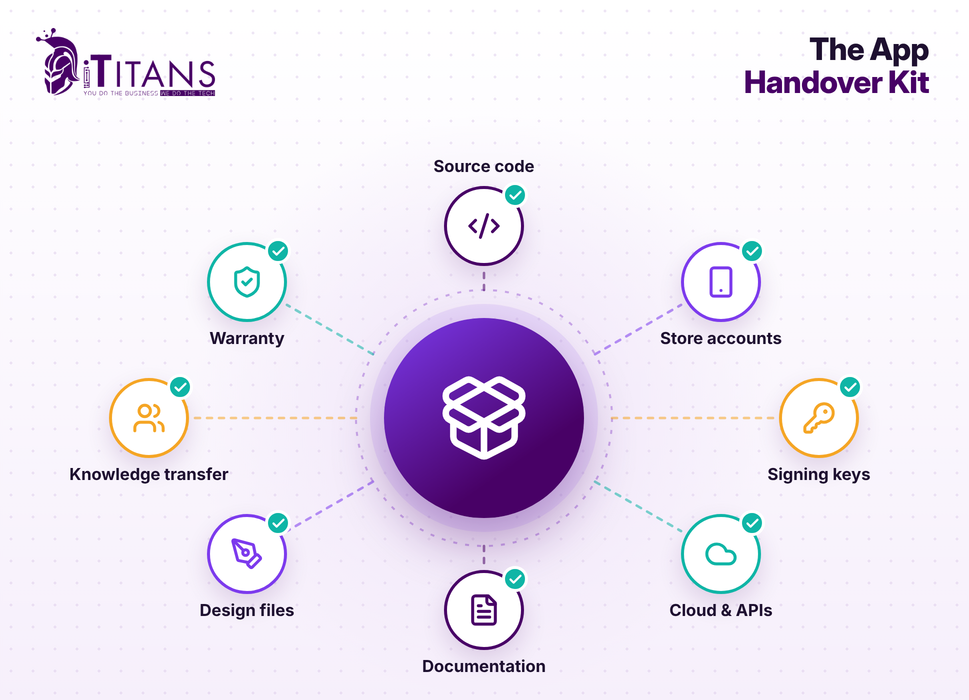
Handover is where many projects quietly fall apart. The app launches, the invoice gets paid, and months later you discover the developer still controls the keys. Write the handover into the contract as a specific deliverable with a deadline, not a favor.
App Store and Google Play Accounts
Publish the app under your own developer accounts from the start:
- Apple Developer Program: 99 USD per membership year. Organizations need a D-U-N-S Number and someone with legal authority to sign.
- Google Play Console: a US$25 one-time registration fee.
Here’s why it matters. Apple only allows app transfers that meet its app transfer criteria, including at least one version released on the App Store. A pre-launch app sitting in a vendor’s account can’t simply move. Invite the developer into your accounts with limited roles instead.
Signing Keys, Certificates and Credentials
This is another detail most checklists skip. Google’s documentation states that if you manage your own signing key and lose it, you lose the ability to update your app, and Google can’t retrieve it for you. With Play App Signing, Google secures that key and lets you request a reset if you lose the upload key.
Your contract should require:
- Play App Signing turned on, with the upload key handed over at launch
- Apple certificates, provisioning profiles and push notification keys created inside your account
- A full credentials list stored in a password manager you control
Cloud, Back-End and Third-Party Services
Your app probably relies on hosting, databases, analytics, crash reporting, payments, maps and email services. Each one should sit under your billing account. List them in a handover exhibit with:
- Service name and purpose
- Account owner and admin users
- Monthly cost and renewal date
- Steps to rotate API keys after handover
Documentation and Knowledge Transfer
Code without context slows down whoever comes next. Require:
- A README with setup, build and release steps
- An architecture overview and API documentation
- Design source files, such as Figma, plus brand assets
- A set number of knowledge transfer hours, recorded for future hires
Transition Help if the Relationship Ends
Even good partnerships end. A strong termination clause lets you exit for convenience with reasonable notice, pay only for accepted work, and receive all work in progress immediately.
Add paid transition assistance at a pre-agreed hourly rate for a fixed window. That way, the outgoing team briefs the incoming one instead of disappearing.
Quick Reference: Clauses, What to Ask For and Red Flags
Use this table as a fast scan during your contract review.
| Clause | What to Insist On | Red Flag Wording |
|---|---|---|
| IP assignment | “Hereby assigns” all deliverables to you | “Will assign upon full and final payment” |
| Background IP | Perpetual, transferable license | “Licensed for use with Developer’s services only” |
| Open source | Dependency list and no copyleft without approval | No mention of open source at all |
| AI-generated code | Disclosure and human review | Complete silence on AI tools |
| Source code access | Repository in your organization from day one | “Code delivered at project completion” |
| Store accounts | App published under your accounts | “Published under Developer’s account for convenience” |
| Signing keys | Handed over at launch, stored in your vault | Keys “retained for security reasons” |
| Termination | Exit for convenience plus transition help | Termination for cause only, no handover duty |
| Warranty | 60 to 90 days of free defect fixes | Software delivered “as is” |
Payment, Acceptance and Warranty Terms That Protect Your IP
Money and ownership are tightly linked, so line them up carefully.
- Tie IP transfer to milestones. Developers reasonably want payment before handing over rights. A fair middle ground: you own each milestone’s work once you pay for it, not only after the final invoice.
- Define acceptance criteria. List measurable tests, like features working as specified, crash-free builds and store-ready binaries. Knowing the top reasons Apple rejects apps in 2026 helps you write sharper criteria.
- Hold back a final payment. Keep a portion, often 10% to 20%, until handover is complete and verified.
- Get a warranty period. Ask for 60 to 90 days of free defect fixes after launch, then budget for ongoing care with this guide to what app maintenance actually costs after launch.
- Control scope changes. Require written change orders showing cost and timeline impact before any extra work begins.
How to Review a Mobile App Development Contract Before You Sign
You don’t need a law degree to catch most problems. Follow these steps:
- Read the exhibits first. The statement of work, deliverables list and handover exhibit hold the real detail.
- Map every payment to a deliverable you can actually verify.
- Search the draft for “assign,” “license,” “own” and “work made for hire,” then check each use.
- Pressure-test the exit. If you terminated tomorrow, what would you walk away with?
- Confirm account control. Who owns each store account, cloud account and signing key on launch day?
- Get a legal review of anything you don’t fully understand.
Red Flags That Should Pause the Deal
- The vendor won’t name the people building your app
- Source code stays on the vendor’s servers until final payment
- The contract grants you a “license” to your own custom code
- No mention of subcontractors or offshore resources
- Vague handover language like “reasonable assistance”
How iTitans Helps You Build an App You Fully Control
iTitans is a Frisco, Texas-based development company with 230+ completed projects, 135+ team members and a 97% customer satisfaction rate. Its process runs from planning and design through development, QA, deployment and ongoing support, which lines up neatly with the checklist above.
Mobile App Development for iOS, Android and Cross-Platform
The iTitans team builds custom mobile apps for startups and established businesses across the US. You can choose:
- Native iOS app development with Swift
- Android app development with Kotlin
- Cross-platform app development with Flutter or React Native
- A lean first release through The MVP Machine if you want to validate an idea fast
QA and DevOps That Make “Buildable Code” Real
A clean handover depends on code that another team can build and ship. The software quality assurance team tests apps across devices and platforms before launch, while DevOps services cover CI/CD pipelines, cloud infrastructure and deployment automation. Both make the “independent build” test from this checklist easier to pass.
Maintenance and Support After Launch
If you’d rather keep a trusted team on call after launch, iTitans offers mobile app maintenance and support in Basic, Growth and Enterprise tiers. That covers bug fixes, OS compatibility updates, performance tuning and, at the top tier, SLA-backed response times.
Questions to Bring to Your First Call
Use this checklist in every vendor conversation, including with iTitans. Ask to see, in the proposal itself:
- The exact IP assignment wording
- Who creates and owns the repository, store accounts and cloud accounts
- The handover exhibit and warranty period
You can also browse the iTitans portfolio to see apps the team has shipped.
Sign a Mobile App Development Contract That Protects Your Future
A mobile app development contract does more than set a price. It settles source code ownership, decides who controls your accounts and shapes how smoothly you can move on if plans change.
Lock in a present-tense IP assignment, a clear background IP license, open source and AI disclosure, and subcontractor agreements. Keep the repository, store accounts and signing keys in your name from day one. Then spell out the handover: code that builds, credentials, documentation, a warranty window and transition help.
Get those pieces right, and you’ll own an asset investors trust and future teams can build on. Ready to build an app you fully control? Talk to the iTitans team about your project and bring this checklist with you.
Frequently Asked Questions
Who owns the source code of an app built by a developer?
The developer owns it by default unless a signed written agreement transfers ownership. A present-tense IP assignment clause makes you the legal owner of your app’s custom source code.
What should a mobile app development contract include?
It should cover scope, milestones, payment, acceptance criteria, IP assignment, source code access, open source disclosure, confidentiality, warranties, termination rights and a detailed handover list of accounts, keys and documentation.
Is software considered a work made for hire?
Code written by employees on the job is. Code from independent contractors usually isn’t, because software rarely fits the nine statutory categories. Always include a written IP assignment too.
What is source code escrow, and do I need it?
A neutral third party holds the code and releases it if the vendor fails or disappears. You mainly need it when the developer keeps code you don’t directly own.
Can a developer refuse to hand over source code?
If your contract doesn’t assign ownership or require delivery, they may legally keep it. Clear assignment, day-one repository access and milestone-based transfers prevent this situation.
How do I protect my app idea when hiring a developer?
Sign an NDA before sharing details, keep the repository and store accounts in your name, and include IP assignment and confidentiality clauses in the main contract.