
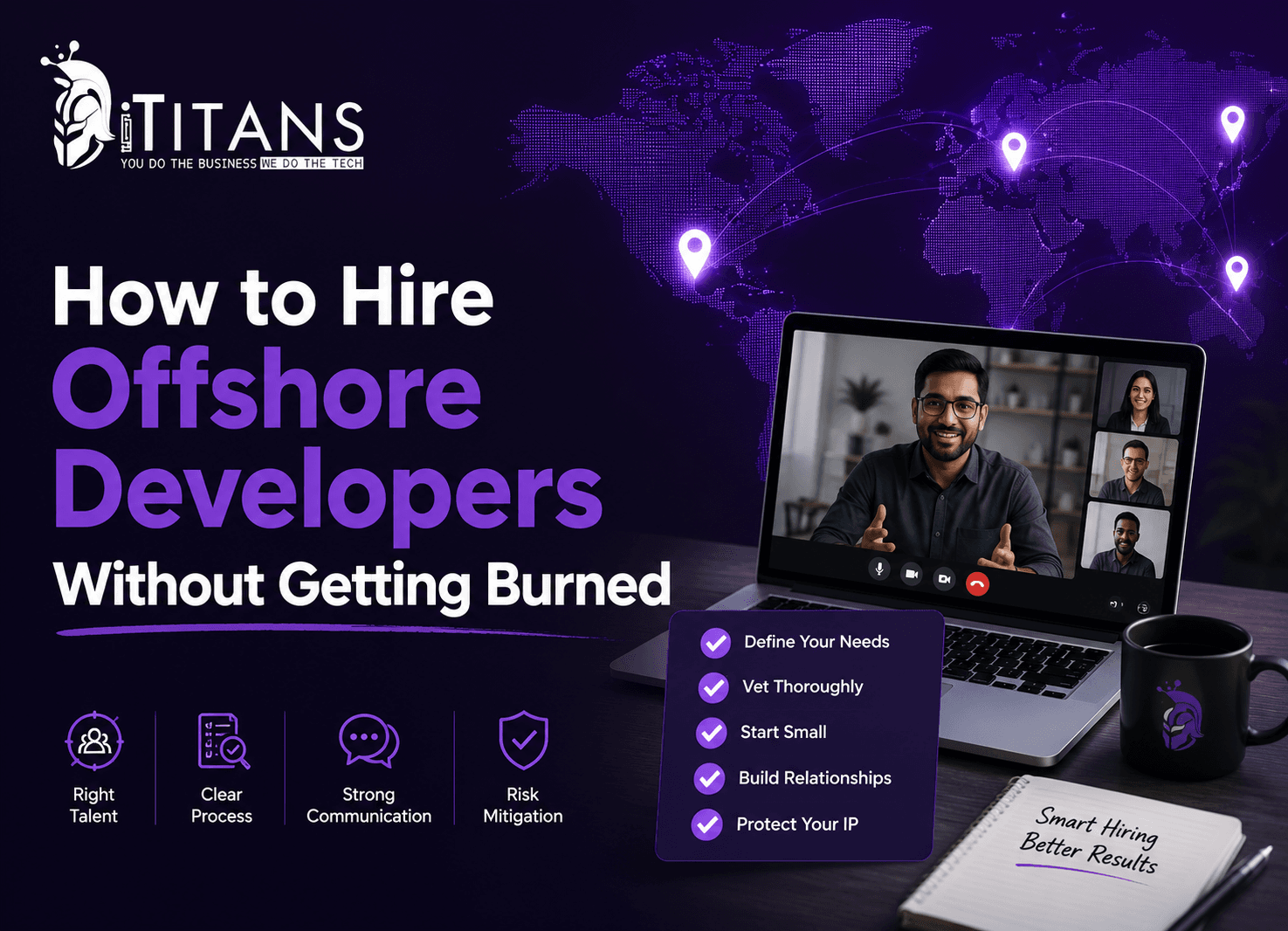
How to Hire Offshore Developers Without Getting Burned
Every founder who hires offshore developers eventually hears the same warning: someone, somewhere, got burned. Maybe the developer disappeared right after the deposit cleared, or the code that looked great in the demo fell apart the moment it hit production.
To hire offshore developers without getting burned, define the exact outcome you need before you start searching, vet every candidate with a paid trial task instead of a resume and a call, insist on direct access to the actual engineer instead of a rotating pool, and lock IP ownership, replacement guarantees, and termination terms into the contract before any money changes hands. Vetting always beats a slick sales pitch.
This guide walks through the real process, the current 2026 rates, the red flags nobody warns you about, and where a partner like iTitans fits if you would rather skip the trial and error.
What Does “Getting Burned” by Offshore Hiring Actually Look Like?
Before you can avoid it, it helps to name it. Offshore hiring goes wrong in a handful of predictable ways, and almost none of them are really about a country or a time zone.
- The bait and switch: You interview a senior developer, then a junior one shows up on day one.
- The silent subcontract: The agency you hired quietly hands your project to a third party you never vetted.
- The vanishing act: Communication slows, then stops, right around the time invoices are due.
- The demo trap: Everything looks polished in a walkthrough, then the underlying code turns out to be barely functional.
- The IP gap: Nobody wrote down who owns the code, and that conversation only happens after a dispute, not before one.
None of these problems start with “offshore.” They start with a rushed hiring process, a missing contract clause, or a founder who picked the lowest number on the quote instead of asking harder questions.

Why Are Companies Still Betting on Offshore Developers in 2026?
Despite the horror stories, offshore hiring keeps growing, and the math explains why. The offshore software development market reached roughly $178 billion in 2025 and is on track to hit $283 billion by 2032, according to industry research from Decode. That is not a niche strategy anymore. It is how most growing tech companies staff their engineering teams.
The reasons are practical, not just financial:
- Lower cost per hire: Offshore rates typically run 40-70% below onshore salaries for the same seniority level.
- Faster access to specialized skills: You are not limited to whoever lives within driving distance of your office.
- Round-the-clock development: A team in a different time zone can pick up work while your in-house team sleeps.
- A real talent gap at home: In a Clutch survey of small business owners, 26% said limited internal technical experience is their single biggest obstacle to hitting their tech goals.
The companies that win with offshore development treat it like a real hiring decision, not a bargain hunt. The ones that get burned usually treat it like the opposite.
What Are Your Options for Hiring Offshore Developers?
Not every offshore engagement looks the same, and picking the wrong model is one of the most common reasons projects stall before they even start. Here is how the four main approaches compare.
| Model | Best For | How You Pay | Level of Control |
|---|---|---|---|
| Freelance marketplace | Small, well-defined tasks | Hourly or fixed price per job | Low, you manage everyone yourself |
| Project-based outsourcing agency | A fixed-scope build with a deadline | Fixed price or milestone billing | Medium, the agency manages the team |
| IT staff augmentation | Extending a team you already have | Monthly rate per developer | High, developers work inside your workflow |
| Dedicated offshore team | A long-term, growing product | Monthly all-inclusive fee | High, though you still need a lead on your side |
Freelance marketplaces work fine for a landing page or a quick bug fix. They fall apart when a project needs sustained context, since you rebuild institutional knowledge with every new contractor.
Staff augmentation tends to be the safest middle ground for most companies. You keep full control over priorities and code review, while someone else handles recruiting, payroll, and replacement if a developer does not work out. Our breakdown of in-house versus outsourcing software development goes deeper into how the two compare on cost, speed, and long-term ownership.
Pick the model that matches your timeline, not the one with the lowest sticker price.
How Much Do Offshore Developers Actually Cost in 2026?
Hourly rate is the number everyone quotes, and the number that misleads the most people. Here is a realistic regional breakdown for 2026.
| Region | Typical Hourly Rate | Known For |
|---|---|---|
| India & South Asia | $15-$45 | Large talent pool, cost efficiency |
| Philippines | $10-$49 | Strong English proficiency |
| Eastern Europe (Poland, Ukraine, Romania) | $35-$70+ | Senior engineering depth, EU overlap |
| Latin America (Brazil, Colombia, Argentina) | $25-$55 | Real-time US overlap |
| Western Europe (Germany, Switzerland) | $100-$170 | Enterprise and compliance experience |
| United States (onshore) | $100+ | Full cultural and time-zone alignment |
These figures line up with the 2026 rate research from Echo Innovate IT and with Clutch-sourced pricing data, which puts the overall global range at $25 to $149 an hour depending on region and seniority.
Here is the part most quotes leave out: the hourly rate is not your real cost. Once you factor in management time, ramp-up, and turnover, your true loaded cost typically lands at 1.4 to 1.8 times the quoted rate. A $30-an-hour developer who needs constant oversight can end up costing more than a $45-an-hour developer who does not.
If you are weighing offshore against building locally, our comparison of offshore versus onshore software development walks through the full cost picture, including the overhead most quotes never mention.
Which Roles Do Companies Usually Hire Offshore for Mobile Apps?
Mobile is one of the most common reasons companies start looking offshore in the first place, mostly because native mobile talent is expensive and hard to find locally. If you are building a consumer or enterprise app, the roles you will most likely need include:
- Android Developers for Kotlin and Java-based native apps
- iOS Developers for Swift-based apps built for the Apple ecosystem
- React Native Developers for a single codebase that runs on both platforms
- Flutter Developers for Google’s cross-platform framework, popular for fast MVP builds
Cross-platform frameworks like React Native and Flutter usually mean a smaller offshore team and a shorter timeline, since you are not maintaining two separate native codebases. Native development still wins when your app depends heavily on device-specific features or you need the absolute best performance.
Which Roles Do Companies Hire Offshore for Web, Backend, and Enterprise Projects?
Web and backend roles cover the widest range of offshore hiring, partly because there are simply more frameworks to choose from. For front-end and full-stack web work, the most requested roles are:
- React Developers for interactive, component-based interfaces
- NextJS Developers for server-rendered React apps with built-in SEO advantages
- NodeJS Developers for JavaScript-based backends and real-time features
- Python Developers for everything from APIs to data-heavy and AI-driven products
- Laravel Developers for PHP-based web applications with rapid scaffolding
- Django Developers for Python-based apps that need built-in security and admin tooling
For larger enterprise systems, companies more often reach for:
- PHP Developers for established content and commerce platforms
- Java Developers for large-scale, high-reliability enterprise systems
- ASP.NET Developers for Microsoft-stack environments
The right framework usually depends on your existing codebase more than any trend. If you already run on Django, hiring a Node specialist just because it is popular creates more problems than it solves.

What Are the Biggest Red Flags When Hiring Offshore Developers?
Most of what goes wrong in offshore hiring shows up before you ever sign a contract, if you know where to look.
No Direct Access To Developers
If every conversation has to go through a project manager, you cannot judge who is actually doing the work.
A Resume Dump Instead Of A Shortlist
A vendor who sends fifty profiles in two days is not vetting, they are handing the work to you.
A Quote With No Discovery Call
A serious partner asks questions about your project before naming a number. A number after a 15-minute call is a guess, not a quote.
Vague Or Missing Ip Ownership Terms
If the contract does not clearly say all code and assets transfer to you on payment, assume they do not.
No Replacement Guarantee
Ask what happens if the assigned developer leaves or underperforms partway through. Silence is your answer.
An Unusually High Acceptance Rate
Vendors who place almost everyone who applies are not filtering for quality.
A Broad Non-Compete Clause
A non-compete that blocks the agency from ever working in your industry again suggests they plan on locking you in, not earning repeat business.
Interview Performance That Does Not Match The Trial Work
If code quality drops sharply between the interview and the actual assignment, someone else may have sat the interview.
Catching even two or three of these before signing saves you months of frustration later.
How Do You Vet an Offshore Developer Step by Step?
A repeatable process beats gut feel every time. Here is the sequence experienced hiring teams actually follow.
- Write a one-page hiring brief: Define the outcome you are hiring for, such as shipping a specific feature or building an MVP in 10 weeks, not just a job title.
- Source from more than one channel: Referrals, vetted platforms, and established development partners each surface different talent pools. Relying on a single job board limits your options.
- Run a structured technical interview: Use the same questions and a scoring rubric for every candidate so you compare apples to apples, not vibes to vibes.
- Assign a paid trial task tied to your real codebase: A short, real assignment reveals more in four hours than a dozen interview questions ever will.
- Call at least one past client reference: Ask specifically about delays, how the team communicated when problems came up, and whether they would hire them again.
- Ask for a technical walkthrough of a past project: A developer who actually built something can explain the architecture decisions and trade-offs in detail. Someone who did not cannot fake that depth.
- Start with a small pilot before scaling: Hire one developer or run a 30-day trial engagement before committing to a full team.
This is essentially how mature engineering organizations approach building offshore engineering teams that actually stick, treating the hire like a critical addition to the company rather than a line item on an invoice.
Skipping steps here is the single most common reason companies end up back at square one six months later, this time with a smaller budget and a lot less patience.

What Should Your Offshore Contract Cover?
Your contract does more work than any interview question, because it is what actually protects you if something goes wrong. Before you sign anything, make sure it covers:
IP Ownership
State plainly that all code, designs, and related assets transfer to you upon payment, not just upon project completion.
An NDA That Covers Subcontractors
Many offshore agencies pass work down the chain. If the NDA only names the primary agency, your confidential information is not actually protected.
No Residual License For The Agency
Some contracts quietly grant the vendor a right to reuse components they built for you. Remove or renegotiate that clause.
A Reasonable, Time-Bound Non-Compete
It should stop the agency from poaching your specific team, not from ever working in your industry again.
Clear Payment Milestones
Tie payment to delivered, working increments instead of a flat monthly retainer with no accountability attached.
A Termination Clause Both Sides Understand
Know exactly how much notice either party needs to give and what happens to work in progress.
Data Handling Terms
Specify where your data lives, who can access it, and what happens to it once the contract ends, especially if you handle user data under frameworks like GDPR.
None of this is exotic. It is standard business protection that any legitimate offshore partner agrees to without pushback. Hesitation on any of these points is itself useful information.
How Do You Manage Time Zones and Communication Without Losing Your Mind?
Time zone gaps are manageable. Poor planning around them is what actually causes friction.
| Region | Typical Overlap With US Business Hours |
|---|---|
| Latin America | 4-8 hours |
| Eastern Europe | 2-5 hours, usually your morning, their afternoon |
| India & South Asia | 0-3 hours, needs an async-first workflow |
| Philippines | 0-2 hours, often structured as a night-shift team |
A few habits make the difference between a team that feels distant and one that feels like an extension of your own:
- Map your real overlap hours and protect them for meetings that need to live back-and-forth.
- Default to async for everything else. Written updates, recorded video walkthroughs, and shared docs remove the need for everyone to be online at once.
- Run a daily written standup, even a short Slack message, so blockers surface within hours instead of days.
- Document decisions, not just tasks. A developer working eight time zones away cannot ask a quick hallway question, so the reasoning behind a decision needs to live somewhere searchable.
- Schedule a weekly video demo. Seeing working software every week catches drift long before it becomes a missed deadline.
None of this requires exotic tooling. It requires treating communication as a process you design on purpose, not something that happens automatically because everyone means well.
How Does iTitans Help You Hire Offshore Developers Without the Risk?
If everything above sounds like a lot to manage on your own, that is exactly the gap iTitans was built to close. iTitans is a US-based software development company headquartered in Frisco, Texas, with a global delivery team that has completed more than 230 projects and maintains a 97% customer satisfaction rate across its client base.
Whether you need a single mobile engineer, a full web team, or backend specialists for an enterprise system, the team covers the roles most companies are hiring for right now, from Flutter and React Native to Python, Node.js, and Java, without the guesswork of vetting an unfamiliar vendor from scratch. You can see how the model works in more detail on the staff augmentation page, or go straight to building your team if you already know the roles you need.
What’s Your Quick Checklist Before You Sign Anything?
Before you commit to any offshore developer or team, run through this final list:
- Have you written a one-page brief defining the exact outcome you are hiring for?
- Have you spoken directly with the developer, not just their account manager?
- Has the candidate completed a paid trial task tied to your real project?
- Have you called at least one past client reference?
- Does the contract explicitly transfer IP ownership on payment?
- Does the NDA cover subcontractors, not just the primary vendor?
- Is there a plan in place if the developer is not the right fit?
- Have you mapped your real time-zone overlap and agreed on communication norms?
- Are you starting with a small pilot instead of a full team commitment?
If you can check off every item, you are hiring the way companies that succeed with offshore development actually hire. If you are missing more than two or three, slow down before you send that deposit.
Ready to build a team of innovative technical experts who can skyrocket your business online? Contact iTitans today to hire offshore developers without burning your time and money.
Frequently Asked Questions
1. How much does it cost to hire offshore developers in 2026?
Rates range from roughly $10-$45/hour in Asia, $25-$70/hour in Latin America and Eastern Europe, and $100+/hour in Western Europe or the US. Budget 1.4-1.8 times the quoted rate once you include management, ramp-up, and turnover costs.
2. What is the biggest risk of hiring offshore developers?
The biggest risk is not geography, it is a rushed vetting process paired with a vague contract. Poor communication structures and unclear IP ownership cause far more failed engagements than any skill gap or time-zone difference.
3. Should I hire directly or go through a staff augmentation partner?
Go direct if you already have in-house recruiting and management capacity for remote teams. Most companies do not, which is why staff augmentation, where a partner handles vetting and payroll while you keep control of the work, tends to be safer.
4. How do I check if an offshore developer is legit before hiring?
Require a camera-on interview, assign a paid trial task on your real codebase, ask for a technical walkthrough of past work, and call at least one previous client directly instead of relying on website testimonials alone.
5. What is the difference between offshore, nearshore, and onshore development?
Offshore means hiring far away with little time-zone overlap, usually at the lowest cost. Nearshore means a nearby region with several overlapping hours. Onshore means hiring locally, at the highest cost but with full cultural and time-zone alignment.
6. How long does it take to build an offshore development team?
Going direct typically takes two to four months once you factor in sourcing, interviews, and onboarding. Working with an established staff augmentation partner can shrink that to one to three weeks for an initial team.