
How Much Does It Cost to Rescue an AI Built App?
Your AI built app worked fine in the demo. Then real users showed up, and things started breaking: logins failing, data vanishing, or a security scan flagging exposed API keys. Now you are staring at a codebase you did not write yourself, wondering what it actually costs to fix.
Here is the direct answer. The cost to rescue an AI built app typically runs from $300 for a quick audit to $50,000 or more for a full rebuild, and most founders pay between $2,500 and $15,000 to stabilize a production app. The right number for you depends on how much technical debt has piled up, how many real users are already active, and whether sensitive data is involved.
In this blog, we are going to guide you about the costs to rescue an AI built app and what pushes the number up or down. We will also discuss how to pick the right level of help for your app.
What Does It Mean to “Rescue” an AI Built App?
“AI app rescue” describes bringing in a professional developer or team to fix, secure, and stabilize an application that was originally built with tools like Lovable, Bolt, Cursor, Replit, v0, or Bubble’s AI features. It is different from routine bug fixing.
A rescue project usually starts with an audit of the whole codebase, not just the one broken feature you noticed. AI coding tools generate code fast, but they optimize for code that runs, not code that holds up over time. That gap is exactly what a rescue engineer gets hired to close.
This is not a niche problem. A quarter of Y Combinator’s Winter 2025 batch reported codebases that are 95% AI-generated, according to TechCrunch, and that pattern is repeating across startups everywhere. If you have not built yet and want to avoid rescue work entirely, our guide to AI app development costs in the USA covers how to plan a stable foundation from day one.
Rescue work covers a real spectrum. Some apps need a handful of focused fixes and a security pass. Others need structural rework because the architecture cannot support real traffic, real payments, or real user data. Figuring out which situation you are in is the first job of any rescue engagement, and it is usually the difference between a $1,000 fix and a $50,000 rebuild.
Signs Your App Needs a Rescue, Not Just a Tweak
Watch for these warning signs:
- Features work fine alone in testing but fail once used together
- You have asked the AI tool to fix the same bug three or more times, and it keeps resurfacing somewhere else
- You are not sure if your API keys, database credentials, or admin routes are exposed
- A developer looked at the code and asked to start over instead of patching it
- The app handled 10 test users fine and now breaks with 200 real ones
- You collect payment details, health information, or other regulated data without a security review
If two or more of these sound familiar, you have moved past the tweak stage.
How Much Does It Cost to Rescue an AI Built App? (Quick Answer)
Rescue pricing is not a single number. It is a range tied to how deep the problem goes. Based on current pricing across freelance platforms, boutique agencies, and dedicated rescue specialists, here is what founders are actually paying in 2026.
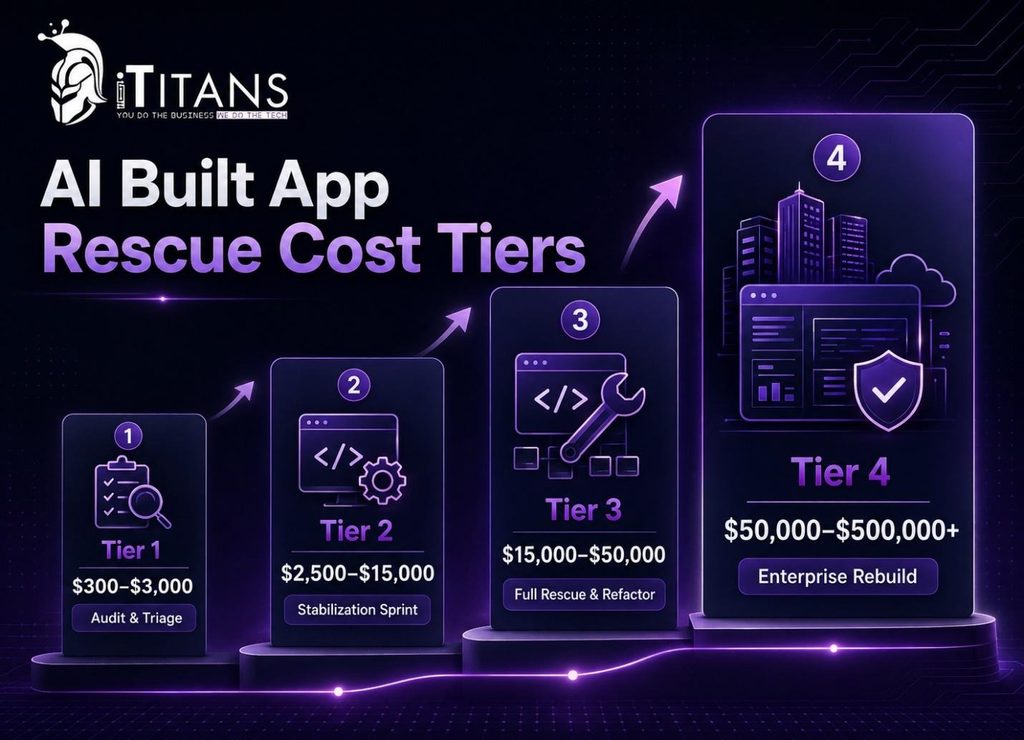
| Rescue Tier | What’s Included | Typical Cost | Timeline |
|---|---|---|---|
| Audit and Triage | Full codebase review, severity-ranked findings, fix-versus-rebuild recommendation | $300 to $3,000 | 2 to 5 days |
| Stabilization Sprint | Priority bug fixes, authentication hardening, critical security patches | $2,500 to $15,000 | 1 to 3 weeks |
| Full Rescue and Refactor | Architecture cleanup, test coverage, de-risking the app for scale | $15,000 to $50,000 | 3 to 8 weeks |
| Enterprise-Scale Rebuild | Rebuilding core systems for an app already carrying real users and revenue | $50,000 to $500,000+ | 2 to 6 months |
These figures come from public pricing on Upwork and Fiverr, published agency rate cards, and dedicated rescue specialists, not a single source. Treat them as directional. Your actual quote depends on your specific codebase, and any AI app rescue services provider worth hiring will confirm the number after looking at your code, not before.
Breaking Down Each AI Built App Rescue Cost Tier
Tier 1: Audit and Triage ($300 to $3,000)
An audit is where almost every rescue should start. A developer reviews your repository, tests core flows, and checks for the patterns AI tools commonly miss, including unvalidated inputs, missing authorization checks, and exposed secrets.
You get a written report ranking issues by severity, plus a straight answer on whether your app needs a rescue or a rebuild. On Upwork, dedicated audit gigs start around $300, while boutique rescue shops price audits at $2,500 to $3,000, often with the fee credited toward follow-up work.
If your app is still pre-launch or has only a handful of users, this tier alone may be all you need to fix a vibe coded app before it causes real damage.
Tier 2: Stabilization Sprint ($2,500 to $15,000)
This is the most common tier, and where most AI app rescue cost estimates land. A developer works through the priority list from your audit: proper authentication, input validation, error handling, and closing security holes.
Freelance rescue sprints on Upwork typically run $4,000 to $8,000 for a 2 to 3 week engagement. Independent developers report realistic totals of $2,500 to $9,000 for turning a broken AI-generated app into something shippable. Agencies that specialize in this work quote stabilization sprints starting around $10,000.
Vibe code cleanup cost data from Upwork shows the average completed invoice for full-project cleanup work lands around $7,200, roughly in line with the stabilization range above. This tier gets your app safe and stable without a full architectural overhaul.
Tier 3: Full Rescue and Refactor ($15,000 to $50,000)
Sometimes stabilizing is not enough because the underlying structure itself is the problem: duplicated logic, no test coverage, or a database schema that cannot scale. This tier rebuilds the foundation while keeping what already works.
Agencies quote what is sometimes called a “de-vibe-coding migration” at $15,000 to $40,000, priced fixed after an audit defines the scope. Other providers price a full rebuild that keeps core features intact at $25,000 to $50,000, depending on how many integrations and user flows are involved.
This is also the tier where moving off a no-code platform onto real, owned code often happens, similar to what founders face when migrating from Bubble to custom apps.
Tier 4: Enterprise-Scale Rebuild ($50,000 to $500,000+)
This tier is rare, and it applies almost exclusively to apps that scaled successfully on a shaky foundation. If your AI-built app grew for a year or more, has thousands of users, and is now hitting real performance or compliance walls, the rescue starts looking like a full enterprise mobile app development project rather than a cleanup.
Industry estimates place this tier anywhere from $50,000 for a large app with a mostly clean data model, up to $500,000 for one carrying 18 months of accumulated architecture debt. Most founders reading this guide will never need this tier. It mainly matters once you are past your seed round and your AI-built app has become core infrastructure.
What Actually Drives Your Rescue Cost Up or Down
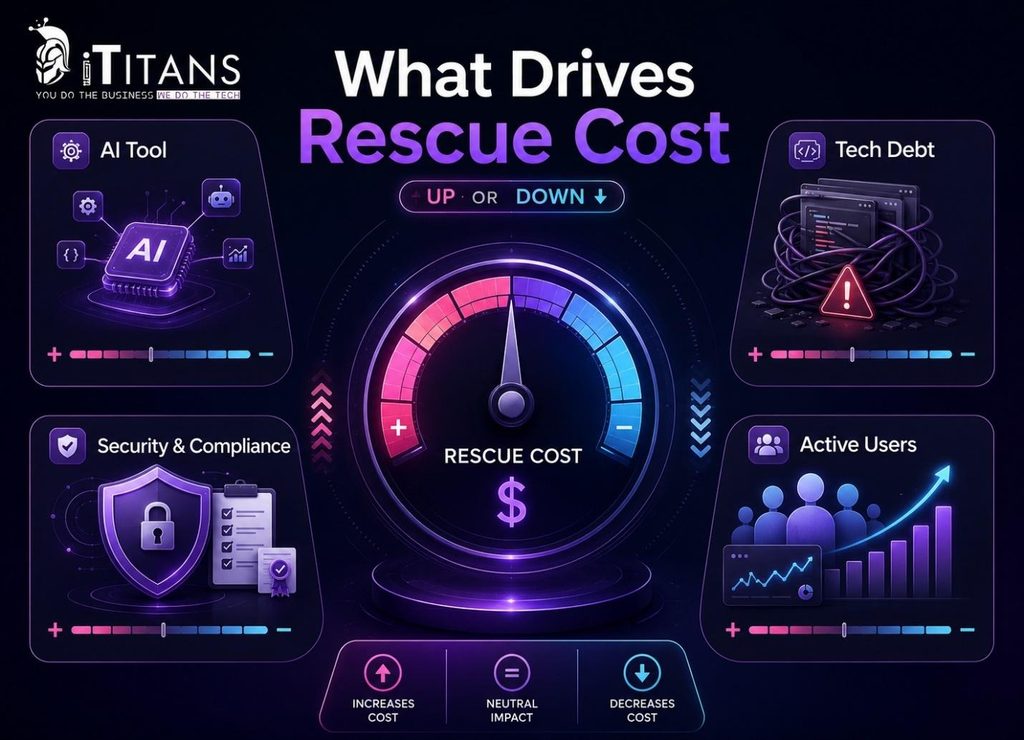
Four factors explain almost all of the variation in vibe coding rescue cost estimates you will see online.
Which AI Tool Built Your App
Lovable, Bolt, and Cursor generate standard React or Next.js code that any developer can read and modify directly. Apps built on Bubble or similar no-code platforms often need to be exported or rebuilt in real code first, which adds cost before any fixing can start.
How Much Technical Debt Has Piled Up
An app you caught after two weeks of vibe coding costs far less to fix than one that has been in production for a year with dozens of AI-generated patches stacked on top of each other. Debt compounds. Catching it early is consistently the single biggest cost lever.
Security and Compliance Requirements
An internal tool with no sensitive data can tolerate more risk and cost less to secure. An app handling payment details, health records, or other regulated data needs a deeper security audit and compliance-aware fixes, which raises both the price and the urgency.
How Many Real Users You Already Have
Fixing a pre-launch app is straightforward: break things, fix things, ship. Fixing a live app with active users means every change needs testing against real data and real traffic, without causing new downtime. That constraint alone can add 30% or more to a rescue budget.
Why AI Built Apps Break in the First Place
Adoption explains why this problem is everywhere. Gartner projects that 75% of enterprise software engineers will use AI code assistants by 2028, up from less than 10% in 2023. Understanding the root cause helps you evaluate any rescue quote you receive, and it explains why asking the AI tool to fix its own mistake rarely works twice.
The Security Gap Nobody Warns You About
This is not a minor concern. Veracode tested more than 100 large language models across Java, Python, C#, and JavaScript and found that AI-generated code introduced a security vulnerability in 45% of cases when the model had a choice between a secure and an insecure way to write the same function, according to its 2025 GenAI Code Security Report. Cross-site scripting failed 86% of the time, and Java-generated code failed security tests 72% of the time.
Its 2026 update found the picture has not improved much. The average security pass rate across newer models sits at 56%, close to where it was a year earlier, even as AI now writes roughly half of all newly committed code industry-wide.
One pattern shows up constantly in apps built on Supabase or similar backends: row-level security policies that are missing or misconfigured. AI tools frequently generate a working login screen and a working database, but skip the rule that stops one logged-in user from reading another user’s data by simply changing an ID in the request. It looks fine in the demo because nobody tries it. It is one of the first things any real audit checks.
The “It Works in the Demo” Trap
Here is the part most guides skip. AI coding tools work within a limited context window, meaning they cannot hold your entire application in memory at once. As your codebase grows past a few thousand lines, the tool increasingly works from summaries and file fragments rather than the full picture.
The result is not random bugs. It is duplicated logic: three slightly different versions of the same validation function, each written in a separate prompt, each handling a different edge case, and none of them aware the others exist. When founders describe an app that seems to have “three different login flows that sort of work,” this is almost always why.
A rescue developer cannot simply delete the duplicates. First they have to trace which version the rest of the app actually depends on, because removing the wrong one silently breaks whichever feature quietly relies on it. That tracing work, more than the actual code changes, is what most rescue quotes are pricing.
DIY Fix vs. Hiring a Rescue Team
Some founders can fix small issues themselves, especially if they are comfortable reading code even if they cannot write it from scratch. Others need a professional from day one. Here is how the two approaches actually compare.
| Factor | Fixing It Yourself | Hiring a Rescue Team |
|---|---|---|
| Upfront cost | $0, plus your time | $300 to $15,000+ depending on tier |
| Security coverage | Limited to what you know to check | Full audit against known vulnerability patterns |
| Speed | Slower, trial and error | 2 days to 8 weeks depending on scope |
| Risk of re-breaking | Higher, without test coverage | Lower, with structured fixes and testing |
| Best for | Small, pre-launch apps with no real users | Apps with real users, payments, or sensitive data |
If your app is still a personal project with no real users, spend a weekend trying to fix it yourself. Read the error logs, ask the AI tool pointed questions about one function at a time, and resist the urge to keep prompting your way through it blind. But the moment real money, real data, or real users are involved, the cost of hiring help is small next to the cost of a breach or an outage. This is also where a fractional team through staff augmentation can help, letting you add a senior developer without a full-time hire.
How iTitans Helps You Rescue and Scale Your AI Built App
If your AI-built app has hit its limits, iTitans works with founders across the US to figure out exactly what is broken and fix it properly. The team has handled everything from quick stabilization work to full legacy modernization projects, so the assessment stays honest about whether you need a rescue or a rebuild.
How the iTitans Rescue Process Works
The process follows a clear path:
- A senior developer audits your repository, tests critical flows, and flags every security and stability issue by severity
- You get a written report and a fixed-price recommendation before any code changes begin
- The team fixes priority issues first, including authentication, data integrity, and exposed credentials
- Quality assurance testing through iTitans’ SQA team confirms fixes hold under real conditions, not just in a local environment
- If your app needs ongoing support after the rescue, iTitans’ DevOps team can set up proper deployment pipelines and monitoring, so the next issue gets caught before users see it
For a full breakdown of what comes after a rescue, see our guide on what app maintenance actually costs after launch.
Why Founders Bring Their AI-Built Apps to iTitans
iTitans has shipped production software across healthcare, fintech, logistics, and consumer apps, which means the team has already seen most of the patterns that break AI-generated code. Whether your app started on Lovable, Bolt, Bubble, or a mix of tools, the review looks at the actual code, not the platform it came from.
For founders who are not ready for a full rescue yet but need to validate an idea properly, iTitans’ MVP Machine builds a stable foundation from the start, so there is no rescue needed later.
How Much Does AI App Rescue Costs
The cost to rescue an AI built app depends entirely on how far the problem has spread, but you now have real numbers to work with: a $300 to $3,000 audit if you catch issues early, $2,500 to $15,000 to stabilize a live app, and $15,000 or more if the architecture itself needs rework. Every tier is a genuine option, not a scare tactic pushing you toward the most expensive fix.
What matters most is not the price tag. It is catching the problem before it reaches your users, your payment processor, or your investors’ due diligence. Vibe coding rescue cost estimates only get worse the longer an unstable app stays in production.
If your AI-built app is breaking, throwing security warnings, or just feels fragile every time you touch it, get it audited before it gets worse. iTitans reviews apps built on Lovable, Bolt, Cursor, Replit, and similar tools, and gives you a straight, fixed-price answer on whether to fix it or rebuild it. Contact iTitans today and get a clear plan for your app before the next small bug turns into a full outage.
Frequently Asked Questions
How much does it cost to fix a vibe coded app?
Most fixes cost $2,500 to $15,000 for stabilization. Quick audits start around $300, while full rebuilds for scaled apps can reach $50,000 or more depending on codebase size and security debt.
Can a vibe coded app be rescued, or does it need a full rebuild?
Most vibe coded apps can be rescued in place. Full rebuilds are usually only needed when the database structure or authentication system is fundamentally broken beyond repair.
How do I know if my AI built app has security vulnerabilities?
Run a professional code audit. Veracode found AI-generated code introduces security flaws in 45% of cases, so assume vulnerabilities exist until an audit confirms otherwise.
How long does it take to rescue an AI built app?
A basic audit takes 2 to 5 days. Stabilization sprints run 1 to 3 weeks. Full refactors typically take 3 to 8 weeks, depending on codebase size and severity.
Is it cheaper to rescue an AI built app or start over?
Rescuing is almost always cheaper. A full rebuild can cost several times more than stabilizing existing code, unless the architecture genuinely cannot support what your app needs to do.
What AI tools most often need rescue work later?
Lovable, Bolt, Cursor, Replit, v0, and Bubble appear most often in rescue requests, since they power the majority of AI-generated apps built by non-technical founders.