
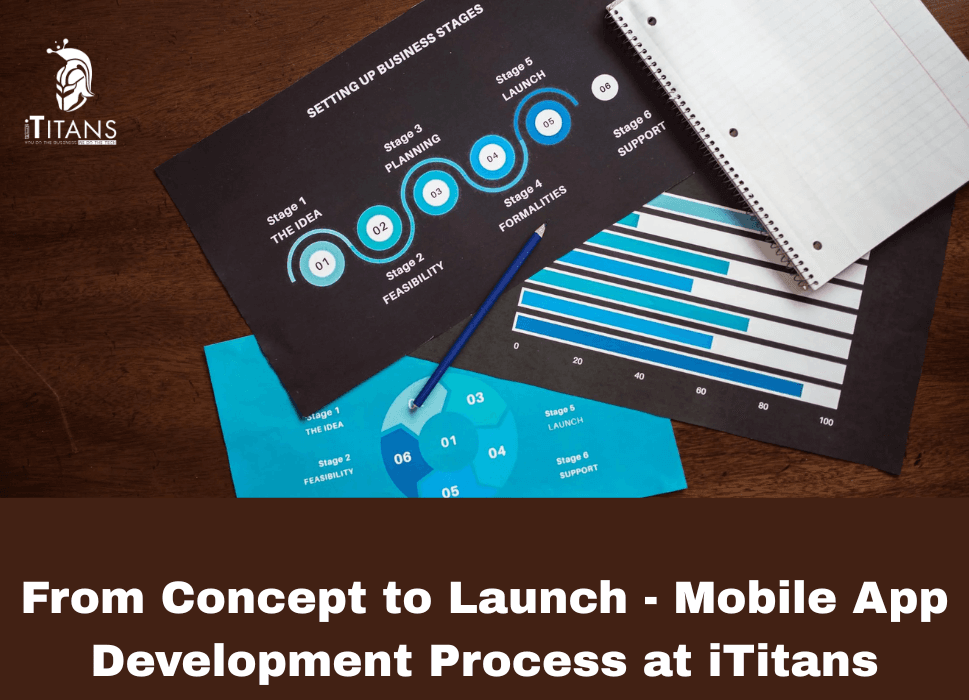
From Concept to Launch | Mobile App Development Process at iTitans
Developing a mobile application is a logical next step for many businesses. But the truth is, many app initiatives either stall mid-development, go over budget, or fail to deliver business value after launch.
At iTitans, we’ve worked with organizations across industries and learned this: the success of an app isn’t just about how it looks or functions. It’s about how well it aligns with your core objectives and how methodically moves from idea to deployment.
This blog walks you through our process of mobile app development at iTitans. It’s not built on trends or assumptions. It’s based on experience, collaboration, and a structured approach designed to deliver outcomes, whether your business creates an internal tool, a customer-facing platform, or something in between.

Real Challenges Businesses Face in App Development
It’s common for businesses to begin development with a promising concept only to run into serious issues along the way. Most of these issues come down to one of three causes:
- Lack of a clear purpose behind the app
- Misalignment between stakeholders and technical teams
- Incomplete or reactive planning
We’ve had clients come to us after spending months with external freelancers or internal teams, only to find the app directionless or unable to scale. Others underestimated the technical scope, resulting in fragmented architecture and unstable builds.
These outcomes are avoidable. But they require a clear process that prioritizes business logic before jumping into design or code.
Step-by-step Mobile App Development Process
Here are the steps we follow as the top mobile app development companies:
1. Defining the Problem Before Discussing Features
At iTitans, every mobile app project begins with discovery. But this isn’t a surface-level conversation. Our team focuses on understanding the business case behind the app.
Key activities in this phase include:
- Stakeholder Interviews: We work with decision-makers to understand operational challenges, user expectations, and strategic goals.
- Problem Framing: What inefficiencies are being addressed? What workflows are being digitized or improved?
- Value Mapping: What does success look like? We define it early, whether it’s reduced overhead, improved customer retention, or better data visibility.
This step ensures the product is built around business logic, not just feature lists. For example, in one recent project, a healthcare client approached us with a request for a patient engagement app.
After initial discovery, it became clear that appointment scheduling inefficiencies were the root issue. The final solution was significantly different from the original idea but far more valuable.
Without this level of analysis, teams risk building features that don’t solve core problems. We avoid that by ensuring the app’s purpose is not only clear, but measurable.
2. Planning the Architecture Before Writing the Code
Once we have a defined objective, we begin structuring the product. Planning is the most underestimated phase in mobile app development and the most critical. Mistakes here can cascade through the project and become difficult (and expensive) to correct later.
At iTitans, we use this phase to build the technical and functional foundation of the application.
This includes:
- Wireframing and Flow Mapping: These early models map out the app’s structure and navigation without distracting from design aesthetics.
- Technical Architecture: We determine what technologies will be used, how systems will integrate, and what third-party services (if any) are needed.
- Phased Roadmap: Development is broken into phases, with clear deliverables at each milestone.
- Budget and Resource Planning: We outline how the budget is allocated across phases, minimizing financial surprises and helping with internal approvals.
This planning’s purpose is to create alignment between your business stakeholders and our development teams. It ensures clear expectations, realistic requirements, and respect for timelines.

3. Designing with the User, Not Just the Brand
Once the architecture is in place, we shift to UI/UX design, but again, not in the way many agencies do it.
At iTitans, we treat design not as a cosmetic layer but as an extension of usability and function. Every visual decision supports the larger purpose of the app. That means balancing the business’s needs with the user’s behaviors.
Here’s how we approach this phase:
- User Journey Mapping: We document how users move through the app to complete specific goals, uncovering friction points and areas of confusion.
- Interface Prototyping: Instead of static screens, we provide clickable prototypes that allow stakeholders to test the flow before a single line of code is written.
- Feedback Loops: We involve stakeholders and, where possible, real users in providing feedback before finalizing designs.
Design at this stage helps de-risk development. When layouts, navigation, and workflows are approved in advance, engineering teams can move more clearly and with less rework.
4. Building in Phases, Not Just “Developing”
Development is where most businesses assume the bulk of the work happens. And while it’s technically accurate that this is the phase where code is written, and systems are built, it should never feel like a black box.
At iTitans, our development process is structured into clearly defined sprints with built-in feedback points. This is crucial for reducing technical debt and keeping business teams involved throughout.
Our approach includes:
- Backend and Frontend Coordination: Development is split between server-side architecture and user-facing components, each advancing in sync.
- Continuous Integration: Code is tested and integrated regularly, avoiding large merges and last-minute surprises.
- Weekly Demos: We show progress in real-time to ensure alignment with the intended functionality and business goals.
- Performance Monitoring from Day One: We test for app speed, data load, and error handling during development, not just at the end.
This structured rhythm gives stakeholders visibility into what’s being built and how it’s tracking against the roadmap. It also makes it easier to make informed decisions if the scope or priorities need to shift.
5. Testing for Reality, Not Just Errors
Quality Assurance (QA) is often the final checkbox before launch. That’s a mistake. Testing isn’t just about making sure the app doesn’t crash. It’s about ensuring it behaves exactly as it should under real-world conditions.
At iTitans, we run multiple layers of QA throughout the project, not just at the end.
This includes:
- Unit Testing: Every component is individually tested to ensure stability at the building block level.
- Integration Testing: We verify that different modules interact correctly, which is especially important for APIs, payment gateways, or third-party services.
- User Testing: Select stakeholders interact with the beta version to validate usability and provide critical early feedback.
- Device and OS Testing: To ensure consistency, we test the app on various devices, operating systems, and screen sizes.
We also stress-test for unexpected user behavior, such as what happens if someone skips a step, loses internet access, or exits mid-process. These scenarios can’t be handled well without proper planning and testing, and they often determine the product’s long-term reliability.

6. Launching with a Plan, Not a Push
The day an app goes live is often seen as the finish line. At iTitans, we treat it as the beginning of the next phase. A successful launch isn’t just about pushing the app to the App Store or Google Play. It’s about ensuring the app enters the market cleanly, without disruptions, and with a clear support structure.
Here’s what we do leading into the launch:
- Deployment Strategy: Whether a full release or a staged rollout, we align the release method with the business needs and user readiness.
- App Store Optimization: Titles, descriptions, media, and compliance checks are managed to improve discoverability and ensure approval.
- Monitoring Tools: Crash reports, real-time analytics, and system health dashboards are integrated before launch.
- Support Framework: We document and provide plans for immediate support requests, user onboarding questions, and initial updates.
We also prepare internal teams, especially customer support or operations, so that any user issues post-launch are addressed quickly and confidently. A strong launch doesn’t eliminate risk but prepares you for it. We help clients launch knowing what’s next, not wondering.
7. Post-launch support and Iteration
No app is complete at launch. Real usage always reveals new insights. Sometimes, it’s behavior patterns that weren’t anticipated. Other times, feature requests from early adopters or issues only emerge at scale.
That’s why our relationship with clients doesn’t stop at delivery.
Post-launch, we focus on:
- Bug Fixes and Patch Management: Fast turnaround on technical issues as user feedback comes in.
- Performance Tuning: Based on usage data, we optimize for speed, load times, and battery consumption.
- Analytics Reviews: We help clients interpret early data and use it to refine the product roadmap.
- Feature Planning: Prioritize and schedule the next set of updates, driven by user feedback and business evolution.
Clients who work with us long-term often see the most significant returns, not because the first version was perfect but because the support and evolution process is structured.
8. Ensuring Security and Compliance from Day One
In today’s digital landscape, security and compliance are not optional. They’re essential. At iTitans, we integrate security measures throughout the development lifecycle to protect both user data and business interests.
Key practices include:
- Data Encryption: Implementing encryption protocols for data at rest and in transit to safeguard sensitive information.
- Authentication Mechanisms: Utilizing robust authentication methods, such as multi-factor authentication, to prevent unauthorized access.
- Compliance Adherence: Ensuring the app meets industry-specific regulations like HIPAA for healthcare or GDPR for data protection.
- Regular Security Audits: Conducting periodic security assessments to identify and mitigate potential vulnerabilities.
We minimize risks and build trust with end-users by embedding these practices early.
Why This Process Works for Decision-Makers
If you’re in a leadership role, founder, director, CTO, or operations lead, your concerns go beyond screens and sprints. You need a development partner that understands:
- How to align product development with revenue and operations
- How to communicate technical decisions in business language
- How to prevent scope creep and manage time and budget expectations
- How to handle the unplanned without derailing the project
At iTitans, we’ve designed our mobile app development process to meet those exact needs. It’s not abstract. It’s built from experience, working with growing startups, enterprise teams, and everything.
We keep our clients involved, informed, and in control every step of the way.

Why iTitans is the Right Mobile App Partner for Your Business
With thousands of app developers out there, why should you trust iTitans?
Here’s what sets us apart:
- Business-First Mindset: We focus on your bottom line, not just your backend.
- Cross-Industry Experience: From healthcare and finance to retail and logistics, we’ve done it all.
- Agile and Transparent: Weekly sprints, regular updates, and open communication throughout the project.
- Proven Track Record: We’ve helped startups get funded and enterprises go mobile. Our portfolio speaks for itself.
- Post-Launch Commitment: We stick around after your app goes live, ensuring long-term success and updates.
Partnering with iTitans means working with a team invested in your growth every step of the way.
Why Business-Driven Mobile Apps Outperform Feature-Driven Ones
A common trap companies fall into during mobile app development is focusing on feature sets rather than the business outcome. While flashy features may feel impressive in a demo, they don’t always translate into value once the app is live.
At iTitans, we believe mobile apps should be designed as business enablers, not just digital products. That’s why our process places business logic and user context ahead of everything else. We work closely with founders, CTOs, product leads, and operations managers to align the app’s architecture with the goals they’re trying to accomplish.
For example:
- An enterprise client needed a customer-facing portal to manage warranty claims. Instead of building a complex app from scratch, we integrated their backend CRM and focused the UX on reducing call center volume.
- A startup approached us wanting social features, but after reviewing their market and goals, we recommended a streamlined MVP that emphasized user onboarding and core transactions.
In both cases, removing unnecessary features made the app not only more efficient but also more aligned with business KPIs.
Aligning Development with Stakeholder Expectations
Mobile app projects often stall or derail due to misalignment between the leadership, marketing, tech, and operations teams. One team wants scalability, another wants speed, and another wants branding perfection. At iTitans, we solve this challenge by anchoring all decisions to a shared understanding of the business objectives.
Here’s how we achieve alignment:
- Centralized Documentation: All requirements, feedback, and versions are tracked in a single source of truth.
- Visual Milestones: Rather than technical jargon, we use wireframes and mockups to show progress in a way everyone understands.
- Regular Sprint Reviews: We don’t just build and report. We demo, explain, and discuss each phase live with our clients.
- Flexible Communication: Whether your team prefers Slack, Zoom, Asana, or traditional email, we adapt our communication to fit your workflow.
We dramatically reduce rework and improve delivery timelines by keeping everyone on the same page, from the C-suite to QA testers.
Choosing the Right Tech Stack for Long-Term ROI
The technology stack you choose is one of the biggest differentiators in app performance, scalability, and cost. Unfortunately, many businesses only consider tech decisions based on what their internal team knows or what a freelancer suggests.
At iTitans, we take a different approach. We look at:
- The problem being solved
- How fast the app needs to scale
- What integrations are needed
- The cost of maintaining the app post-launch
- The skills your internal team already has
Then, we match the proper framework, language, and infrastructure to fit the product vision.
For example:
- We use Flutter or React Native for cross-platform apps that need fast deployment on both iOS and Android.
- We recommend Kotlin or Swift for native development when performance and device-specific features are critical.
- Depending on the complexity of the logic and desired integrations, we may use Node.js, Django, or Laravel for the backend.
What’s important isn’t just what tools we use but why we use them. That’s how we ensure your mobile app is sustainable, secure, and prepared for future growth.
UX Isn’t Just Design, It’s Decision Science
Most people associate UX with design elements like buttons, icons, and screen transitions. But at iTitans, we know UX is much deeper. It’s about predicting how users think, behave, and react, then shaping the app around those behaviors to drive action.
Our UX team doesn’t just “design” screens. They engineer decision-making journeys.
Here’s what sets our UX apart:
- Behavioral Research: We analyze real-world user behavior to anticipate friction points and cognitive loads.
- Simplicity First: We reduce decision fatigue by minimizing clicks, scrolls, and interruptions in the user flow.
- Micro-Interactions: Thoughtful feedback loops (like animations or confirmation messages) help users feel in control.
- Accessibility Focus: We design for all users, including those with disabilities, to ensure inclusivity.
A well-designed UX reduces user churn, improves conversion rates, and increases app ratings. Users who can’t intuitively navigate your app won’t use it, no matter how powerful it is behind the scenes. That’s why we make UX a data-backed science, not just a creative step.

Building for Scale: What Happens When Your User Base Grows?
Every founder dreams of launching the next breakout app, but many fail to prepare for what happens when their user base actually grows. A poorly designed app may perform well in the pilot phase but collapse under real-world usage.
At iTitans, scalability has been part of the plan from day one.
We design apps with:
- Modular Architecture: Components can be updated or scaled independently without affecting the whole system.
- Cloud-Native Infrastructure: Hosting on AWS, GCP, or Azure allows automatic resource scaling and security management.
- Code Efficiency: We avoid bloated libraries and unnecessary dependencies, ensuring lightweight, maintainable builds.
- Load Testing: We simulate high-traffic scenarios before launch so you can be confident your app can handle spikes.
By thinking ahead, we protect your app from growing pains, so when your users increase 10x, your performance doesn’t drop.
Maintenance Isn’t Optional, It’s Strategic
Most agencies complete a project, deliver the source files, and move on. At iTitans, post-launch support is as important as the initial build. Your mobile app needs updates to stay relevant, secure, and compatible with OS updates.
But maintenance shouldn’t feel like a cost center. It should feel like product evolution.
Here’s how we handle it:
- Monthly Health Checks: We run diagnostics to ensure optimal performance and address latent issues.
- Usage Analytics: We track which features users engage with and which they don’t. This data drives smarter update decisions.
- Feedback Loops: We keep the app connected to business stakeholders for constant iteration and improvement.
- Security Updates: As mobile platforms evolve, we proactively patch vulnerabilities to keep your users safe.
With the right strategy, maintenance becomes a tool to keep your app competitive, not just operational.
How iTitans Reduces Development Risk for Your Business
Every app project carries risks: budget overruns, missed deadlines, misaligned outcomes, tech limitations, or poor execution. The difference between a successful project and a failed one often comes down to how risk is managed, not eliminated, but intelligently reduced.
Here’s how iTitans lowers your risk:
- Transparent Pricing: We provide clear estimates with phased breakdowns, no vague “hourly rates” or surprise invoices.
- Agile Methodology: With two-week sprints, you always know what’s done, what’s next, and what needs your input.
- Prototype Testing: We validate designs and user flows through prototypes and MVPs before writing production code.
- Senior-Led Teams: Every project has experienced leads overseeing strategy, architecture, and delivery, not juniors learning on the job.
- Clear KPIs: From load times to retention metrics, we define success and measure it consistently.
Your app is an investment, not an experiment. We have treated it that way since day one.
If It’s Worth Building, It’s Worth Doing Right
At iTitans, we understand the stakes. Your mobile app isn’t just a piece of technology. It’s a crucial part of your business transformation. We focus on building apps that don’t just function; they evolve with your business, delight your users, and provide measurable value.
If you’re ready to develop an app that aligns with your business strategy and delivers results, let’s talk. Contact us today, and let’s make your mobile app vision a reality.
Related Posts