
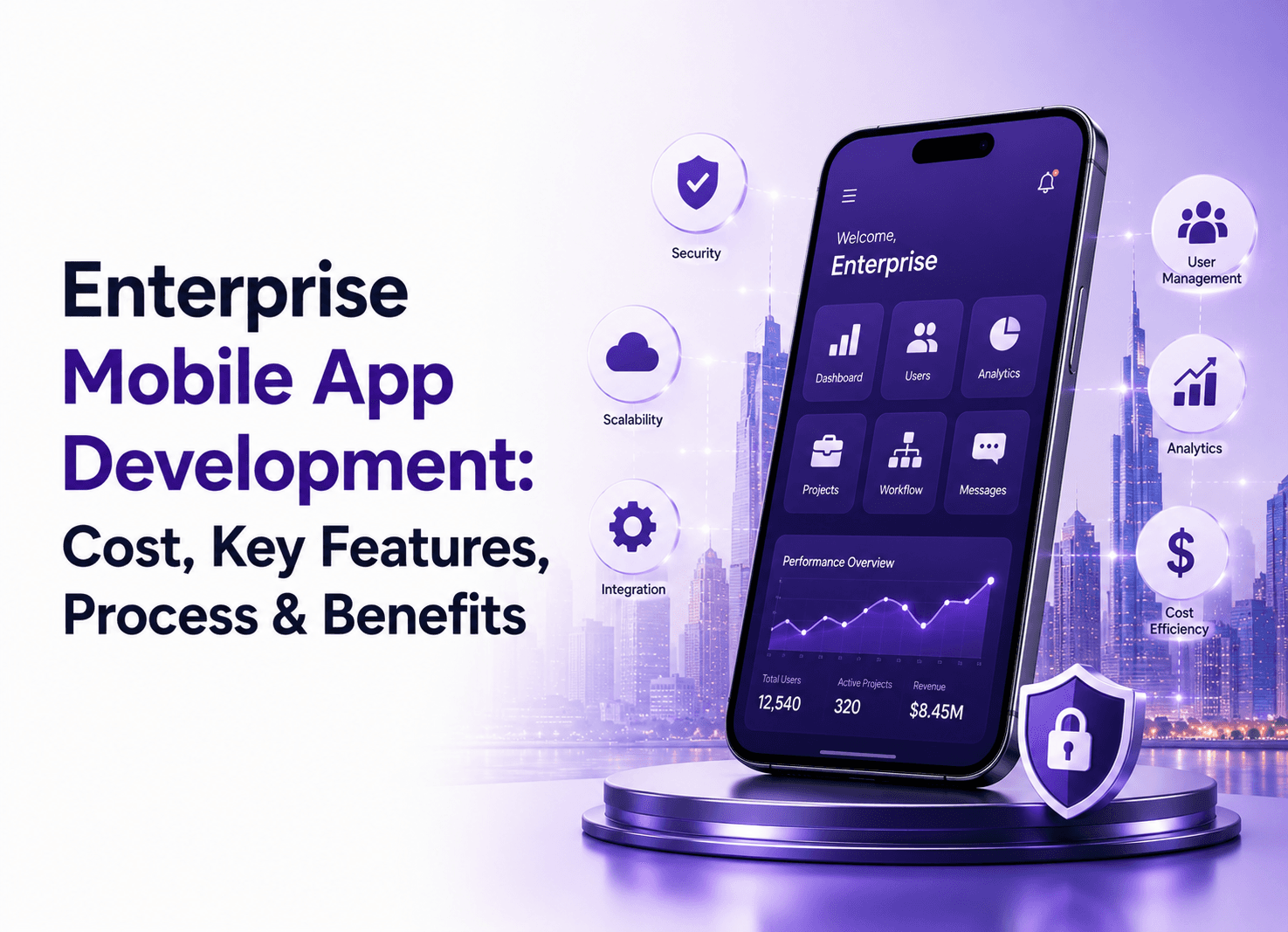
Enterprise Mobile App Development: Cost, Key Features, Process & Benefits
Enterprise applications are no longer reserved for global corporations with massive IT budgets. Businesses across healthcare, logistics, retail, finance, manufacturing, and professional services are investing in mobile technology to improve operations, connect distributed teams, and make faster decisions. As organizations increasingly depend on digital workflows, enterprise mobile app development has become a strategic investment rather than a technology upgrade.
Unlike consumer apps designed for broad audiences, enterprise app development focuses on solving internal business challenges. These applications often integrate with existing systems such as ERP, CRM, HRMS, accounting software, and cloud platforms while meeting strict security and compliance requirements. They are expected to support thousands of users, protect sensitive company data, and adapt as business needs evolve.
This guide explains what enterprise mobile app development involves, how much it typically costs, the features businesses should prioritize, the development process, and the common challenges that influence project outcomes.

What Is Enterprise Mobile App Development?
Enterprise mobile application development is the process of designing and building mobile applications that support business operations, employees, partners, or customers within an organization. Rather than serving entertainment or social networking purposes, these applications are built to improve efficiency, automate workflows, manage data, and connect with existing business systems.
An enterprise application often becomes part of a company’s digital infrastructure. Instead of functioning independently, it exchanges data with systems such as SAP, Salesforce, Microsoft Dynamics, Oracle ERP, or custom business platforms through secure APIs.
For example, a logistics company may build an application that allows drivers to update deliveries in real time while synchronizing inventory with the warehouse management system. A healthcare provider may develop a secure mobile application that gives clinicians access to patient records while complying with HIPAA requirements. A retail chain may equip store managers with mobile dashboards that display inventory levels, sales performance, and workforce scheduling from multiple locations.
Although each use case differs, enterprise applications typically share several characteristics:
- Multiple user roles with different access permissions
- Integration with existing enterprise software
- High security standards
- Large-scale user support
- Centralized administration
- Continuous maintenance and feature updates
These requirements make enterprise development significantly more complex than building a standard consumer mobile application.
Why Businesses Are Investing in Enterprise Mobile Apps
Organizations increasingly expect employees to work from anywhere without losing access to essential business information. Mobile applications provide that flexibility while reducing manual processes that slow operations.
Instead of relying on spreadsheets, emails, or disconnected software, businesses can centralize workflows inside one secure application. Employees spend less time switching between systems and more time completing tasks.
The benefits extend beyond convenience. Enterprise applications help organizations improve visibility across departments, reduce duplicate work, and make decisions based on real-time information rather than outdated reports.
Some of the most common business objectives include:
- Automating repetitive workflows
- Improving communication across teams
- Providing instant access to business data
- Reducing paperwork and manual entry
- Supporting remote and field employees
- Improving customer service response times
- Increasing operational efficiency
From a leadership perspective, enterprise applications also create measurable business value through lower operating costs, improved productivity, and better reporting capabilities.
Key Features Every Enterprise Mobile App Should Include
Many projects fail because organizations focus on visible features before addressing technical foundations. Attractive interfaces matter, but security, scalability, and integration capabilities determine whether an enterprise application continues delivering value over the long term.

Strong Security and Identity Management
Security should influence architectural decisions from the beginning rather than becoming an afterthought during testing.
Enterprise applications commonly include:
- Multi-factor authentication
- Single Sign-On (SSO)
- Role-Based Access Control (RBAC)
- End-to-end encryption
- Secure API authentication
- Device management policies
- Audit logs
Organizations operating in regulated industries may also require compliance with standards such as HIPAA, GDPR, PCI DSS, SOC 2, or ISO 27001.
Ignoring these requirements early often leads to expensive redesigns later.
Integration With Existing Business Systems
Most businesses already use multiple software platforms. A mobile application delivers the greatest value when it becomes part of that ecosystem instead of creating another isolated data source.
Common integrations include:
- ERP systems
- CRM platforms
- HR management software
- Accounting systems
- Payment gateways
- Business intelligence platforms
- Cloud storage services
Well-planned API architecture reduces duplicate data entry and improves consistency across departments.
Scalability
Many organizations initially build applications for one department before expanding company-wide.
A scalable architecture allows the application to support:
- Growing user numbers
- Additional business units
- New integrations
- Increased transaction volumes
- Future feature releases
Planning for growth early is usually less expensive than rebuilding the application later.
Offline Capability
Employees working in warehouses, manufacturing plants, hospitals, construction sites, or remote locations may not always have reliable internet access.
Offline functionality allows users to continue working while the application stores information locally and synchronizes data once connectivity returns.
For field teams, this feature often has a greater business impact than adding additional interface enhancements.
Analytics and Reporting
Enterprise leaders require visibility into business performance.
Applications should collect meaningful operational data that helps management answer questions such as:
- How quickly are tasks completed?
- Which departments experience delays?
- Where are workflow bottlenecks occurring?
- How are employees using the application?
- Which features require improvement?
Integrating dashboards with business intelligence tools enables organizations to make decisions based on measurable outcomes instead of assumptions.
Enterprise Mobile App Development Process
A structured enterprise application development process reduces uncertainty, controls costs, and minimizes project delays. Although every organization follows its own methodology, successful projects generally move through the same core stages.

Discovery and Business Analysis
The discovery phase determines whether the project solves the right business problem before development begins.
This stage typically includes:
- Stakeholder interviews
- Existing workflow analysis
- Technical feasibility assessment
- User research
- Functional requirements
- Integration planning
- Risk identification
Skipping discovery often results in scope creep because new requirements continue appearing after development has started.
UX and Technical Architecture
Once requirements are approved, designers and solution architects collaborate to define how the application should function.
This includes:
- User journeys
- Wireframes
- Interface design
- Database planning
- API architecture
- Security model
- Cloud infrastructure selection
Many organizations underestimate this phase, but architectural decisions made here influence maintenance costs for years.
Development and Integration
Development usually follows Agile methodologies, allowing features to be released in iterations instead of waiting for the entire application to be completed.
During this stage, engineering teams build:
- Mobile interfaces
- Backend services
- APIs
- Authentication systems
- Notification services
- Data synchronization
- Third-party integrations
Frequent stakeholder reviews reduce misunderstandings and help ensure the application continues aligning with business goals.
Testing Before Deployment
Enterprise applications interact with sensitive business information, making quality assurance an ongoing process rather than a final checkpoint.
Testing commonly includes functional testing, security testing, integration testing, performance testing, device compatibility testing, and user acceptance testing before production deployment.
Poor testing rarely becomes visible immediately after launch. Problems often emerge when hundreds or thousands of employees begin using the application simultaneously.
How Much Does Enterprise Mobile App Development Cost?
One of the most common questions businesses ask is, “How much does an enterprise mobile app cost?” The honest answer is that there is no universal price because enterprise applications vary significantly in complexity. A mobile app for internal employee communication has very different requirements than a healthcare platform connected to electronic medical records or a logistics application synchronizing with multiple warehouse systems.
In general, businesses can expect the following ranges:
| App Complexity | Estimated Cost | Typical Timeline |
| Basic enterprise app | $30,000–$60,000 | 3–5 months |
| Mid-level enterprise app with integrations | $60,000–$150,000 | 5–8 months |
| Large-scale enterprise platform | $150,000–$500,000+ | 8–15+ months |
The final investment depends on several factors rather than screen count alone.
Application complexity has the greatest influence. Workflow automation, advanced reporting, AI capabilities, offline synchronization, and real-time communication all increase development effort.
System integrations also affect cost. Connecting with ERP, CRM, accounting software, payment gateways, or legacy systems often requires custom APIs and additional testing to ensure reliable data exchange.
Security and compliance can significantly increase development time. Industries such as healthcare, finance, and insurance require stronger authentication, encryption, audit logging, and compliance with standards like HIPAA, GDPR, or PCI DSS.
Technology choices matter as well. Native development may provide better platform-specific performance, while cross-platform frameworks such as Flutter or React Native can reduce development effort for applications that target both iOS and Android.
Finally, businesses should budget beyond the initial launch. Maintenance, cloud hosting, security updates, operating system compatibility, monitoring, and feature enhancements typically represent 15–25% of the original development cost annually. Planning for these ongoing expenses prevents unpleasant surprises after deployment.

Common Challenges That Increase Cost and Delay Delivery
Even well-funded projects can exceed their budgets when planning is weak. Most cost overruns are not caused by programming alone but by decisions made before or during development.
One of the biggest issues is scope creep. Teams often begin with a clear vision, but new requests emerge throughout development. Individually these additions may seem minor, yet collectively they can extend timelines by months. Establishing a clear product roadmap and prioritizing features into phased releases helps maintain control.
Another frequent challenge is integrating with older enterprise systems. Many organizations rely on software that was never designed for modern mobile applications. Missing documentation, inconsistent APIs, or outdated databases can require additional engineering effort before the mobile app can communicate reliably with existing systems.
Technical debt is another hidden risk. Rushing development to meet aggressive launch dates may produce faster short-term results, but poorly structured code often becomes difficult to maintain. Future updates take longer, defects become more common, and development costs increase over time.
Communication also plays a major role. Enterprise projects involve executives, department managers, IT teams, compliance officers, and end users. Without regular alignment, conflicting priorities can lead to redesigns that affect both budget and schedule.
A practical way to reduce these risks is to begin with a minimum viable product focused on high-value workflows. Once the application proves its value and user feedback is collected, additional capabilities can be introduced through planned releases rather than attempting to deliver every feature on day one.
How to Choose the Right Enterprise Mobile App Development Partner
Selecting a development company should involve more than comparing hourly rates. Enterprise applications become long-term business assets, and the right partner should understand both technology and operational requirements.
Look for experience with projects that involve enterprise integrations, cloud infrastructure, secure authentication, and large-scale deployments. A strong portfolio should demonstrate familiarity with industries that require strict compliance and complex business processes rather than only consumer-focused applications.
The development approach is equally important. Ask how requirements are gathered, how progress is communicated, how testing is performed, and how changes are managed throughout the project. Clear documentation, regular sprint reviews, and transparent reporting reduce uncertainty and help keep stakeholders informed.
Post-launch support should also be discussed early. Enterprise software continues evolving as operating systems change, business processes mature, and new security threats emerge. An experienced partner should offer ongoing maintenance, performance monitoring, feature enhancements, and technical support instead of treating deployment as the end of the engagement.
Why Enterprise Mobile Apps Deliver Long-Term Business Value
While development costs often receive the most attention, the long-term return comes from operational improvements that continue long after launch.
When employees can access business systems from anywhere, response times improve and manual work decreases. Integrated workflows reduce duplicate data entry, while real-time reporting enables managers to identify issues before they become larger operational problems.
Enterprise applications also improve consistency. Standardized workflows reduce human error and ensure employees across departments follow the same business processes. This becomes especially valuable for organizations operating across multiple offices or regions.
Scalability is another advantage. As businesses grow, a well-designed application can accommodate additional users, departments, integrations, and services without requiring a complete rebuild. Instead of replacing software every few years, organizations expand an existing digital foundation that evolves with changing business needs.
Perhaps the greatest benefit is better decision-making. Mobile access to dashboards, analytics, and operational metrics allows leadership teams to respond quickly to changing conditions using current data rather than relying on delayed reports or manual updates.

Build an Enterprise Mobile App That Delivers Long-Term Business Value
At iTitans, we develop secure, scalable enterprise applications with seamless integrations, intuitive user experiences, and architectures built for long-term success.
Frequently Asked Questions
1. What factors have the biggest impact on enterprise mobile app development costs?
The biggest cost drivers are application complexity, third-party integrations, security requirements, compliance standards, supported platforms, and custom features. Projects involving ERP, CRM, AI, or real-time data synchronization typically require larger budgets.
2. Can an enterprise mobile app integrate with existing ERP and CRM systems?
Yes. Enterprise mobile apps can integrate with platforms like SAP, Salesforce, Microsoft Dynamics, Oracle ERP, and other business systems using secure APIs, allowing employees to access real-time business data from a single application.
3. How do enterprise mobile apps handle offline access?
Enterprise apps use local data storage to let users continue working without an internet connection. Once connectivity is restored, the app automatically syncs updated data with the central server.
4. Is cross-platform development a good choice for enterprise applications?
Cross-platform frameworks like Flutter and React Native are suitable for many enterprise apps because they reduce development time and maintenance costs. However, native development may be a better option for apps requiring advanced device features or maximum performance.
5. How often should an enterprise mobile app be updated after launch?
Most enterprise mobile apps require regular updates every few months to improve security, maintain compatibility with new operating system releases, fix bugs, and introduce features based on user feedback and business needs.
6. What security measures should every enterprise mobile app include?
An enterprise app should include multi-factor authentication, role-based access control, data encryption, secure API communication, audit logs, and compliance with standards such as GDPR, HIPAA, or SOC 2 when applicable.
7. What is the biggest mistake companies make during enterprise app development?
A common mistake is trying to build every feature in the first release. Starting with a minimum viable product (MVP), validating user needs, and adding features in phases helps control costs and reduces project delays.
8. How can businesses measure the ROI of an enterprise mobile app?
Businesses can measure ROI by tracking productivity improvements, reduced manual work, faster process completion, lower operational costs, increased employee adoption, and improvements in customer satisfaction and revenue.