
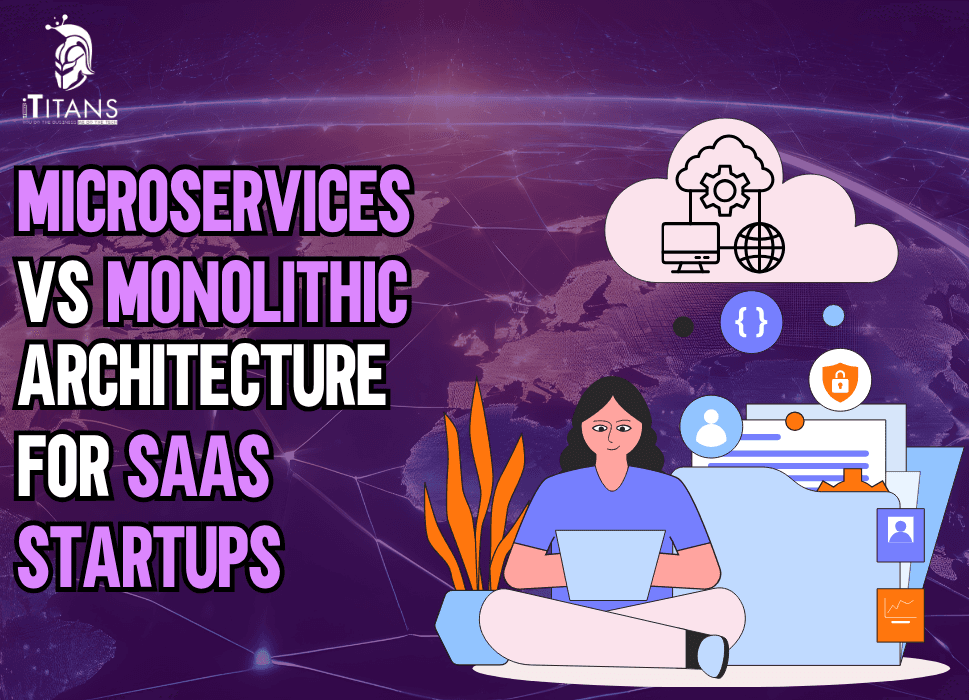
Microservices vs Monolithic Architecture for SaaS Startups: Which One Actually Makes Sense in 2026?
Building a SaaS startup is exciting, but choosing the right software architecture can quietly shape your company’s future for years. Founders often get stuck between two popular approaches: monolithic architecture and microservices architecture.
One promises simplicity and speed, while the other offers scalability and flexibility. The tricky part is that both can be the right choice depending on your startup stage, product complexity, engineering resources, and long-term goals.
Today’s SaaS landscape is moving faster than ever. Cloud-native development has reached massive adoption globally, with more than 15.6 million developers now using cloud-native technologies and 46% of backend developers actively working with microservices.
But despite this growth, many SaaS founders are discovering that jumping into microservices too early can slow product launches, increase infrastructure overhead, and create operational headaches.
So, which architecture should SaaS startups choose? Let’s break it down in practical terms without unnecessary technical jargon.

What is Monolithic Architecture
A monolithic architecture is the traditional way of building software applications. Everything lives inside a single codebase. The frontend, backend logic, APIs, user authentication, billing systems, admin panel, and database interactions all work together as one connected application.
For SaaS startups, this usually means:
- One repository
- One deployment pipeline
- One database
- One hosting environment
- Centralized management
Think of it like building a single large building where all departments operate under one roof.
Many successful SaaS businesses actually started as monoliths. Companies like Shopify, Basecamp, and even parts of Amazon initially relied heavily on monolithic systems before evolving their infrastructure later.
For early-stage startups, monoliths are attractive because they allow developers to move quickly. Teams can ship features faster, debug issues more easily, and avoid managing multiple distributed services.
Why Monolithic Architecture Still Works for SaaS Startups
There’s a misconception in startup culture that monolithic applications are outdated. That simply isn’t true. In fact, many modern SaaS platforms still use modular monoliths because they balance speed and maintainability exceptionally well.
A monolith works particularly well when:
- Your startup is pre-seed or seed-stage
- The engineering team is small
- Product-market fit is still uncertain
- Rapid iteration matters more than scaling
- Infrastructure budgets are limited
One Reddit founder shared how they spent four months building a highly scalable microservices SaaS architecture only to gain 31 users. After rebuilding the platform as a simple monolith in two weeks, they scaled much faster because they could focus on customer acquisition instead of infrastructure complexity.
That story resonates with many SaaS founders because premature architectural complexity is surprisingly common.
What Is Microservices Architecture?
Microservices architecture breaks an application into multiple independent services. Each service handles a specific business function and communicates through APIs or messaging systems.
Instead of one giant application, you may have separate services for:
- User authentication
- Payment processing
- Notifications
- Analytics
- Product catalog
- Search
- AI processing
- Reporting dashboards
Each service can use its own database, programming language, deployment cycle, and scaling rules.
This architecture became popular with companies operating at massive scale, including Netflix, Uber, Spotify, and Amazon.
Microservices are deeply connected with cloud-native development trends. According to CNCF research, 77% of backend developers now use at least one cloud-native technology, while API gateways and microservices remain dominant technologies across enterprise software systems.
Why SaaS Companies Move Toward Microservices
Microservices become valuable when a SaaS platform grows rapidly and different parts of the system experience different scaling demands.
For example:
- Video processing may need high compute power
- Billing systems require strict security
- Search functionality may require Elasticsearch
- AI services may run better in Python
- Real-time messaging may need WebSockets and event streaming
Instead of scaling the entire application, startups can scale only the services under heavy load.
This flexibility becomes extremely valuable as SaaS businesses expand globally, integrate AI workflows, or handle enterprise-level traffic.
The Biggest Difference Between Monolith and Microservices
At a high level, the difference comes down to complexity versus flexibility.
- Monoliths optimize for development speed and simplicity.
- Microservices optimize for scalability and organizational independence.
That sounds straightforward, but the real-world tradeoffs are far more nuanced.
A monolith allows developers to work inside one ecosystem. Testing, deployment, debugging, and onboarding are usually easier.
Microservices introduce distributed systems challenges:
- API communication failures
- Service discovery
- Network latency
- Distributed tracing
- Data synchronization
- Container orchestration
- CI/CD complexity
- Kubernetes management
These are not small challenges for early-stage SaaS teams.
One experienced software architect recently pointed out that startups with four engineers often end up running eight microservices unnecessarily, creating coordination problems instead of solving scalability issues. That observation reflects a growing industry shift toward “modular monoliths” for startups.
Why Many SaaS Startups Start With a Monolith
For most SaaS startups, speed matters more than scalability in the beginning. At the MVP stage, your biggest risk usually isn’t infrastructure failure. It’s building something nobody wants.
A monolithic architecture helps founders validate ideas quickly because developers spend less time managing infrastructure and more time shipping features.
Faster Product Development
With a monolith:
- Developers work in one environment
- Features are easier to implement
- Refactoring is simpler
- Debugging happens in one place
- Testing is more straightforward
This dramatically improves iteration speed. When startups need rapid SaaS product development, architecture simplicity often becomes a competitive advantage.
Lower Infrastructure Costs
Microservices typically require:
- Containers
- API gateways
- Service meshes
- Monitoring systems
- Logging pipelines
- Orchestration tools
- Message brokers
All of these increase infrastructure spending. Meanwhile, many modern SaaS MVPs can operate extremely cheaply with a monolithic stack. Some founders report running profitable SaaS platforms for under $50 per month during the MVP phase. That matters when startups are trying to conserve runway.
Easier Team Collaboration
Smaller engineering teams often work more efficiently in monolithic environments because:
- Knowledge is centralized
- Dependencies are visible
- Cross-team communication is simpler
- Deployment ownership is clear
Microservices require stronger DevOps maturity and operational processes. Without those systems, engineering velocity can actually decline.

When Microservices Become the Better Choice
Microservices shine when a SaaS company reaches significant operational scale.
That scale may include:
- Millions of API requests
- Global users
- Enterprise workloads
- AI integrations
- Complex analytics pipelines
- Multi-region infrastructure
- Multiple engineering teams
At that stage, monolith limitations begin appearing.
Independent Scaling
One of the biggest advantages of microservices is independent scalability.
Imagine a SaaS platform where:
- Search receives heavy traffic
- Reporting generates large database loads
- AI recommendations consume GPU resources
Instead of scaling the entire application, each service scales independently. This improves infrastructure efficiency significantly.
Faster Deployment Cycles
Microservices allow engineering teams to deploy services independently.
For example:
- Billing updates don’t affect authentication
- Search deployments don’t interrupt dashboards
- AI modules can release separately
This reduces deployment risk for large SaaS platforms.
Technology Flexibility
Microservices allow teams to use the best technology for specific use cases.
Examples include:
- Python for AI services
- Go for high-performance APIs
- Node.js for real-time communication
- Java for enterprise processing
One SaaS founder explained how their team added Python microservices alongside a Node.js backend specifically to support AI functionality without rebuilding the entire platform.
That kind of flexibility becomes valuable as SaaS products evolve.
The Hidden Complexity of Microservices
Microservices look impressive on architecture diagrams, but they come with operational realities many startups underestimate.
Distributed Systems Are Hard
Once services are separated, everything becomes network communication.
That introduces challenges like:
- Timeouts
- Retry failures
- Eventual consistency
- Queue backlogs
- Service outages
- Data synchronization issues
Debugging problems across distributed systems becomes much harder than debugging a monolith.
Observability Requirements Increase
Microservices demand advanced monitoring infrastructure.
You need:
- Distributed tracing
- Centralized logging
- Metrics aggregation
- Real-time alerts
- Performance monitoring
Platforms like Datadog, Grafana, Prometheus, and OpenTelemetry become essential.
According to Datadog’s 2025 DevSecOps report, modern cloud applications face increasing operational and security complexity, especially as systems become more distributed.
DevOps Becomes Critical
Microservices require mature DevOps practices.
This includes:
- CI/CD automation
- Container orchestration
- Infrastructure as code
- Kubernetes management
- Cloud cost optimization
Without experienced DevOps engineers, operational overhead grows rapidly.
Modular Monolith: The Middle Ground SaaS Startups Love
Today, many SaaS startups are choosing a hybrid approach called the modular monolith.
This architecture keeps everything inside one deployable application while organizing code into clearly separated modules.
You still get:
- Simpler deployments
- Easier debugging
- Centralized databases
But you also prepare the system for future microservice extraction if needed.This approach has become extremely popular because it avoids premature complexity while preserving scalability pathways.
Many software architecture experts now recommend modular monoliths as the ideal starting point for SaaS startups.
Database Management Differences
Databases become one of the biggest architectural differences between monoliths and microservices.
Monolithic Database Structure
Monoliths typically use:
- One centralized relational database
- Shared schemas
- Easier transactions
- Simpler reporting
This makes data consistency much easier.
Microservices Database Structure
Microservices usually follow the “database per service” pattern. Each service owns its own data. While this improves service independence, it creates challenges:
- Cross-service joins become difficult
- Reporting pipelines grow complex
- Data duplication increases
- Event consistency issues appear
Research analyzing nearly 1,000 microservices projects found that 52% of microservices systems combine multiple database categories, increasing operational complexity considerably.
For startups, managing multiple databases too early can become overwhelming.
Performance Comparison
Performance discussions between monoliths and microservices are often misunderstood.
Monolith Performance
Monoliths often perform better initially because:
- Internal function calls are faster
- No network overhead exists
- Transactions remain local
- Simpler caching works effectively
For many SaaS startups, monoliths are more than capable of handling thousands or even millions of users.
Microservices Performance
Microservices improve scalability rather than raw performance.
Benefits include:
- Independent service scaling
- Better resource allocation
- Fault isolation
- Geographic deployment flexibility
However, inter-service communication adds latency.
This tradeoff only becomes worthwhile at scale.
Security Considerations
Security becomes increasingly important as SaaS startups grow.
Microservices introduce additional security layers because every API endpoint and service communication path becomes a potential attack surface.
This requires:
- API authentication
- Service authorization
- Zero-trust networking
- Token management
- Secure service communication
Monoliths generally have fewer moving parts, making security management simpler early on.
That said, enterprise SaaS platforms often adopt microservices because isolated services can improve containment during incidents.
Cloud-Native Development and SaaS Growth
The rise of cloud-native infrastructure is accelerating microservices adoption.
The global cloud microservices market is projected to grow rapidly through 2034 as organizations modernize applications with Kubernetes, serverless infrastructure, and AI-native systems.
Meanwhile, cloud-native technologies are becoming standard across modern backend development.
For SaaS startups planning long-term enterprise growth, understanding cloud-native architecture is increasingly important.
Still, cloud-native doesn’t automatically mean “start with microservices.”
That distinction matters.
AI Is Changing SaaS Architecture Decisions
AI integrations are reshaping modern SaaS platforms.
Features like:
- AI chatbots
- Recommendation engines
- Content generation
- Predictive analytics
- AI search
often require specialized infrastructure.
This is one reason many startups gradually adopt microservices over time rather than immediately.
AI services frequently need:
- GPU processing
- Python ecosystems
- Isolated scaling
- Background task processing
Separating AI workloads into independent services can make sense without converting the entire platform into microservices.
Cost Comparison for SaaS Startups
Cost plays a major role in architectural decisions.
Monolithic Architecture Costs
Generally lower because:
- Fewer servers
- Simpler infrastructure
- Easier deployments
- Reduced monitoring overhead
- Smaller DevOps requirements
Microservices Costs
Usually higher because:
- Multiple services require separate resources
- Monitoring stacks expand
- Kubernetes clusters add expense
- Logging pipelines grow
- Networking costs increase
Cloud infrastructure spending globally is approaching nearly $100 billion per quarter as businesses continue scaling distributed cloud systems.
For bootstrapped startups, keeping infrastructure lean remains critical.
Team Structure Matters More Than People Think
Architecture should match organizational structure. Small teams usually benefit from monoliths.
Larger engineering organizations benefit from microservices because independent teams can own independent services.
If your startup has:
- 2–8 developers → monolith or modular monolith usually fits better
- 20+ engineers → microservices may improve scalability
- Multiple product squads → service separation becomes more valuable
Many startups choose architecture based on trends instead of actual operational needs.
That often creates unnecessary complexity.
Migration From Monolith to Microservices
One important reality founders should understand is this:
You do not need to choose microservices forever on day one.
Many successful SaaS companies started with monoliths and gradually extracted services over time.
This migration usually happens when:
- Teams scale
- Traffic grows
- Product complexity increases
- Deployment bottlenecks appear
A modular monolith makes this transition much smoother.
Common Migration Strategy
Typical migration steps include:
- Build modular boundaries internally
- Identify scaling bottlenecks
- Extract isolated services gradually
- Introduce API gateways
- Move toward event-driven communication
This evolutionary approach reduces risk significantly.
Real-World SaaS Startup Advice
The startup ecosystem is slowly moving away from architecture hype and toward practical execution.
Many experienced founders now recommend:
- Launch fast
- Validate demand
- Keep infrastructure simple
- Scale architecture only when needed
Even Reddit discussions among SaaS founders increasingly emphasize avoiding premature optimization and focusing on customer acquisition first.
The architecture that helps you launch quickly often beats the architecture that looks impressive in diagrams.
Where iTitans Fits Into Modern SaaS Architecture Development
Choosing between monolithic architecture and microservices architecture is not always straightforward, especially for startups balancing growth, budget, scalability, and product deadlines. This is where experienced SaaS development partners become incredibly valuable.
What Does iTitans Offers?
iTitans is a USA-based full-service software development company that works with businesses globally to build scalable digital products, SaaS platforms, mobile applications, and custom web applications. Their team helps startups and enterprises design architecture strategies that align with business goals instead of blindly following industry trends.
Building Optimized Architectures
For early-stage SaaS founders, iTitans can help build modular monolithic platforms optimized for rapid MVP launches, faster feature releases, and efficient cloud deployment. As products mature, their engineering teams can also assist with cloud-native transformation, API development services, DevOps consulting, Kubernetes implementation, and microservices migration planning.
Throughout Technical Guidance
One of the biggest advantages of working with experienced SaaS development companies like iTitans is having long-term technical guidance. Architecture decisions made during the MVP stage can significantly impact scalability, maintenance costs, and engineering efficiency later. Having experts who understand SaaS product engineering, UI/UX development, backend infrastructure, cloud integration, mobile app development, and post-launch support helps startups avoid expensive rebuilds.
Complete Roadmap for Digital Transformation
Beyond development, iTitans also supports businesses through digital transformation services that help companies modernize legacy systems, improve performance, and scale applications for global audiences. Their focus on scalable growth and ongoing technical support makes them especially relevant for SaaS startups planning long-term expansion.
So, Which Architecture Should SaaS Startups Choose?
The honest answer is: it depends on your stage.
If you are:
- Building an MVP
- Searching for product-market fit
- Operating with a small engineering team
- Managing tight budgets
A monolithic or modular monolithic architecture is usually the smarter choice.
If your SaaS platform is:
- Scaling rapidly
- Serving enterprise workloads
- Running globally
- Supporting multiple engineering teams
- Integrating complex AI services
Microservices may become the better long-term architecture.
The key is understanding that architecture should support business growth, not become a distraction from it.
The smartest SaaS founders today are avoiding extremes. Instead of blindly following architecture trends, they focus on building systems that match their current business needs while leaving room for future evolution.
Ready to build the right SaaS architecture for your business? Partner with iTitans today and launch your startup with a strong impact that lasts for businesses.
FAQs
Why do many SaaS startups begin with a monolithic architecture?
Most SaaS startups start with monolithic architecture because it is easier and faster to develop in the early stages. A single codebase simplifies deployment, testing, and debugging, which helps startups launch their minimum viable product quickly.
When should a SaaS startup switch from monolithic architecture to microservices?
A SaaS startup should consider moving to microservices when the application becomes difficult to scale or maintain as a single unit. Common signs include slower deployment cycles, increasing bugs, performance bottlenecks, and large development teams working on the same codebase. Microservices allow independent scaling and deployment of specific features, improving flexibility and system reliability.
What are the biggest advantages of microservices for SaaS businesses?
Microservices provide better scalability, faster deployments, and greater flexibility for SaaS businesses. Each service can be developed, updated, and scaled independently without affecting the entire application. This architecture also supports continuous integration and continuous delivery practices, making innovation faster.
Is monolithic architecture less scalable than microservices?
Monolithic architecture can scale, but scaling usually happens by duplicating the entire application instead of scaling individual components. This approach may become inefficient as traffic and user demands grow. Microservices provide more targeted scalability because each service can scale independently based on workload.
Which architecture is more cost-effective for early-stage SaaS startups?
For most early-stage SaaS startups, monolithic architecture is generally more cost-effective. It requires fewer servers, simpler deployment pipelines, and smaller development teams to maintain the system. Microservices often involve additional costs related to cloud infrastructure, orchestration tools, and DevOps management. Startups with limited funding usually benefit from the simplicity and affordability of a monolithic approach during the early stages.