
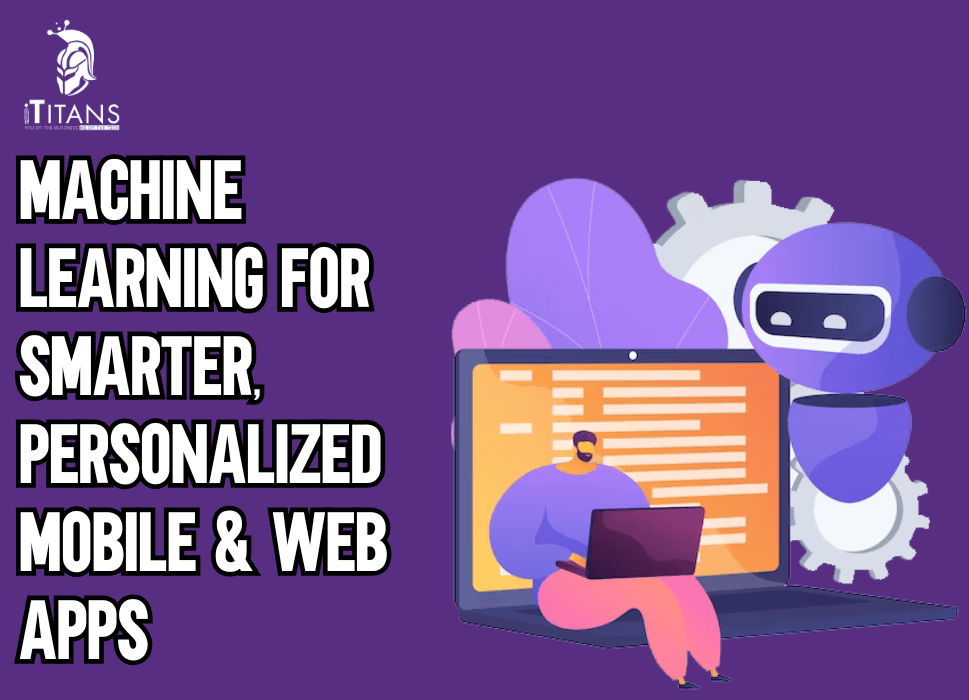
Machine Learning for Smarter, Personalized Mobile & Web Apps
Digital users today do not just want apps that work. They expect apps to understand them, adjust in real time, and respond like a human would. Static experiences no longer survive. This is exactly where machine learning personalization changes the game for modern mobile and web applications.
Every scroll, tap, pause, and exit leaves behind behavioral signals. When apps learn from these signals, they stop being reactive and start becoming predictive. This shift is why machine learning mobile apps and AI for web app personalization are now shaping how leading digital products retain users, increase engagement, and drive revenue.
This guide breaks down how machine learning for smarter, personalized mobile & web apps actually works, the algorithms behind it, and how businesses use it to create experiences users don’t abandon.
Why Personalization Is No Longer Optional in Mobile & Web Apps
Users abandon apps fast. Studies consistently show that more than 70% of users uninstall an app within 30 days if it feels irrelevant or repetitive. Generic experiences fail because they treat every user the same.
With machine learning personalization, apps adapt continuously. They learn who the user is, what they prefer, when they engage, and how their behavior evolves.
Here’s what personalization driven by ML enables:
- Content changes based on user behavior
- Interfaces adjust to usage patterns
- Recommendations improve with every interaction
- Notifications arrive when users are most likely to respond
This is not guesswork. It’s data-driven decision-making powered by personalization algorithms.
What Is Machine Learning Personalization?
Machine learning personalization is the process of using ML models to analyze user data and automatically customize app experiences for individual users.
Unlike rule-based personalization (where developers define fixed rules), machine learning systems learn patterns on their own.
For example:
- Instead of showing the same homepage to everyone, the app predicts what this user wants to see.
- Instead of hardcoded suggestions, recommendation systems evolve with each interaction.
In short, the system improves itself over time.
How Machine Learning Personalization Works Behind the Scenes
To understand how AI-driven personalization functions, it helps to break it into stages.
1. Data Collection
Personalization starts with data. Mobile and web apps collect:
- Click behavior
- Session duration
- Search history
- Purchase or conversion data
- Location, device type, time of usage
- Scroll depth and navigation paths
This data becomes the foundation for predictive analytics apps.
2. Feature Extraction and User Profiling
Raw data is noisy. Machine learning models extract meaningful patterns, such as:
- Frequent actions
- Content preferences
- Behavioral timing patterns
- Engagement triggers
Users are grouped dynamically using customer segmentation machine learning, not fixed demographics.
3. Model Training and Learning
This is where personalization algorithms come in. Models are trained to predict:
- What content a user wants next
- Which feature they will use
- When they are likely to disengage
These models continuously retrain as new data arrives.
4. Real-Time Personalization
Modern machine learning mobile apps operate in real time.
- UI elements adjust dynamically
- Content recommendations update instantly
- Notifications adapt to user behavior
This creates adaptive mobile experiences that feel natural rather than forced.
Core Machine Learning Algorithms Powering Personalized Apps
Not all algorithms serve the same purpose. Successful personalization stacks use multiple models working together.
Recommendation Systems
Recommendation systems are central to machine learning personalization examples you see daily.
They power:
- Product suggestions
- Content feeds
- Video and music recommendations
Types include:
- Collaborative filtering
- Content-based filtering
- Hybrid models
These systems analyze user similarity and behavior patterns rather than static categories.
Classification Models
Classification predicts user intent. Examples include:
- Will this user click?
- Will they convert?
- Will they churn?
These models help apps decide what action to take next.
Clustering Models
Clustering groups users based on behavior patterns. Unlike demographics, clusters change over time.
This allows adaptive UI/UX that responds to evolving user needs.
Predictive Analytics Models
Predictive analytics apps anticipate future behavior:
- When a user is likely to return
- What feature they may explore next
- When engagement is dropping
This enables proactive experiences instead of reactive ones.
Machine Learning Personalization in Mobile Apps
Mobile environments add complexity: limited screen space, varied devices, and short attention spans.
This is why machine learning mobile apps rely heavily on behavioral signals.
Personalized Onboarding
ML models detect how fast users progress and adjust onboarding steps dynamically.
- New users see guided flows
- Experienced users skip unnecessary steps
Context-Aware Experiences
With context-aware computing, mobile apps adapt based on:
- Location
- Time of day
- Device state
- Past behavior
This is why fitness apps suggest workouts at certain times or food apps show relevant options during meal hours.
Smarter Push Notifications
Generic notifications annoy users. ML-driven notifications are sent:
- At the right time
- With relevant content
- Based on engagement likelihood
This improves retention without overwhelming users.
Machine Learning Personalization in Web Applications
Web apps benefit from richer datasets and longer sessions, making AI for web app personalization even more powerful.
Dynamic Content Personalization
Web platforms personalize:
- Landing pages
- Blog recommendations
- Product displays
This improves conversion rates without redesigning the entire site.
Behavioral-Based Navigation
Navigation menus adjust based on usage patterns. Frequently accessed features surface automatically, improving usability.
Personalized UX at Scale
Enterprise platforms use real-time personalization to serve thousands of users with unique experiences simultaneously.
Why Businesses Are Investing in ML-Based Personalization
Companies adopting machine learning personalization consistently report:
- Higher engagement rates
- Lower churn
- Better conversion metrics
- Stronger user loyalty
More importantly, ML reduces dependency on assumptions. Decisions are backed by real user data.
Common Myths About Machine Learning Personalization
“Personalization Is Just Recommendations”
False. Recommendations are only one component. ML personalizes UI, timing, messaging, and interactions.
“It’s Too Complex for Most Apps”
With modern frameworks, how machine learning personalizes mobile apps has become far more accessible than before.
“It Invades User Privacy”
When implemented responsibly, personalization respects user consent and data protection standards.
How to Implement Personalized App Features with Machine Learning
Understanding machine learning personalization is one thing. Implementing it correctly inside real products is another. Most apps fail here not because the idea is wrong, but because execution lacks clarity.
Let’s break down how to implement personalized app features with ML in a way that actually delivers results instead of bloated systems that no one trusts.
Step 1: Define the Personalization Goal Clearly
Before touching models or data, ask one sharp question:
What behavior do you want to influence?
Good personalization goals include:
- Increasing session duration
- Improving content discovery
- Reducing churn
- Boosting conversions
Bad goals are vague, like “make the app smarter.”
Every machine learning personalization system must be tied to a measurable outcome. Without this, models drift and personalization becomes noise.
Step 2: Identify High-Value User Signals
Not all data matters. Strong AI-driven personalization depends on signals that reflect intent.
High-value signals include:
- Repeated actions
- Time spent per feature
- Drop-off points
- Search behavior
- Purchase hesitation patterns
Avoid vanity metrics. Focus on behavioral indicators that reveal decision-making patterns. These signals power user behavior prediction, which is the backbone of personalization.
Step 3: Choose the Right Personalization Algorithms
Different goals require different personalization algorithms. Using the wrong model creates irrelevant experiences.
Recommendation Algorithms
Best for:
- Content feeds
- Product discovery
- Media platforms
These systems analyze similarity between users and items to deliver relevant suggestions.
Classification Models
Best for:
- Churn prediction
- Conversion likelihood
- Feature adoption
Classification helps apps decide when and how to engage users.
Clustering Models
Best for:
- Audience segmentation
- Adaptive UI behavior
- Feature prioritization
This supports customer segmentation machine learning, allowing apps to adapt without hardcoded logic.
Predictive Analytics Models
Best for:
- Forecasting engagement
- Anticipating user drop-off
- Timing notifications
These models are central to predictive analytics apps that act before problems occur.
Step 4: Build the Personalization Pipeline
Personalization fails when systems are fragmented. A working pipeline connects data, models, and experience delivery.
A typical ML personalization pipeline includes:
- Event tracking and data ingestion
- Data cleaning and feature extraction
- Model training and validation
- Real-time or batch inference
- UI and content adaptation
This structure ensures real-time personalization without lag or inconsistency.

Best ML Frameworks for Personalized Apps
Choosing the right tools determines how scalable your personalization efforts become.
TensorFlow and PyTorch
These frameworks dominate best ML frameworks for personalized apps because they support:
- Deep learning
- Recommendation systems
- Scalable model deployment
They are widely used in machine learning mobile apps and web platforms alike.
Cloud-Based ML Platforms
Platforms like AWS SageMaker and Google AI services simplify deployment and monitoring. They are ideal for teams scaling AI for web app personalization across large user bases.
Personalization Libraries and APIs
Some apps integrate ML through specialized APIs that handle:
- Recommendation engines
- User profiling
- Behavioral prediction
These reduce development time while maintaining performance.
Machine Learning Personalization Examples from Real Products
Understanding machine learning personalization examples makes the value tangible.
Content Platforms
Feeds adapt continuously based on:
- Viewing history
- Scroll behavior
- Interaction frequency
This keeps users engaged longer without overwhelming them.
E-Commerce Apps
Products are ranked dynamically based on:
- Past purchases
- Browsing hesitation
- Price sensitivity
This is AI-driven personalization improving conversions without aggressive selling.
SaaS Platforms
Dashboards rearrange features based on usage frequency. Users see what matters most to them first, creating adaptive mobile experiences and web interfaces.
Designing Adaptive UI/UX with Machine Learning
Personalization is not just content. It changes how interfaces behave.
Adaptive Layouts
Layouts adjust based on:
- Screen usage patterns
- Feature popularity
- User expertise level
This leads to adaptive UI/UX that feels intuitive instead of overwhelming.
Dynamic Feature Exposure
Features appear when users are ready, not all at once. ML detects readiness through interaction signals.
This reduces cognitive load and improves onboarding success.
Context-Aware Computing in Personalized Apps
Context-aware computing allows apps to understand the user’s situation.
Examples include:
- Time-based recommendations
- Location-sensitive content
- Device-specific layouts
This context improves relevance without collecting unnecessary data.
Measuring the Success of Machine Learning Personalization
Without measurement, personalization becomes opinion-driven.
Key metrics include:
- Engagement lift
- Retention rate changes
- Conversion improvements
- Reduced bounce rates
A/B testing is essential. Compare ML-driven personalization against static experiences to validate impact.
Common Implementation Mistakes to Avoid
Over-Personalization
Too much personalization can feel intrusive. Balance relevance with user control.
Poor Data Quality
Bad data leads to bad predictions. Invest in clean pipelines before complex models.
Ignoring Performance Constraints
Mobile apps especially must optimize inference speed. Heavy models slow down experiences and hurt adoption.
Privacy and Ethics in Machine Learning Personalization
Responsible personalization respects user trust.
Best practices include:
- Clear consent mechanisms
- Data minimization
- Transparent personalization logic
Ethical machine learning personalization builds long-term loyalty instead of short-term gains.
Preparing for Scale
As your app grows, personalization systems must:
- Handle increased data volume
- Maintain model accuracy
- Support cross-platform experiences
Scalable architecture ensures consistent AI for web app personalization and mobile performance.
Advanced Machine Learning Personalization Strategies Most Apps Miss
Many apps claim to use personalization, but most stop at basic recommendations. True machine learning personalization goes further by adapting experiences at multiple layers simultaneously.
Multi-Signal Personalization
Instead of relying on one behavior, advanced systems combine:
- Short-term actions
- Long-term preferences
- Contextual signals
- Historical engagement patterns
This layered approach improves user behavior prediction and avoids one-dimensional experiences.
Continuous Learning Models
Static models decay quickly. The most effective AI-driven personalization systems retrain models continuously.
Benefits include:
- Faster adaptation to changing preferences
- Reduced model bias
- Improved accuracy over time
This is critical for apps operating in dynamic environments.
Cross-Platform Personalization
Users switch between mobile and web constantly. Leading platforms unify behavior data across devices.
This enables:
- Consistent personalization
- Better recommendations
- Seamless journeys across platforms
Cross-platform machine learning mobile apps and web systems significantly outperform isolated implementations.
Performance Optimization for Machine Learning on Mobile Devices
Mobile personalization introduces strict performance constraints. Users abandon slow apps instantly.
Lightweight Models for Mobile
Heavy models belong on servers. Mobile apps benefit from:
- Model compression
- On-device inference for simple predictions
- Hybrid architectures combining cloud and local processing
This ensures real-time personalization without degrading performance.
Smart Caching Strategies
Predictions don’t always need to be recalculated. Caching frequent outcomes improves speed and reduces compute load.
This is especially useful in predictive analytics apps where behavior patterns remain stable over short periods.
Network-Aware Personalization
Personalization logic should adapt to network conditions. Offline or low-bandwidth scenarios still require meaningful experiences.
This improves reliability and user trust.
Personalization That Respects Privacy
Modern users care deeply about data usage. Ethical machine learning personalization respects boundaries.
Transparent Personalization Logic
Users should understand:
- Why content is recommended
- How preferences are learned
- How data influences experiences
Transparency builds confidence and long-term retention.
Privacy-First Data Design
Best practices include:
- Anonymized behavior tracking
- Limited data retention
- Clear opt-in mechanisms
Responsible AI for web app personalization aligns with global compliance standards.
Future Trends Shaping Machine Learning Personalization
The next phase of personalization focuses on deeper intelligence and less intrusion.
Explainable AI in Personalization
Users and regulators increasingly demand explainability. Models must justify decisions without exposing complexity.
This strengthens trust and accountability.
Emotion-Aware Experiences
Advanced systems infer emotional states through interaction patterns.
This supports:
- Mood-sensitive content
- Stress-aware notifications
- Adaptive UX flows
Emotion-aware personalization is emerging as a differentiator.
Autonomous Personalization Systems
Future machine learning personalization systems will optimize themselves without manual tuning.
They will:
- Detect performance drops
- Adjust models automatically
- Improve engagement continuously
This reduces operational overhead while improving outcomes.
How Personalization Creates Competitive Advantage
Personalization is not a feature. It is a strategy.
Apps that master machine learning personalization benefit from:
- Higher user loyalty
- Better lifetime value
- Reduced acquisition costs
- Stronger brand affinity
When users feel understood, they stay.
Turning Personalization into a Business Asset
Successful teams treat personalization as a core product capability.
This means:
- Investing in data infrastructure
- Aligning personalization with business goals
- Iterating based on measurable outcomes
Personalization should evolve with the product, not exist as an afterthought.

Machine Learning Personalization Examples That Drive Results
Let’s summarize where machine learning personalization examples consistently succeed:
- Recommendation systems improving discovery
- Adaptive UI/UX reducing friction
- Predictive analytics apps anticipating user needs
- Context-aware computing enhancing relevance
Each example demonstrates how personalization improves experiences without overwhelming users.
Build Smarter, Personalized Mobile & Web Apps with iTitans
At iTitans, we design and develop intelligent mobile and web applications powered by machine learning personalization, predictive analytics, and AI-driven personalization that deliver measurable engagement and long-term growth.
Talk to our experts today and see how smarter personalization can turn your app into an experience users actually stay for.
FAQs
1. How does machine learning personalization differ from rule-based personalization in apps?
Rule-based personalization follows fixed logic defined by developers, while machine learning personalization learns from real user behavior and adapts automatically over time. This allows apps to respond to changing preferences instead of relying on static assumptions.
2. What data is required for machine learning mobile apps to personalize user experiences?
Machine learning mobile apps rely on behavioral data such as clicks, session duration, navigation paths, and feature usage rather than personal identity data. This behavioral focus enables accurate personalization while maintaining user privacy.
3. Which personalization algorithms are most effective for real-time app experiences?
Recommendation systems, clustering models, and predictive analytics models are the most effective personalization algorithms for real-time experiences. They enable apps to adjust content, UI, and interactions instantly based on user behavior.
4. How does AI for web app personalization improve conversion rates?
AI for web app personalization improves conversions by showing users relevant content, features, and offers at the right moment. This reduces friction and shortens the decision-making process during critical user actions.
5. Can predictive analytics apps reduce user churn?
Yes, predictive analytics apps identify early signs of disengagement by analyzing behavioral trends and interaction frequency. This allows apps to intervene proactively before users abandon the platform.
6. What are common challenges in implementing adaptive mobile experiences with machine learning?
Challenges include poor data quality, slow model performance, and over-personalization that feels intrusive. Successful adaptive mobile experiences balance relevance, speed, and user control.
7. How does context-aware computing enhance personalization without overwhelming users?
Context-aware computing adjusts experiences based on time, location, device state, or usage context instead of excessive personalization rules. This makes interactions feel natural and situational rather than forced.
8. Are machine learning personalization examples scalable across large user bases?
Yes, modern machine learning personalization examples are designed to scale using automated model retraining and real-time inference systems. This allows thousands of users to receive unique experiences simultaneously without manual intervention.