
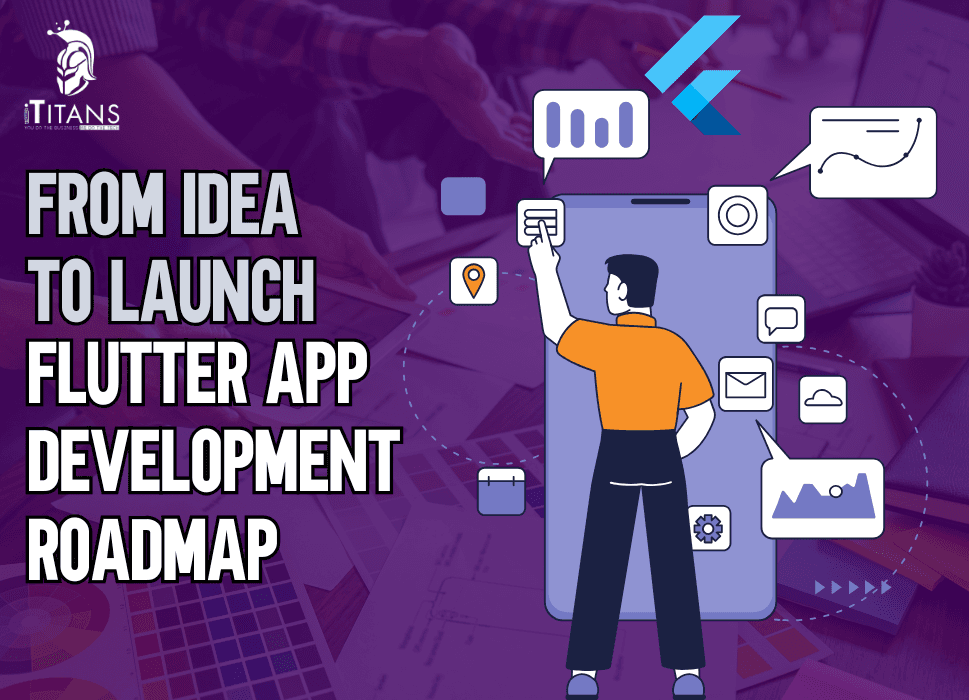
Flutter App Development | From Idea to Launch Roadmap
The journey from conceptualizing a mobile app to launching it successfully in the market is a complex process that requires strategic planning, technical expertise, and a deep understanding of user needs. With numerous development frameworks available, businesses and developers seek a solution that is not only efficient but also cost-effective. Flutter, an open-source UI toolkit developed by Google, has emerged as a game-changer in mobile app development.
Flutter enables developers to build cross-platform applications with a single codebase, reducing development time and ensuring a consistent experience across iOS and Android devices. Its fast development cycle, rich UI components, and strong community support make it a preferred choice for startups and enterprises alike.
This article provides a detailed roadmap for Flutter app development, from the initial idea stage to the final launch. Additionally, we will explore how iTitans, a leading software development company, can assist businesses in transforming their app ideas into high-performing mobile applications.
Step 1: Defining the App Idea and Objectives
Every successful app starts with a well-defined idea. Before jumping into development, it is crucial to clearly outline the purpose of the app, target audience, and key features. Businesses should conduct market research to identify gaps in the industry and validate their app idea.
Understanding the competition is equally important. By analyzing similar apps, businesses can determine what works well and what can be improved. This helps in creating a unique value proposition that differentiates the app from others in the market.
At this stage, it is also essential to define key performance indicators (KPIs) that will measure the app’s success. These could include metrics such as user engagement, retention rate, and revenue generation.
Step 2: Planning and Wireframing
Once the app idea is validated, the next step is to create a detailed plan for development. This includes defining the app’s core functionalities, choosing the right technology stack, and setting a timeline for different development phases.
Wireframing is a critical part of this stage. A wireframe is a blueprint of the app’s user interface, outlining the placement of various elements and the overall user flow. This helps in visualizing how users will interact with the app before actual development begins.
At this stage, it is also important to decide whether the app will have a Minimum Viable Product (MVP) version for early testing. An MVP allows businesses to launch a basic version of the app with essential features and gather feedback for improvements.

Step 3: Choosing Flutter for Development
Flutter has gained immense popularity due to its cross-platform capabilities, fast development process, and expressive UI components. Unlike traditional development frameworks that require separate codebases for iOS and Android, Flutter allows developers to write once and deploy across both platforms.
One of the biggest advantages of Flutter is its hot reload feature, which enables developers to see real-time changes in the code without restarting the entire app. This significantly speeds up development and enhances productivity.
Moreover, Flutter comes with a rich set of widgets that ensure a consistent and visually appealing design across devices. With support from Google and a growing developer community, Flutter continues to evolve, making it a future-proof choice for mobile app development.
Step 4: UI/UX Design and Prototyping
The design phase plays a crucial role in determining the app’s success. A well-designed user interface (UI) enhances user experience (UX) and ensures intuitive navigation. Flutter provides a variety of widgets that allow developers to create beautiful, highly customizable interfaces.
Designers use tools like Figma, Adobe XD, and Sketch to create prototypes that simulate the app’s look and feel. These prototypes help in gathering feedback from stakeholders and making necessary adjustments before development begins.
The focus during this stage should be on creating a user-friendly interface, ensuring accessibility, and maintaining brand consistency. A good design not only attracts users but also keeps them engaged.
Step 5: Backend Development and API Integration
While the frontend focuses on user interactions, the backend handles the app’s functionality, data storage, and processing. Depending on the app’s complexity, developers may choose Firebase, Node.js, or Django for backend development.
Flutter apps often require integration with third-party services such as payment gateways, authentication systems, and cloud storage. APIs (Application Programming Interfaces) play a crucial role in connecting the frontend with the backend and enabling seamless communication between different components.
Security is a major consideration during this stage. Implementing data encryption, user authentication, and secure API connections ensures that user information is protected from cyber threats.
Step 6: Development and Testing
With the designs finalized and the backend set up, the actual development process begins. Flutter’s Dart programming language is used to write the application’s logic, integrating UI elements and backend functionalities. During development, rigorous testing is essential to identify and fix bugs. Various testing techniques include:
- Unit Testing: Ensures individual components function correctly.
- Integration Testing: Verifies how different modules work together.
- UI/UX Testing: Checks for design consistency and usability.
- Performance Testing: Measures speed and responsiveness.
Flutter provides built-in testing tools that help developers maintain high code quality and stability throughout the development process.
Step 7: Deployment and App Store Submission
Once development and testing are complete, the app is ready for deployment. This involves preparing the app for Google Play Store and Apple App Store submission.
- Each platform has specific guidelines that must be followed, including app store policies, security requirements, and content guidelines. A well-prepared launch strategy includes:
- Creating compelling app store descriptions with keywords for better visibility.
- Designing attractive app screenshots and promotional materials.
- Running a beta testing phase with platforms like TestFlight (iOS) and Google Play Beta Testing.
- Implementing an app marketing strategy to attract early users.
After submission, it may take a few days to weeks for the app to be reviewed and approved by the respective app stores.
Step 8: Post-Launch Support and Maintenance
Launching the app is not the end of the journey. Regular updates, bug fixes, and feature enhancements are necessary to keep the app relevant and competitive. Post-launch support includes:
- Monitoring app performance using analytics tools like Google Firebase.
- Gathering user feedback and implementing necessary improvements.
- Fixing bugs and optimizing the app for better speed and performance.
- Rolling out new features based on user demand and market trends.
- Continuous monitoring and improvement ensure that the app remains successful in the long run.

How iTitans Can Help You Develop a Flutter App from Idea to Launch
For businesses looking to develop a high-quality mobile application, partnering with an experienced Flutter development company like iTitans can make a significant difference.
iTitans offers end-to-end Flutter development services, from conceptualization to post-launch support. With a team of skilled developers, designers, and strategists, iTitans ensures that every app meets the highest standards of performance and usability.
Customized Flutter App Development
Whether you need a simple MVP or a full-scale enterprise application, iTitans provides tailored solutions that align with your business goals. Their expertise in Dart, Firebase, API integration, and UI/UX design ensures a seamless development process.
Expertise in Cross-Platform Solutions
iTitans leverages Flutter’s cross-platform capabilities to create apps that run smoothly on both iOS and Android, reducing development time and costs without compromising quality.
Ongoing Maintenance and Support
After the app is launched, iTitans offers continuous maintenance, updates, and technical support to ensure long-term success. Their dedicated team monitors app performance, fixes bugs, and implements new features based on user feedback.
Security and Performance Optimization
iTitans prioritizes security and speed, implementing the latest encryption techniques, authentication methods, and performance optimization strategies to keep your app secure and efficient.
FAQs
What are the key steps in the Flutter app development roadmap?
The roadmap includes idea validation, UI/UX design, Flutter development, backend integration, testing, deployment, and post-launch maintenance. Each phase ensures a smooth transition from concept to a fully functional app.
Why choose Flutter for app development?
Flutter offers cross-platform compatibility, a single codebase, fast development, and a rich widget library. It also provides excellent performance and a native-like experience, making it a top choice for developers.
How long does it take to develop a Flutter app?
The development timeline varies based on app complexity, features, and team expertise. A basic Flutter app may take 2-3 months, while a feature-rich app with backend integration can take 4-6 months or more.
What are the biggest challenges in Flutter app development?
Challenges include optimizing performance, managing state efficiently, ensuring smooth animations, and integrating third-party plugins. However, Flutter’s growing community and robust documentation help overcome these hurdles.
How can I successfully launch a Flutter app?
A successful launch involves thorough testing, app store optimization (ASO), marketing strategies, and gathering user feedback. Regular updates and performance monitoring post-launch are essential for long-term success.
Conclusion
The journey from an idea to a successful mobile app launch requires careful planning, technical expertise, and a robust development strategy. Flutter has revolutionized mobile app development by offering a fast, flexible, and cost-effective framework for building high-quality cross-platform applications.
By partnering with iTitans, businesses can streamline the entire development process, from wireframing and design to deployment and ongoing support. With their expert Flutter developers and end-to-end solutions, iTitans ensures that your mobile app stands out in today’s competitive market. Contact iTitans now and get a quote based on your requirements.
Related Post