
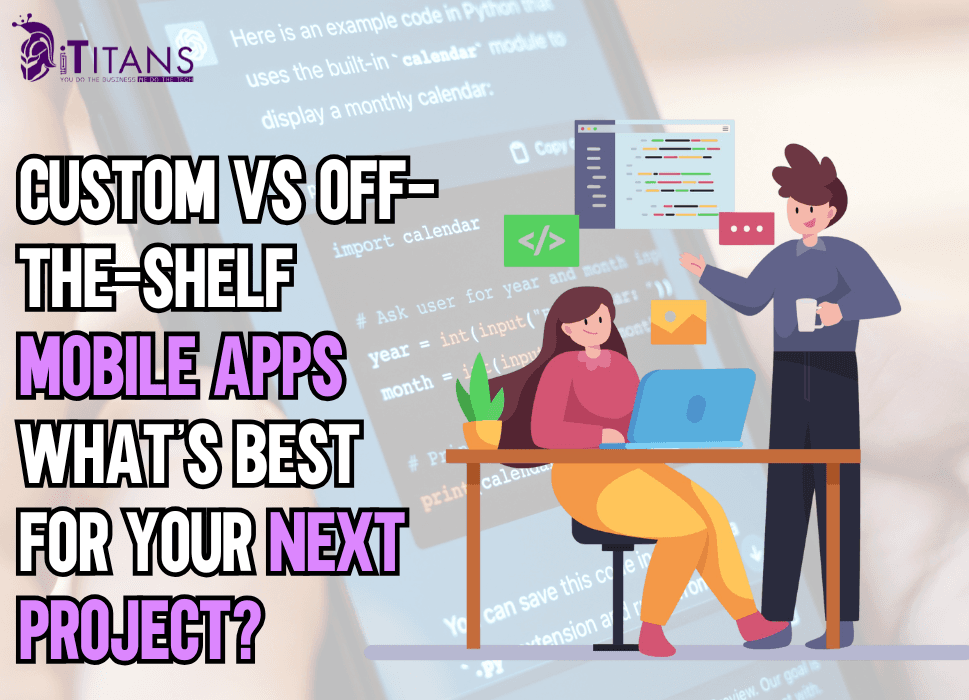
Custom vs Off-the-Shelf Mobile Apps | Which is Best?
When your business is ready to launch a mobile app, one question hits hard, and early:
Should you go for a custom mobile app or choose an off-the-shelf solution?
This isn’t a small decision. The direction you take will shape your budget, your development timeline, your scalability, and ultimately, your user experience.
So, before you start throwing time or money into an app build, you need to ask the right questions and get the answers that actually matter to your business.
Let’s break it all down. No fancy jargon. Just clear insights that help you figure out what’s best for your next app project.

What Is a Custom Mobile App?
A custom mobile app is built from the ground up, designed specifically for your business needs, goals, and workflows. It doesn’t come with pre-made features or templates. Instead, you work with a development team to define exactly what the app should do and how it should look.
Think of it like designing your own house. You choose the number of rooms, the layout, the lighting, the materials, everything. The result is an app that fits your business like a glove.
Who is it for?
- Startups building something unique
- Businesses with complex workflows
- Brands looking for full control over the experience
- Companies scaling fast and need flexibility
What Is an Off-the-Shelf Mobile App?
An off-the-shelf app is a ready-made solution. It’s already built, already tested, and available to buy or subscribe to. These apps are usually designed for a wide audience and come with a standard set of features.
Using the house analogy again, it’s like buying an apartment in a complex. You get a kitchen, a living room, maybe a gym access, but you can’t change the floor plan or knock down walls.
Who is it for?
- Businesses needing fast deployment
- Small teams with limited budget
- Companies looking to test a simple idea
- Entrepreneurs who want to avoid development headaches
The Key Differences You Can’t Ignore
Let’s be real. Choosing between custom vs off-the-shelf mobile apps isn’t always black and white. But there are core differences that will push you in the right direction, especially if you’re working on tight deadlines or with specific business goals.
1. Cost
This one hits the hardest.
Custom mobile app development costs more upfront—because it involves a dedicated team, planning, testing, and revisions. But it’s a long-term investment that can grow with your business.
On the flip side, off-the-shelf apps are cheaper to start with. You pay a license fee, subscription, or a one-time purchase. But over time, the cost of limitations, integrations, and support can pile up.
2. Time to Market
Off-the-shelf apps are instant. You can install, set up, and start using them almost immediately. If speed is your top concern, this might feel like the smarter move.
But if you’re building a product that needs to stand out or do something specific, custom apps give you more freedom, even if it takes longer to launch.
3. Scalability
If you plan to expand, add more users, features, or integrate with other tools, custom apps give you that breathing space. They’re built to grow with you.
Most off-the-shelf mobile apps have limits. You’re stuck with what they offer, unless you upgrade to a pricier plan or find third-party workarounds.
4. Ownership & Control
When you build a custom mobile app, you own everything: the code, the database, the data. You call the shots.
With off-the-shelf solutions, the control lies with the vendor. They decide when to update, what features to remove, and how to handle bugs. That can become frustrating if your business relies heavily on the app.
5. Security
Custom-built apps can be made secure based on your needs, especially if you’re handling sensitive user data.
Off-the-shelf apps come with generic security protocols, which might not match your business or industry standards. That’s a risk you shouldn’t overlook.
When You Should Choose a Custom Mobile App
Here’s the deal, you should consider going custom if:
- You have unique functionality your business can’t compromise on
- You need to scale fast and can’t be limited by preset features
- You want to own your data and code
- You’re building a brand-defining product or MVP
- You’re ready to invest in long-term flexibility and control
When an Off-the-Shelf App Is the Smarter Pick
Not every project needs a custom-built product. Sometimes, pre-made tools are more than enough:
- You need to launch something fast
- Budget is tight and you need to test the waters
- Your workflows are simple and match what the app already offers
- You’re experimenting with a small audience or prototype
The Hybrid Middle Ground
In some cases, businesses start with an off-the-shelf app and then transition to a custom app once they know what’s working.
This is a smart move if you’re not 100% sure about the demand or product direction yet. Think of it as renting before buying.
So, What’s Best for Your Next Project?
This is where things get personal.
There’s no one-size-fits-all answer to custom vs off-the-shelf mobile apps. It really comes down to:
- What your app needs to do
- How fast you need to launch
- Your budget
- How much control you want
Here’s what we always recommend at ITitans:
Start by identifying your app’s goals, audience, and must-have features. From there, the right path will become clear.

The Real Costs: What Are You Paying For?
When deciding between custom mobile apps and off-the-shelf mobile apps, budget is often the biggest deciding factor. And while cost matters, it’s rarely as straightforward as a one-time price tag.
You’re not just paying for the app, you’re investing in how it performs, scales, and serves your users.
Upfront Cost vs Hidden Expenses
Off-the-shelf mobile apps are usually seen as more affordable because you’re buying a ready-made solution. It’s a fixed product with a predictable price. But here’s where most businesses get blindsided: what happens when that app can’t keep up with your growing needs?
You might end up paying more for third-party plugins, feature extensions, or even switching platforms entirely. That’s a lot of time and money down the drain.
With a custom mobile app, the initial cost may be higher — you’re hiring a team, investing in UX/UI, and building from scratch. But this upfront investment often prevents long-term expenses caused by limitations, outdated features, or lack of scalability.
Ownership and Licensing: Who Controls the Product?
When you buy an off-the-shelf solution, you’re essentially renting it. Their licensing terms bind you. If they shut down or change their business model, you could lose access or be forced to migrate.
With a custom mobile application, you own the code. You decide when to update, how to scale, and where to integrate. That kind of control brings peace of mind and long-term flexibility — especially for startups planning to scale or enterprises with strict data control policies.
Time to Market: How Soon Can You Launch?
Speed matters, especially when you’re racing competitors or trying to launch with a first-mover advantage. In this regard, off-the-shelf apps have the upper hand, temporarily.
You can install, configure, and go live often within days or weeks. But here’s the trade-off: quick deployment comes with compromise. You’re locked into someone else’s architecture, design, and feature set.
Custom mobile apps, on the other hand, take longer to develop, from a few months to a year, depending on complexity. But every screen, function, and integration is built for your specific use case. This ensures smoother performance, better user experience, and fewer headaches post-launch.
So if you’re running a short-term campaign or MVP test, off-the-shelf could work. But if your app is the core of your business model, say, an eCommerce platform, delivery service, or fitness tracker, custom is the safer long game.
Scalability: What Happens When You Grow?
Let’s say your app is a hit. User count spikes. You want to roll out new features, support multiple devices, or expand internationally.
With an off-the-shelf app, you may hit a wall. Some platforms aren’t built to support high-volume usage. Others lock premium features behind paywalls. Worse, you might find yourself rewriting entire workflows just to fit within their framework.
A custom-built mobile app, though, grows with you. Need to support 10,000 new users overnight? Want to add AI chat, integrate new payment systems, or optimize for wearables? You can. Because your infrastructure is built with your vision in mind, not someone else’s product limitations.
This is where custom mobile application development gives businesses a serious edge. It’s the difference between renting a studio apartment and building your own house, one you can remodel whenever you want.
Maintenance and Support: Who’s Got Your Back?
Off-the-shelf apps usually come with customer support, but it’s often limited. If something breaks, you’re at the mercy of their tech stack and team, which could take hours or even days to respond. And let’s not forget that you’ll be competing with hundreds of other customers for their attention.
With a custom mobile app, you typically have a dedicated development team or agency. They know your codebase inside out and can fix bugs, roll out updates, or add features without delay.
Need urgent support during a product launch? You won’t be opening a ticket and waiting in line, you’ll be speaking directly with someone who built your app. That level of support can be a game-changer when user experience is on the line.
Integration and Compatibility: Will It Work with Your Tools?
Modern businesses don’t operate in silos. You have CRMs, ERPs, payment gateways, email systems, and analytics tools. The question is, will your app play nice with all of them?
Most off-the-shelf apps offer some level of third-party integration, but it’s usually limited to popular platforms. Need something custom or niche? You might be out of luck.
Custom mobile apps, however, can integrate with your existing systems seamlessly. Whether you’re using a custom-built backend, legacy software, or multiple APIs, your app can be designed to connect everything smoothly.
This matters a lot for industries like finance, healthcare, or logistics, where real-time data and system reliability aren’t just nice-to-haves, they’re mission-critical.
User Experience: One Size Doesn’t Fit All
User expectations are sky-high. People want intuitive navigation, lightning-fast performance, and sleek design. An app that feels clunky or generic will be abandoned in seconds.
Off-the-shelf mobile apps try to cater to a broad audience, which often leads to a diluted user experience. You’re stuck with templates and UI decisions that weren’t made with your users in mind.
With a custom mobile application, you’re building every pixel and interaction around what your users actually want. That means smoother onboarding, fewer drop-offs, and higher engagement rates.
If user retention, reviews, and revenue matter to you (and they should), investing in a custom UX pays off.
Security: How Safe Is Your Data?
Security isn’t optional, it’s expected. Whether you’re dealing with user data, transactions, or internal operations, one breach could ruin your reputation.
Off-the-shelf apps are used by thousands, which means they’re often prime targets for hackers. And while reputable platforms patch vulnerabilities, you don’t have much control over how or when it happens.
Custom mobile apps offer the ability to build security into the foundation. You can include advanced encryption, biometric logins, multi-factor authentication, and even GDPR or HIPAA compliance depending on your needs.
In industries like healthcare, fintech, or legal, this isn’t just smart, it’s required.
What Do Other Businesses Choose?
Startups and small businesses often start with off-the-shelf mobile apps because they’re fast and cheap. For quick testing or simple solutions like scheduling apps, CRMs, or productivity tools, they do the job.
But as businesses grow, they often find these apps become limiting. They start investing in custom mobile apps to gain better performance, branding control, and long-term growth potential.
Enterprises and funded startups usually skip the off-the-shelf phase altogether, investing directly into custom development. The reason? They need ownership, flexibility, and reliability from day one.
Making the Final Choice: What Should Drive Your Decision?
So you’ve weighed the pros and cons, thought about your timeline, considered your budget, and still feel like you’re sitting on the fence. Don’t worry, you’re not alone.
Every business, startup, or enterprise faces this same crossroad when choosing between custom mobile app development and off-the-shelf mobile apps.
Now, let’s help you decide.
Start by answering these critical questions:
- Do you have a very specific set of features that existing apps don’t support?
- Are you planning to scale and upgrade your app frequently?
- Is your app tied directly to your brand identity and user experience?
If you answered “yes” to any of the above, then a custom app may serve your goals better.
But if you’re testing the waters, need to launch quickly, or have minimal requirements, then an off-the-shelf mobile application can get you started with minimal cost and effort.
There’s no one-size-fits-all answer here, but there is a “best-fit” option for your goals.
Maintenance, Security, and Control – The Long-Term View
Most people get so caught up in development costs that they forget to consider long-term needs. So let’s talk about three big things that will matter later: maintenance, security, and control.
Maintenance in an off-the-shelf setup is usually handled by the vendor. You don’t have to worry about updates or bug fixes, unless they roll out changes that break things for you. That’s the risk. You’re not in control.
With a custom mobile app, maintenance is all yours. You’ll need to set up a support team or keep your devs on retainer. But the benefit is clear: you call the shots. You decide when to fix, update, or enhance features.
When it comes to mobile app security, off-the-shelf tools are often built for mass use, which means vulnerabilities can be exploited at scale. If a hacker finds a loophole, thousands of apps could be affected.
Custom apps are harder targets. That’s because they’re built uniquely, and if your developers follow strong security protocols, your app becomes far less appealing to attackers. This is especially important if you’re dealing with sensitive user data, financial information, or proprietary business processes.
Control is also a major factor. With prebuilt apps, you’re always dependent on the platform provider. They could change pricing, restrict features, or even discontinue the product.
With a custom-built mobile app, that risk is eliminated.
Budget Isn’t Just About Upfront Costs, It’s About ROI
A lot of people ask: “How much does a custom app cost?”
But a better question would be: “What’s the return on investment?”
Sure, a custom mobile app may take more time and money upfront. But what if it leads to better customer retention, higher conversion rates, and stronger brand loyalty?
For instance, if you’re an eCommerce business, building your own app with custom checkout flows, personalized recommendations, and in-app loyalty programs could boost your revenue far more than a generic app ever could.
On the other hand, if your project is internal—like an employee task manager—you may not need high customization. An off-the-shelf mobile app solution could serve you well without straining your budget.
The takeaway? Look at the full picture. Don’t just compare price tags. Compare outcomes.
Real-Life Examples: When Each Option Works
Let’s bring this home with some real-life scenarios:
- Startup MVP: A SaaS startup wants to validate an idea fast. They go with an off-the-shelf mobile app template, customize it slightly, and launch in 2 weeks. They save money and get early feedback. Once their idea gains traction, they build a custom app for long-term growth.
- Enterprise Integration: A logistics company needs an app to track fleet performance and fuel costs. They require custom APIs, live data sync, and integration with legacy systems. No off-the-shelf solution can do all this. So they go for a custom mobile app, which eventually helps them cut costs and increase delivery speed.
- E-learning Platform: A coaching company wants branded apps with quizzes, video content, and certificates. Off-the-shelf solutions lack flexibility, and white-label options are expensive. A custom mobile application allows them to stand out in the saturated market and grow their user base 3x in a year.
- Local Grocery App: A small shop wants to allow users to place orders and get home delivery. An off-the-shelf app like Shopify or Instacart plug-ins work just fine. No need for complex backend development.
Hybrid Approach: The Smart Middle Ground?
Here’s something most people don’t consider: You don’t always have to pick one extreme.
Some companies start with an off-the-shelf solution, validate their features and business model, and then transition to a custom mobile app when the time is right.
Others use off-the-shelf components for parts of their app (like analytics or chat), and then build the rest from scratch.
This hybrid approach can save costs, reduce time-to-market, and still allow for customization.
So if you’re stuck between the two worlds, remember, you can have the best of both.

Final Verdict: Custom vs Off-the-Shelf Mobile Apps, Which Wins?
Here’s a quick recap to help you decide:
- Go Custom if your app is mission-critical, customer-facing, and tightly connected to your business growth.
- Go Off-the-Shelf if you need something fast, functional, and not too specific.
And if you’re somewhere in between? Combine both. Start small. Scale smart.
Whatever you choose, make sure your app works for your users, not just your budget.
How iTitans Can Help You Make the Right Move?
At ITITANS, we help businesses worldwide choose the right mobile app, custom or off-the-shelf, ensuring it aligns with strategy, not just tech.
Contact us today and let’s turn your idea into something users love.
Frequently Asked Questions (FAQs)
What is the difference between custom and off-the-shelf apps?
A custom mobile app is built from scratch for your business needs, while an off-the-shelf mobile app is pre-built and ready to use with limited customization.
Are custom apps more secure than off-the-shelf apps?
Yes, because custom apps have fewer known vulnerabilities and can include unique security measures designed for your data.
Can I start with an off-the-shelf app and later go custom?
Absolutely. Many companies start with off-the-shelf to test the market and build a custom mobile app when they’re ready to scale.
Which is more cost-effective: custom or off-the-shelf?
Off-the-shelf apps are cheaper initially, but custom mobile apps may offer better ROI in the long run by aligning better with your brand and goals.
How long does it take to build a custom app?
Depending on complexity, building a custom mobile application can take anywhere from 3 months to over a year.