
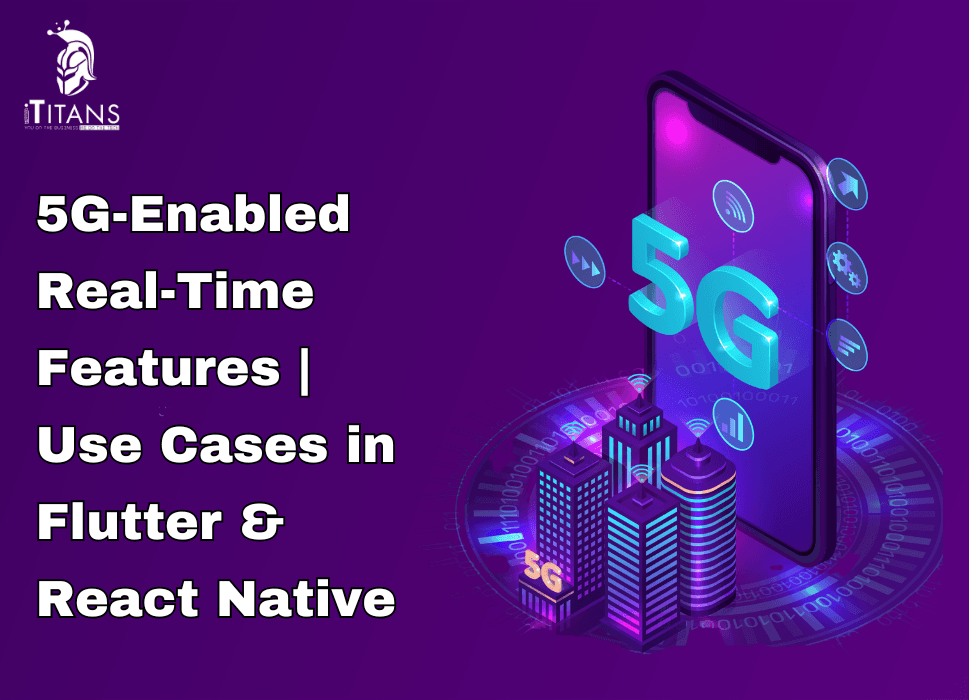
5G Features for Flutter & React Native Apps
With 5G in mobile app development becoming more than just a buzzword, we’re seeing a massive shift in what developers can build and users can experience.
This isn’t about faster downloads or streaming videos without buffering anymore, it’s about bringing real-time responsiveness and ultra-low latency into the core of your app logic.
Whether you’re a startup founder building your MVP, a product manager upgrading an existing app, or a developer exploring advanced tech stacks, the impact of 5G-enabled app features in Flutter and React Native can’t be ignored.
This blog explores how real-time use cases are evolving and what this means for cross-platform apps.

Why 5G Changes Everything for Mobile App Development
Let’s break it down. The average 4G latency is around 50ms, while 5G brings that down to under 10ms. That’s not a small technicality, it’s a total upgrade to how fast users interact with apps.
This means:
- Video calls feel instantaneous
- Multiplayer games sync in real time
- IoT-based home control apps operate without lag
- Logistics and tracking apps update every second
- AR and VR content becomes usable on mobile
And that’s just scratching the surface. These are no longer futuristic features, they’re what users expect.
What Is Real-Time Communication in Mobile Apps?
When people talk about real-time communication in apps, they usually refer to messaging apps like WhatsApp or video platforms like Zoom. But that’s just one category.
Real-time features now show up in:
- Live auctions and bidding apps
- Stock market tracking dashboards
- Real-time sports score apps
- Remote device monitoring systems
- On-demand taxi dispatching platforms
The only problem? Traditional mobile networks often struggle to keep up. This is where 5G real-time features enter the scene, promising smoother performance, instant feedback, and minimal wait time across networks and devices.
Flutter and React Native: Why They’re Ready for the 5G Shift
Before diving into use cases, let’s get one thing straight: Flutter and React Native aren’t just good choices for modern app development, they’re built for the kind of flexibility 5G demands.
Flutter enables pixel-perfect rendering and native performance across platforms with a single codebase. That makes it ideal for apps that require fast UI updates in real-time, such as those in streaming, finance, and logistics.
React Native, with its modular architecture and support for third-party plugins, is already widely used in messaging apps, social platforms, and delivery solutions. Combined with 5G-enabled app features, it becomes even more capable of handling live data sync, push notifications, and GPS-driven experiences.
Let’s now look at the most exciting use cases of 5G in mobile app development, especially in Flutter and React Native.
Use Case 1: Real-Time Video Streaming in Education & Healthcare
Online learning platforms like Byju’s, Khan Academy, or Coursera have exploded in popularity. But with 5G real-time features, the streaming experience can go beyond watching recorded lectures.
In a Flutter 5G use case, developers can build:
- Interactive classrooms where teachers can draw or annotate live
- Live quizzes with instant leaderboard updates
- One-on-one mentoring with live feedback using WebRTC and Firebase
In healthcare, React Native 5G integration allows for:
- Live video consultations with near-zero lag
- Real-time health monitoring using IoT devices
- AI diagnostics with real-time symptom input and analysis
Before 5G, latency made these use cases clunky or outright impossible. Now, developers can explore deeper engagement models with full confidence that the tech will hold up.
Use Case 2: Real-Time Multiplayer Gaming
Gaming is one of the most demanding sectors when it comes to network performance. With 5G in mobile app development, we’re entering an era where multiplayer games don’t just run smoothly, they feel as responsive as local play.
In Flutter, developers can create:
- Multiplayer turn-based games with real-time score updates
- Low latency in mobile apps that need fast state management with Bloc or Provider
- Cloud-connected game logic using Firebase or Supabase
React Native gives game developers an advantage with its plugin ecosystem.
Combined with 5G real-time features, it enables:
- Fast sync across multiple players’ devices
- Live chat, leaderboard, and tournament integration
- Real-time match replays and stat generation
These features were often exclusive to console games, but 5G now brings them into mobile development.
Use Case 3: Smart Transportation & Live Location Apps
Companies like Uber, Careem, and Bolt rely heavily on real-time location tracking, traffic data sync, and ride assignments. With 5G-enabled app features, there’s an opportunity to push this to a new level of responsiveness and accuracy.
In React Native, developers can now:
- Fetch location updates every second
- Offer live ETAs with real-time route changes
- Push driver-customer chat with instant delivery
And with Flutter, location tracking gets even sharper.
Combining 5G and mobile edge computing, a logistics app can:
- Update parcel location with zero delay
- Alert users when a delivery is one minute away
- Use real-time geofencing to trigger automation or status changes
The promise of low latency in mobile apps becomes real when users can see their ride or delivery update live—no loading bar, no frozen maps.
Use Case 4: Live Auctions & Instant Bidding
Auction platforms and NFT marketplaces live and die by milliseconds. In traditional networks, delays between user bids and server sync create confusion, disputes, and loss of interest.
Here’s how 5G real-time features change the game:
- React Native 5G integration allows auctioneers to push updates instantly to every participant
- With Flutter, apps can display price changes, countdowns, and user rankings live
- Developers can build push-to-bid buttons that lock transactions the moment they’re clicked, reducing disputes and increasing trust
This is not only great for NFT platforms—it also works for event ticketing, concert sales, and even eCommerce flash deals.
Use Case 5: Real-Time Fitness & Health Monitoring
Fitness apps like Strava, Nike Training Club, or Fitbit have long tried to build real-time sync features. But network limitations often created a 5–10 second lag between workout tracking, GPS mapping, and cloud updates.
5G in mobile app development now brings serious improvement:
- Runners can get live heart rate and pace feedback
- Workout sessions can be streamed live with real-time trainer feedback
- Health data from wearables can be shared instantly with doctors or family members
Flutter 5G use cases include wearable integration via Bluetooth and syncing it with Firebase in real time.
React Native supports native modules for health data syncing, and 5G allows developers to scale this to millions of users without speed drops.
Real-Time Experiences That Actually Matter
The 5G era isn’t about loading websites faster. It’s about enabling real-time mobile experiences that were nearly impossible just a few years ago.
With Flutter and React Native, you can now develop features that demand instant feedback, lightning-fast communication, and seamless responsiveness, all baked into a mobile UI that feels natural.
Let’s break down how developers are applying 5G-powered real-time use cases using Flutter and React Native today.
1. Live Video & Audio Streaming with Sub-Second Latency
Apps like Instagram Live, Clubhouse, and TikTok have made real-time broadcasting mainstream. But most of them still suffer from lag, buffering, or audio delay.
With 5G, the low latency and high bandwidth allow developers to deliver sub-second video and audio experiences, even in high-motion scenarios.
- Flutter: Plugins like flutter_webrtc support live video streaming using WebRTC protocols. Combine this with 5G’s performance and you have crystal-clear streaming without needing to buffer.
- React Native: Libraries like react-native-webrtc provide peer-to-peer media channels perfect for 5G use.
2. Multi-User Collaboration in Real-Time
From whiteboard apps to collaborative design tools like Figma or Google Docs, people now expect instant updates from multiple users working together in-app.
Thanks to 5G-enabled real-time synchronization, you can build experiences like:
- Real-time drawing
- Multi-user coding (like Replit)
- Synchronous UI state editing
Flutter with Firebase makes it smooth using Firestore’s real-time listeners. React Native also works well with solutions like Socket.IO or WebSockets, pushing changes instantly to all users.
3. Instant Multiplayer Gaming
Multiplayer mobile games have always struggled with latency, jitter, and device compatibility. 5G changes the game, literally.
In Flutter, tools like flame game engine support real-time logic while integrating seamlessly with Firebase or custom backend services for multiplayer sync.
React Native developers are integrating engines like Unity (via wrappers) or developing native modules for direct game logic syncing.
- 5G’s <10ms latency means the server doesn’t become a bottleneck
- Instant move mirroring and player feedback becomes possible
4. Real-Time Remote Monitoring & Diagnostics
IoT and connected devices are booming — from vehicle telematics to remote patient health monitoring. With 5G connectivity and native cross-platform apps, data is streamed in real-time, not in chunks.
- In Flutter, use BLE and MQTT for IoT connectivity
- In React Native, react-native-ble-plx and mqtt.js support direct device integration
5. Real-Time Translation & Speech Recognition
Language isn’t a barrier anymore. Apps now allow you to speak in one language and have it instantly translated and spoken in another, live.
5G makes this a breeze with near-zero lag for:
- Speech recognition (Google Speech-to-Text)
- Natural language translation (Google Translate API, OpenAI Whisper)
Combine this with Flutter or React Native and you’ve got a mobile app that can act as a pocket translator.
6. Real-Time Augmented Reality (AR)
AR apps were once heavy, slow, and often unusable without WiFi. With 5G, real-time cloud anchors, image recognition, and rendering are now possible on mobile devices.
Flutter now supports AR through native plugins while React Native benefits from libraries like ViroReact.
- ARCore/ARKit offloads 3D rendering to the cloud via 5G
- Large assets can stream on-demand rather than preload
Flutter vs React Native: Real-Time Capability Breakdown
When it comes to building real-time applications using Flutter or React Native, each framework offers a unique set of tools and integrations. Let’s break it down by real-time feature categories:
Real-Time Messaging
Flutter supports real-time chat and messaging through options like Firebase Realtime Database, MQTT protocol, and third-party services like Stream. The use of StreamBuilder in Flutter makes it easy to listen to data changes and update the UI in real-time.
React Native, on the other hand, also leverages Firebase and MQTT, but Socket.IO is a popular go-to option in this ecosystem for handling real-time communication, especially for custom chat solutions.
Video and Audio Calling
In both frameworks, WebRTC and Agora are widely used for real-time video and voice calling capabilities. These services are platform-agnostic and come with SDKs that are well-supported in both Flutter and React Native, enabling smooth and low-latency media communication.
AR/VR Integration
Flutter provides access to AR capabilities primarily through ARCore plugins, which are more effective when working directly with native modules.
React Native offers ViroReact for AR/VR projects, along with bridging into ARKit for iOS devices. This gives React Native a slight edge when building AR experiences that need to run across platforms.
Live UI Syncing
For real-time UI updates, Flutter uses reactive widgets like StreamBuilder paired with services such as Firestore or Realtime Database. This makes it seamless to sync UI elements with backend changes.
In React Native, developers rely on Redux for state management and connect it with real-time databases like Firebase or Supabase to ensure live syncing of UI elements.
Device Connectivity
Flutter integrates well with device hardware using Bluetooth plugins and Platform Channels to communicate with native APIs when needed.
React Native achieves similar functionality using BLE (Bluetooth Low Energy) plugins and Native Modules, offering solid support for device-level features like scanning, pairing, or controlling external hardware.
Real-Time Doesn’t Mean Real Risk
Of course, building real-time mobile features on Flutter or React Native means testing across conditions, and 5G makes that more reliable, but not perfect.
You’ll still need:
- Offline handling (caching, retries)
- Data compression for failover
- App lifecycle optimization
But you’re closer than ever to delivering an experience that’s smooth, natural, and fast enough to feel magical.
Unlocking the Potential of 5G in Cross-Platform App Development
As 5G technology becomes more widespread, developers must rethink how their apps operate under ultra-fast conditions. With download speeds exceeding 10 Gbps and latency dipping below 1 ms, both Flutter and React Native can now support experiences that were previously unachievable.
For example, apps can now:
- Stream 4K or even 8K video in real time
- Deliver instant multiplayer gaming
- Enable AR navigation in complex environments
- Provide real-time feedback in fitness and health apps
But taking advantage of these possibilities demands rethinking both front-end and back-end architecture.
Simply using Flutter or React Native isn’t enough. Developers must optimize data fetching strategies, improve state management, and leverage new APIs that 5G opens access to.
New Tools & APIs for 5G-Driven Development
The tech ecosystem is evolving quickly. Here are some technologies making 5G-ready apps more achievable:
1. WebRTC & 5G: Real-Time Communication
WebRTC was once limited by network reliability. But with 5G, it becomes incredibly powerful. You can now:
- Build Flutter and React Native apps with real-time HD video chat
- Enable instant voice processing without audio lag
- Combine WebRTC with AI-based noise cancellation libraries
2. Edge Computing + 5G
With 5G’s low latency and edge computing, data can be processed closer to the device, resulting in faster processing times.
This allows:
- Live analytics without routing data to distant servers
- Faster loading of in-app recommendations and personalization
- Improved AR/VR interactivity in apps like tourism, retail, or gaming
In Flutter, libraries like cloud_functions can pair well with Firebase edge deployments. In React Native, serverless functions (such as those provided by Vercel or Netlify Edge) can achieve the same result.
Security Considerations in Real-Time 5G Apps
With increased speed comes increased responsibility. Apps transferring large volumes of data in real time over 5G must prioritize:
- End-to-end encryption (especially for chat and video apps)
- Authentication rate limits, to avoid abuse of fast login attempts
- Zero-trust architecture, since more real-time endpoints mean more attack surfaces
Frameworks like Firebase Auth, OAuth, and biometric integrations help both Flutter and React Native apps stay secure.

Future Trends: What’s Next for 5G in Mobile Development?
1. Mass Adoption of AR in Daily Apps
Expect grocery stores, museums, or even restaurants to offer AR interfaces for browsing, instructions, or ordering—all inside apps built with Flutter or React Native.
2. 5G-Powered AI Inference on Devices
With faster data transmission, AI models can now process inputs live, like:
- Translating voices in real time
- Identifying objects or faces during video calls
- Applying ML-based filters and effects in AR
3. Real-Time Content Personalization
Recommendation engines that once refreshed after hours can now adapt within seconds of user behavior, thanks to 5G and edge analytics.
5G isn’t just a speed upgrade. It’s a game-changer for how mobile apps are built, delivered, and experienced. For Flutter and React Native developers, it opens the door to previously unthinkable possibilities: instant streaming, immersive interactivity, real-time syncing, and hyper-personalization.
The real challenge? Not in the code, but in the mindset. It’s about shifting from static to dynamic, from buffered to live, from responsive to predictive.
And 2025 is the year that shift becomes the new norm.
Want to build 5G-ready real-time apps using Flutter or React Native?
At iTitans, we design and develop apps that push the boundaries of mobile performance. Whether it’s AR features, sensor integration, or ultra-low-latency streaming, we bring real-time ideas to life.
Let’s connect to build your next-generation app!
FAQs
How does 5G improve real-time features in mobile apps?
5G drastically reduces latency and increases bandwidth, enabling smoother video calls, live streaming, multiplayer gaming, and real-time data syncing in apps.
Can Flutter apps fully support 5G-based features?
Yes. Flutter supports plugins and APIs that can utilize 5G capabilities such as cloud rendering, WebRTC, and edge functions for low-latency apps.
Are React Native apps 5G compatible out of the box?
React Native apps don’t require modification to use 5G, but to take advantage of it, developers should optimize networking, caching, and backend strategies.
What industries benefit the most from 5G-enabled apps?
Healthcare, gaming, fitness, logistics, AR-based retail, and live streaming platforms benefit significantly from real-time data transfer powered by 5G.
How can developers test 5G features during development?
Use cloud device farms like Firebase Test Lab, connect to 5G-enabled physical devices, or simulate low-latency conditions via network throttling tools.
Is 5G necessary for real-time mobile experiences?
While not strictly necessary, 5G enables a much richer and more responsive experience, especially for AR, live video, and instant collaborative apps.