
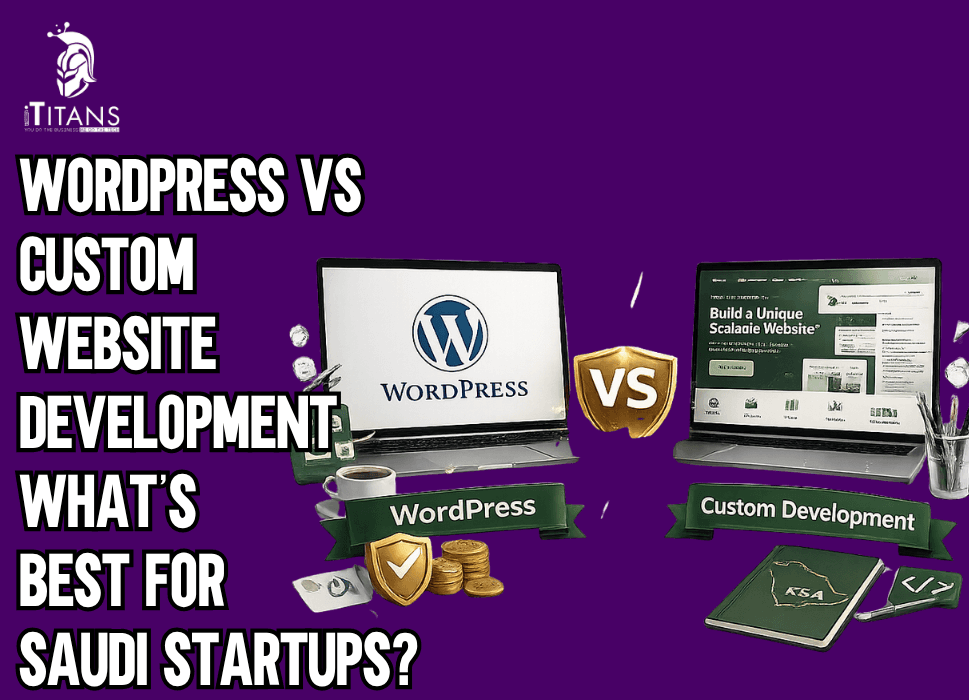
WordPress vs Custom Website Development: What’s Best for Saudi Startups?
Saudi Arabia’s startup ecosystem is moving faster than ever. New fintech apps are entering the market every month. Logistics startups are raising funding rounds at record speed. SaaS companies are competing aggressively for regional expansion.
At the same time, customer expectations have changed dramatically. Users now expect lightning-fast websites, flawless mobile experiences, Arabic-first interfaces, secure payment systems, and smooth onboarding from the very first interaction.
That shift has made one decision surprisingly important for founders: choosing the right website foundation.
Some Saudi startups launch quickly on WordPress and find themselves trapped months later by plugin conflicts, slow performance, security vulnerabilities, and limited customization. Others spend massive budgets on custom development far too early, only to burn cash on unnecessary engineering complexity before finding product-market fit.
The reality is that there is no universal answer. The best option depends on your startup stage, business model, growth expectations, operational complexity, and long-term digital strategy.
This guide breaks down the real differences between WordPress and custom development from the perspective of Saudi startups, founders, CTOs, and product teams trying to make a smart long-term decision instead of chasing short-term convenience.
Why Website Infrastructure Matters More Than Most Saudi Startups Realize
Many early-stage founders treat their website as a marketing asset instead of operational infrastructure. That mindset creates problems later.
A startup website today is no longer just a collection of pages explaining services. It often becomes the central layer connecting marketing, lead generation, analytics, automation, customer onboarding, CRM systems, payment gateways, support systems, mobile applications, and sales pipelines.
When the underlying architecture is weak, the business feels the impact everywhere.
A slow-loading website damages conversion rates. A poorly coded CMS creates SEO issues. Weak security affects customer trust. Plugin-heavy environments become unstable during traffic spikes. Development bottlenecks delay product launches. Eventually, the company spends more fixing problems than building growth opportunities.
This is becoming increasingly relevant in Saudi Arabia because the startup environment is more competitive than it was even three years ago.
Saudi consumers are digitally mature. Mobile browsing dominates user behavior. Arabic user experience expectations are significantly higher. Investors are asking harder technical questions before funding rounds. Businesses are under pressure to align with the Kingdom’s rapid digital expansion under Vision 2030.
As a result, startup infrastructure decisions matter earlier than most founders expect.
The Cost of Choosing the Wrong Platform
A surprising number of startups choose platforms based purely on launch speed without considering operational realities six or twelve months later.
A founder hires a low-cost offshore agency promising a complete WordPress website in two weeks. Initially, everything appears fine. The homepage looks modern. Basic pages work. Contact forms function properly.
Then growth begins.
The startup wants custom dashboards. CRM integrations become necessary. Marketing teams need automation workflows. SEO traffic starts increasing. Customers begin uploading data. Multiple plugins stop working after updates. Website speed declines sharply. Security warnings appear. Developers begin patching temporary fixes onto unstable code.
At that point, the startup faces a painful decision: continue repairing a fragile system or rebuild from scratch.
Both options are expensive.
This cycle is extremely common among startups that prioritized short-term affordability over long-term architecture planning.
Understanding WordPress Development
Before discussing whether WordPress is the right fit for Saudi startups, it is important to understand what WordPress actually is beyond the simplified “website builder” label many people associate with it.
WordPress is an open-source content management system that powers a large percentage of websites globally. Its popularity comes from accessibility. Businesses can launch websites relatively quickly using themes, plugins, and prebuilt templates without building everything from the ground up.
For startups trying to validate ideas quickly, that flexibility is attractive.
A basic MVP website can be launched in days instead of months. Marketing teams can update pages without developer involvement. Plugin ecosystems provide immediate access to SEO tools, contact forms, analytics integrations, booking systems, and eCommerce functionality.
For many early-stage companies, these advantages are genuinely useful.
The problem begins when startups assume WordPress can handle every future requirement without tradeoffs.
Why Many Startups Choose WordPress Initially
The biggest advantage of WordPress is speed.
A startup with limited funding can launch a professional-looking digital presence quickly without hiring a large engineering team. That matters during early traction stages when founders are testing messaging, customer acquisition channels, and business models.
For service-based startups, agencies, consultants, and small businesses, WordPress often works well because operational complexity remains relatively low.
Content publishing is simple. SEO plugins help with optimization. Blog management is straightforward. Landing pages can be created rapidly for campaigns. Teams without technical backgrounds can manage updates internally.
This is one reason many startups searching for a wordpress website for startup business solutions initially lean toward WordPress.
Another factor is cost predictability.
Custom engineering projects can spiral financially when requirements change. WordPress environments appear safer because initial pricing is lower and development timelines are shorter.
For founders who previously experienced missed deadlines from outsourced engineering teams, WordPress feels less risky.
Unfortunately, those assumptions are not always accurate.
The Hidden Problems Behind Cheap WordPress Development
The WordPress ecosystem contains thousands of freelancers and agencies offering extremely low-cost development services. Many Saudi startups are drawn toward these offers during early growth stages.
The issue is that cheap development usually produces expensive maintenance problems later.
Many low-cost WordPress projects rely heavily on third-party plugins stacked together without long-term architecture planning. Developers prioritize visual delivery instead of performance, security, maintainability, or future scalability.
Initially, founders rarely notice these issues.
The website launches. Everything appears functional.
Then operational stress begins exposing weaknesses.
Plugin conflicts start breaking functionality after updates. Website speed drops because of bloated themes. Security vulnerabilities appear through outdated third-party components. Developers leave incomplete documentation behind. New features become increasingly difficult to implement cleanly.
Communication breakdowns make things worse.
A common complaint among startup founders involves agencies disappearing after launch or becoming unresponsive once ongoing technical issues begin appearing. Since much of the website relies on fragmented plugin ecosystems, new developers often struggle to understand how everything was originally configured.
This creates dependency problems that become expensive over time.
Where WordPress Works Well for Saudi Startups
Despite these concerns, WordPress is not inherently a bad choice. In fact, for certain business models, it remains highly practical.
The key is understanding where WordPress fits operationally and where it does not.
Content-Heavy Businesses
Media companies, educational platforms, blogs, consulting firms, and content-driven businesses often perform well on WordPress because the platform was originally built for publishing workflows.
Content management remains one of WordPress’s strongest capabilities.
If your startup’s growth strategy depends heavily on SEO publishing, blog production, landing pages, multilingual content, and inbound marketing campaigns, WordPress can support those objectives effectively.
This becomes especially relevant for startups investing heavily in Arabic and English SEO simultaneously.
Fast MVP Launches
Some founders make the mistake of building enterprise-level systems before validating market demand.
That approach burns resources quickly.
For startups still testing demand, pricing models, positioning, or customer acquisition strategies, launching quickly matters more than engineering perfection.
In these cases, WordPress can reduce development timelines significantly.
A startup validating a niche SaaS offering, educational platform, consulting service, or marketplace idea may benefit from rapid deployment rather than investing six months into custom infrastructure prematurely.
The important distinction is understanding that MVP infrastructure and long-term infrastructure are not always the same thing.
Marketing-Focused Websites
Many Saudi startups primarily need strong marketing websites rather than deeply customized operational platforms.
For example:
- Law firms
- Real estate agencies
- Medical clinics
- Business consultants
- Recruitment firms
- Creative agencies
These businesses often prioritize lead generation, SEO visibility, landing pages, and content marketing over advanced backend functionality.
In these scenarios, WordPress can remain efficient for years if developed correctly.
However, even in these cases, quality development standards matter enormously.
Poorly structured WordPress environments still create SEO problems, slow loading speeds, weak Core Web Vitals scores, and security concerns that directly impact growth performance.
That is why choosing experienced development partners matters just as much as choosing the platform itself.
For startups evaluating a wordpress development company saudi arabia, the real differentiator is not design aesthetics alone. Founders should examine architecture quality, code standards, long-term maintainability, technical SEO implementation, hosting recommendations, and post-launch support processes.
A visually impressive website built on unstable foundations eventually becomes a business liability rather than a growth asset.
What Custom Website Development Actually Means
One of the biggest misconceptions among startup founders is assuming that custom development simply means “a more expensive website.”
That interpretation misses the entire point.
A custom-built platform is not just about appearance. It is about control, operational flexibility, system architecture, performance, security, and long-term business capability. Instead of assembling functionality through third-party plugins and prebuilt templates, developers create the system around the business itself.
That distinction changes everything.
A startup building a fintech product in Riyadh has completely different operational needs compared to a logistics platform, SaaS company, healthcare system, or B2B marketplace. Their customer flows, integrations, security requirements, onboarding systems, dashboards, analytics needs, and data structures vary dramatically.
Trying to force all of those requirements into a plugin-heavy CMS environment often creates technical chaos behind the scenes.
This is why many growing companies eventually move toward custom website development for startups once their operational complexity increases.
Why Startups Outgrow WordPress Faster Than Expected
Most founders do not plan to outgrow WordPress in the beginning.
The problem usually appears gradually.
At first, the website functions as a marketing platform. Then new business requirements start emerging every few months. Teams want custom reporting systems. Sales departments need CRM synchronization. Marketing teams require automation workflows. Customers request account dashboards. Mobile applications need API connectivity. Internal operations require role-based access systems.
Each new requirement adds another layer of complexity.
On WordPress, those layers are often handled through third-party plugins developed by unrelated companies with different coding standards, update schedules, and compatibility limitations.
Eventually, the startup reaches a point where the website resembles a patchwork system rather than a stable business platform.
Performance declines become common at this stage.
Pages begin loading slowly because dozens of plugins inject scripts, database calls, and unnecessary assets into the frontend. Developers spend more time troubleshooting compatibility issues than building actual improvements. Security monitoring becomes increasingly difficult because vulnerabilities may exist across multiple third-party components.
From the founder’s perspective, growth suddenly feels operationally painful.
That pain is usually a signal that the infrastructure no longer matches the business.
The Real Advantages of Custom Website Development
Custom development requires higher upfront investment, but for many startups, the long-term operational benefits justify the decision.
The key advantage is that the business controls the architecture instead of adapting business requirements around CMS limitations.
Better Performance and Speed
Website performance is not just a technical issue anymore. It directly affects revenue, SEO rankings, user retention, and customer trust.
Saudi consumers expect fast mobile experiences. If a website takes several seconds to load, users leave quickly. This is especially true for eCommerce startups, SaaS platforms, booking systems, and marketplaces competing aggressively for user attention.
Custom-built systems remove much of the unnecessary code commonly found in plugin-heavy WordPress environments.
Developers can optimize database structures, reduce script bloat, implement efficient caching systems, and create lean frontend experiences specifically designed around business goals.
This matters heavily for SEO as well.
Google’s ranking systems increasingly prioritize performance metrics such as Core Web Vitals. Slow websites often struggle to compete even when content quality is strong.
For startups investing heavily into organic traffic acquisition, architecture decisions directly influence long-term SEO performance.
Stronger Security Architecture
Security discussions are often ignored during early startup stages because founders assume attackers only target large enterprises.
That assumption is dangerous.
Startups frequently handle sensitive customer data, payment systems, user credentials, internal communications, and operational workflows. Even smaller businesses can become attractive targets when vulnerabilities exist.
WordPress itself is not inherently insecure. The problem usually comes from dependency chains involving outdated plugins, unsupported themes, weak configurations, and inconsistent maintenance practices.
Custom development reduces exposure significantly because the platform contains only the functionality the business actually needs.
There are fewer unnecessary entry points.
Security systems can also be designed around specific operational requirements instead of relying on generalized plugin ecosystems.
For Saudi startups operating in sectors like fintech, healthcare, logistics, or enterprise SaaS, these considerations become even more important because customer trust and regulatory expectations are much higher.
Full Control Over Business Logic
This is where custom development becomes particularly valuable.
Businesses evolve constantly. New workflows appear. Teams change processes. Customer expectations shift. Products expand into new markets.
A rigid platform eventually creates operational friction.
Custom systems allow startups to build workflows around actual business operations instead of adapting operations around software limitations.
For example:
- A logistics startup may require route management systems connected to customer dashboards.
- A SaaS company may need usage-based billing systems and advanced analytics.
- A recruitment platform may require custom candidate matching algorithms.
- A healthcare startup may need encrypted patient workflows and role-specific access systems.
Trying to manage these systems inside WordPress often creates unstable architecture over time.
Custom development provides much more flexibility because developers build features intentionally instead of forcing integrations between unrelated plugins.
Why Many Saudi Startups Regret Cheap Development Decisions
One of the most expensive mistakes founders make is choosing development vendors based entirely on price.
The Saudi startup market has seen a sharp increase in offshore outsourcing arrangements over the last several years. On paper, many of these deals appear attractive. Agencies promise fast delivery timelines, low monthly retainers, and “complete” development packages.
The problems usually begin after launch.
Missed Deadlines and Communication Failures
A major issue with low-cost development teams is fragmented communication.
Founders explain business goals clearly during onboarding calls, but technical execution often becomes disconnected from those objectives. Requirements get misunderstood. Timelines shift repeatedly. Developers disappear for days without updates. Revisions take weeks instead of hours.
For startup teams moving aggressively toward funding rounds or product launches, those delays become extremely costly.
A missed development deadline is not simply an inconvenience. It can affect investor confidence, partnership opportunities, campaign launches, customer onboarding schedules, and revenue targets.
This is why experienced founders eventually prioritize process maturity over cheap pricing.
Technical Debt That Slows Growth
Technical debt is one of the most underestimated startup risks.
Poor development decisions rarely create immediate collapse. Instead, they gradually slow the business over time.
Adding features becomes harder. Bugs appear more frequently. Performance declines. Security monitoring becomes inconsistent. Development costs increase because developers spend more time fixing existing systems than building new capabilities.
This pattern is common in poorly structured WordPress projects where businesses continuously add plugins instead of addressing foundational architecture problems.
At some point, rebuilding becomes unavoidable.
That rebuild often costs significantly more than building correctly from the beginning.
The Problem With “Template Thinking”
Many low-cost agencies rely heavily on prebuilt themes and recycled codebases.
The website may look visually impressive during presentation meetings, but underneath, the structure often lacks flexibility and long-term maintainability.
This creates major limitations once startups begin growing aggressively.
A company entering new GCC markets may require multilingual workflows, regional payment integrations, custom analytics systems, or enterprise-grade API connections. Template-based environments struggle badly under these conditions because they were never designed around unique operational requirements.
The founder ends up trapped between expensive rebuild costs and increasingly unstable systems.
WordPress vs Custom Website Development for Different Startup Stages
The smartest decision often depends less on the technology itself and more on the company’s growth stage.
Early-Stage Startups
For startups validating ideas quickly, WordPress can absolutely make sense.
At this stage, founders are usually focused on:
- Testing demand
- Acquiring initial users
- Building credibility
- Launching quickly
- Preserving cash flow
A professionally developed WordPress website may provide enough flexibility to support those goals without unnecessary engineering complexity.
However, even at this stage, founders should avoid extremely cheap development shortcuts because rebuilding unstable systems later becomes far more expensive.
Growth-Stage Startups
This is where infrastructure decisions become more strategic.
Growth-stage businesses often require:
- Custom workflows
- Advanced integrations
- Better security
- High traffic handling
- Performance optimization
- Operational automation
- API-driven systems
At this point, many businesses begin evaluating custom web development company saudi arabia options because WordPress environments start creating operational limitations.
This transition period is critical.
Founders who delay infrastructure upgrades too long often experience mounting technical debt that slows expansion during the exact phase where speed matters most.
Funded and Enterprise-Level Startups
Once startups enter serious scaling phases, custom development usually becomes the stronger long-term choice.
Investors increasingly examine operational infrastructure before large funding rounds. Weak systems create concerns about reliability, scalability, security, and long-term maintainability.
For enterprise-focused startups, architecture quality becomes part of business credibility itself.
A company handling enterprise clients cannot afford unstable systems, plugin conflicts, security failures, or slow platform performance.
At this level, custom development is no longer simply a technical preference. It becomes an operational requirement tied directly to growth capacity, customer trust, and competitive positioning.
Saudi-Specific Factors Most Global Comparison Articles Ignore
Most discussions around wordpress vs custom website development are written from a generic global perspective. They compare pricing, themes, plugins, and development timelines without considering how regional business environments change technical priorities.
Saudi Arabia is different.
Startups operating in the Kingdom face unique digital expectations that directly affect website architecture decisions. User behavior, language requirements, payment systems, mobile usage patterns, and business regulations all influence what type of infrastructure actually works long term.
Ignoring these factors often leads founders toward platforms that look affordable initially but create operational friction later.
Arabic UX and RTL Complexity
Many startup founders underestimate how difficult Arabic-first user experiences can become technically.
Arabic websites require right-to-left interface structures, font rendering optimization, localization support, responsive mobile alignment, and bilingual content management workflows that remain consistent across devices.
This becomes more complicated when businesses expand into multilingual SEO strategies targeting both Arabic and English audiences simultaneously.
Poor implementation damages user trust immediately.
Saudi users notice broken RTL alignment, inconsistent Arabic typography, awkward translations, and mobile layout issues very quickly. These problems make businesses appear unprofessional regardless of how visually attractive the design may seem.
WordPress can support Arabic websites, but plugin-heavy multilingual environments often become unstable over time, especially when multiple translation systems interact with themes and page builders.
Custom development provides more control over multilingual architecture because developers build localization workflows directly into the system rather than relying on disconnected third-party tools.
For startups planning serious regional expansion, this distinction matters significantly.
Payment Gateway and Local Integration Requirements
Saudi startups increasingly depend on localized digital infrastructure.
Payment systems such as Mada, STC Pay, Apple Pay integrations, regional shipping providers, ERP systems, invoicing platforms, and CRM workflows all require stable technical implementation.
This is where many businesses begin encountering limitations with template-based WordPress environments.
Initially, integrations may appear functional. Then operational issues emerge under real usage conditions:
- Checkout delays
- API failures
- Broken plugin updates
- Syncing issues between systems
- Database conflicts
- Slow dashboard performance
Custom-built systems generally handle these integrations more effectively because developers control how systems communicate internally.
For startups managing large transaction volumes or operationally complex services, this stability becomes critical.
Mobile-First Consumer Behavior in Saudi Arabia
Saudi Arabia has one of the strongest mobile usage environments globally.
Customers browse, shop, register, book services, and consume content heavily through smartphones. A slow mobile experience directly affects conversion rates.
Unfortunately, many WordPress websites perform poorly on mobile because of bloated themes, excessive JavaScript loading, poorly optimized plugins, and inefficient frontend rendering.
Founders often realize this too late after marketing campaigns begin underperforming.
Custom development allows businesses to optimize mobile performance intentionally around user behavior patterns instead of adapting prebuilt themes that were designed for broad mass-market use cases.
This becomes especially important for:
- eCommerce startups
- Delivery platforms
- SaaS applications
- Marketplace businesses
- Booking systems
- Fintech platforms
In highly competitive sectors, even small speed improvements affect customer retention significantly.
WordPress vs Custom Website Development Cost in Saudi Arabia
One of the biggest reasons startups initially choose WordPress is cost.
That decision is understandable.
Early-stage companies must preserve cash carefully. Founders are balancing hiring costs, product development, marketing expenses, investor expectations, and operational uncertainty simultaneously.
A lower upfront website budget naturally feels safer.
The problem is that many founders compare only initial development pricing instead of total operational cost over several years.
That creates misleading assumptions.
The Real Cost of WordPress Development
A basic WordPress website can certainly launch at a lower initial cost compared to custom development.
But long-term expenses often grow faster than founders expect.
Recurring costs usually include:
- Premium plugins
- Theme licensing
- Security monitoring
- Performance optimization
- Plugin conflict troubleshooting
- Ongoing maintenance retainers
- Hosting upgrades
- Emergency fixes after updates
- Malware cleanup
- Developer dependency for custom functionality
These costs accumulate gradually.
The startup may spend relatively small amounts each month, but after several years, the total operational spending often becomes surprisingly high, especially when multiple rebuilds or migrations occur.
Poorly developed WordPress environments become even more expensive because every update introduces instability risks.
This is why businesses searching for wordpress vs custom coded website cost in saudi arabia should evaluate lifecycle cost rather than launch pricing alone.
Why Custom Development Appears Expensive Initially
Custom systems require higher upfront planning because developers are building architecture intentionally instead of assembling prebuilt components.
This process involves:
- Business analysis
- System architecture planning
- Database structuring
- Frontend engineering
- Backend development
- API integration
- Security implementation
- Quality assurance testing
Naturally, that requires more engineering time.
However, businesses gain significantly more control over future operational costs because the system is built specifically around business requirements rather than layered on top of generalized CMS infrastructure.
The important distinction is predictability.
Well-structured custom systems usually produce fewer emergency problems, lower plugin dependency risks, cleaner maintenance workflows, and more stable long-term performance.
For startups expecting aggressive growth, those advantages often outweigh the initial investment difference.
SEO Performance Comparison Between WordPress and Custom Development
Many founders assume SEO depends only on content quality.
That assumption is incomplete.
Website architecture directly influences search visibility through performance, crawlability, page rendering efficiency, mobile usability, Core Web Vitals, indexing structure, and technical SEO implementation.
This is where platform decisions matter more than many startups realize.
Why WordPress Dominates SEO Discussions
WordPress became popular partly because of its SEO accessibility.
Plugins such as Rank Math and Yoast simplified metadata management, sitemap creation, schema implementation, and content optimization for non-technical teams.
For content-driven businesses, this remains extremely useful.
Marketing teams can publish blogs quickly, optimize pages internally, and manage SEO workflows without heavy developer involvement.
This flexibility makes WordPress attractive for businesses heavily focused on inbound marketing strategies.
The SEO Limitations Most Businesses Discover Later
The problem is that plugin accessibility does not automatically equal strong technical SEO.
Poorly optimized WordPress environments often suffer from:
- Slow loading speeds
- Excessive script rendering
- Duplicate content issues
- Weak mobile performance
- Plugin conflicts affecting indexing
- Bloated code structures
- Server response delays
These problems directly affect rankings.
Many startups produce excellent content but struggle competitively because their technical infrastructure creates poor user experience signals.
This becomes increasingly important after Google’s Core Web Vitals updates, where performance metrics became stronger ranking considerations.
Why Custom Development Can Outperform WordPress in Competitive SEO Markets
Custom-built systems allow developers to engineer SEO performance directly into the architecture itself.
Developers can:
- Optimize database queries
- Reduce unnecessary frontend rendering
- Implement cleaner code structures
- Improve server response times
- Control JavaScript execution
- Create lightweight page experiences
- Structure scalable internal linking systems
For startups competing aggressively in crowded markets, these advantages become meaningful.
This does not mean every startup requires custom development for SEO success. Many businesses rank effectively on WordPress.
The real issue is execution quality.
A professionally engineered WordPress environment will outperform a poorly developed custom website every time. But at enterprise growth levels, custom architecture often provides stronger long-term SEO flexibility and performance control.
When Should a Startup Move From WordPress to Custom Development?
This is one of the most important strategic questions founders face.
The answer is rarely based on aesthetics. It usually comes down to operational strain.
A startup should begin evaluating custom infrastructure when WordPress starts slowing business execution rather than supporting it.
Warning Signs That Your Startup Has Outgrown WordPress
Several indicators typically appear before businesses transition away from WordPress.
Development Becomes Increasingly Frustrating
New features take too long to implement because developers must work around plugin limitations and compatibility concerns.
Performance Declines Continue Getting Worse
Even after optimization efforts, website speed problems persist due to bloated architecture.
Security Risks Increase
The business becomes dependent on too many third-party plugins with inconsistent maintenance quality.
Operational Workflows Become Disconnected
Teams rely on multiple external systems patched together inefficiently instead of operating through unified infrastructure.
Customer Experience Starts Suffering
Dashboards feel slow. Checkout systems become unreliable. User flows break after updates.
These are usually signs that the infrastructure no longer matches the company’s operational complexity.
Build the Right Website Before Growth Becomes Expensive
iTitans helps Saudi startups build websites designed for growth, performance, and long-term operational stability. From startup MVPs to enterprise platforms, our team delivers development solutions built around real business needs, not short-term shortcuts.
FAQs
Is WordPress good enough for funded startups in Saudi Arabia?
WordPress can work for funded startups during early growth stages, but businesses handling complex operations, heavy traffic, or custom workflows usually move to custom development for better performance and flexibility.
Why do many startups rebuild their websites after using WordPress?
Most startups rebuild because plugin-heavy systems become difficult to manage as the business grows, especially when performance, integrations, and security requirements become more demanding.
Can custom website development improve SEO performance?
Yes, custom-built websites often achieve better Core Web Vitals, cleaner code structure, faster loading speeds, and stronger technical SEO performance compared to bloated CMS environments.
How much does custom website development cost in Saudi Arabia?
Custom website pricing in Saudi Arabia depends on business complexity, integrations, user roles, and platform requirements, but serious startup platforms usually require a larger upfront investment than WordPress.
What are the biggest risks of cheap offshore website development?
Low-cost development often creates hidden technical debt, weak code quality, missed deadlines, plugin conflicts, poor communication, and expensive rebuilds later.
Is WordPress secure for Saudi startups handling customer data?
WordPress can be secure when properly maintained, but startups relying on multiple third-party plugins face higher security risks compared to businesses using controlled custom-built systems.
When should a startup move from WordPress to custom development?
A startup should consider custom development when website performance declines, integrations become difficult, operational workflows feel disconnected, or developers spend more time fixing issues than building growth features.
Which is better for SaaS startups: WordPress or custom development?
Custom development is usually better for SaaS startups because SaaS platforms require advanced user management, APIs, dashboards, automation systems, and long-term architectural flexibility.