
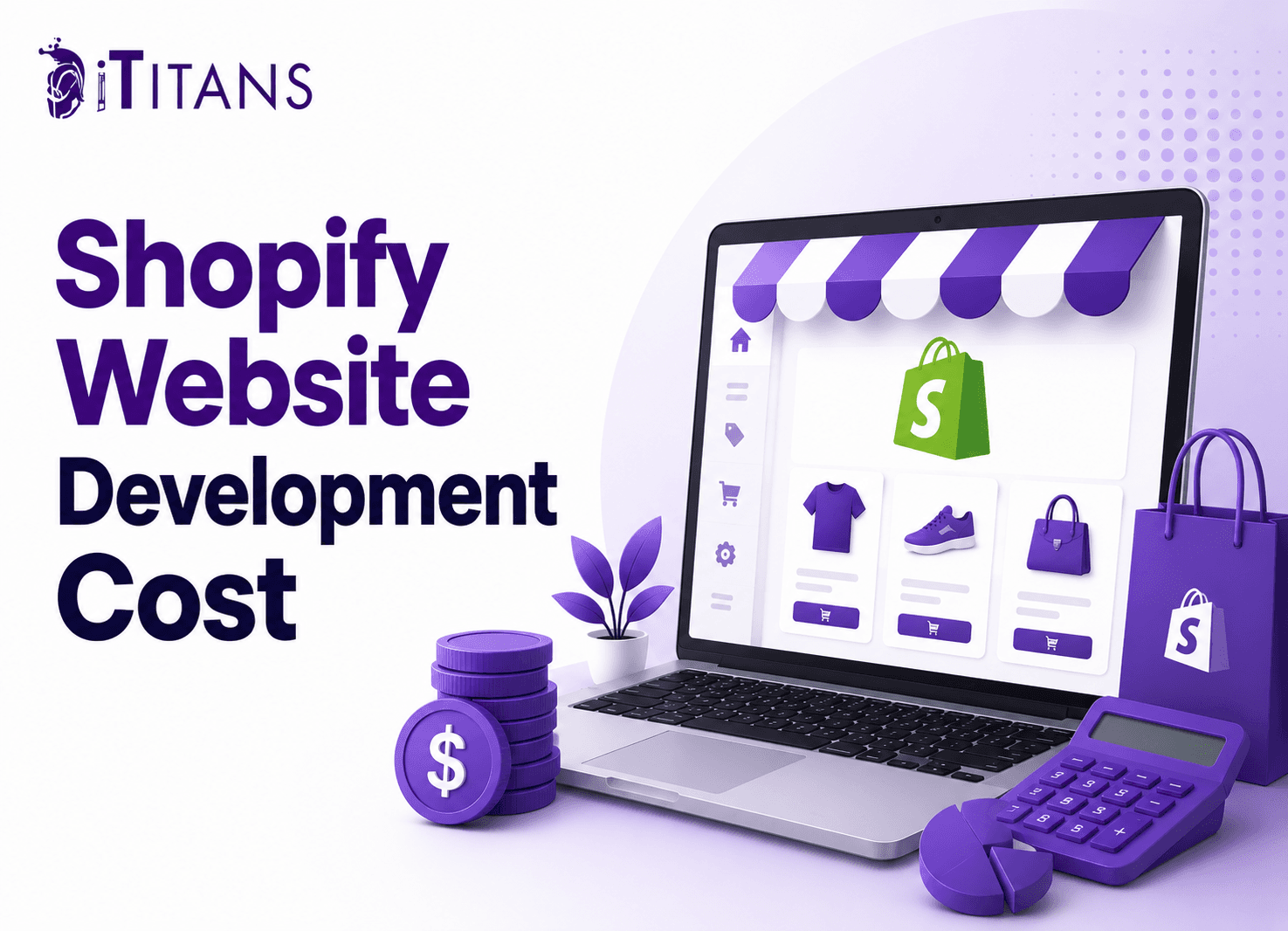
Shopify Website Development Cost in 2026: The Complete Pricing Guide
If you’ve been researching Shopify website development cost, you’ve probably found estimates ranging from a few hundred dollars to well over six figures. The variation isn’t because pricing lacks transparency, it’s because people often combine several separate expenses into one figure.
Your total investment includes Shopify’s monthly subscription, website design and development, premium themes, third-party apps, payment processing, ongoing maintenance, and SEO. Every business has different requirements, so costs naturally vary.
This guide separates each expense using current 2026 pricing, helping you understand what a basic Shopify store costs, when custom development becomes worthwhile, which factors influence pricing, and how to avoid unexpected expenses before your project begins.

Shopify Subscription Plans and Pricing for 2026
Before investing in design or development, you’ll need a Shopify subscription. As of 2026, Shopify offers five plans designed for different business stages. Annual billing reduces the three core plans by approximately 25% compared to monthly billing.
| Plan | Monthly Price | Transaction Fee (Shopify Payments) | Best For |
| Starter | $5/month | 5% | Selling via social, SMS, or a link-in-bio — no full storefront |
| Basic | $39/month | 2.9% + $0.30 online | New stores, solo entrepreneurs, under ~$1M GMV |
| Grow | $105/month | 2.7% + $0.30 online | Growing stores needing more staff accounts & reporting |
| Advanced | $399/month | 2.5% + $0.30 online | Scaling brands needing advanced reports & lower fees |
| Plus | From $2,300/month | Custom / negotiated | Enterprise brands needing B2B, custom checkout, and Functions |
One important consideration is payment processing. Businesses using a third-party payment gateway instead of Shopify Payments typically pay an additional 0.5%–2% transaction fee, which can significantly impact costs as sales increase.
Keep in mind that your Shopify subscription only covers the platform itself. Website design, custom development, migration, integrations, and SEO are separate investments that make up the majority of your overall budget.
Shopify Website Development Cost Breakdown
Beyond the Shopify subscription, your budget is divided into one-time development costs and ongoing operating expenses. The overall investment depends largely on your store’s complexity.
| Project Type | Typical Cost | Timeline | What’s Included |
| Basic store (premium theme) | $1,500 – $5,000 | 1–3 weeks | Theme customization, 10–50 products, standard checkout, basic SEO setup |
| Mid-size custom store | $8,000 – $25,000 | 4–8 weeks | Custom theme sections, app integrations, migration, on-page SEO, QA testing |
| Advanced/custom build | $25,000 – $75,000 | 2–4 months | Fully custom storefront, ERP/CRM integration, subscriptions, multi-currency |
| Enterprise (Shopify Plus) | $75,000 – $250,000+ | 4–8+ months | Headless commerce, B2B portals, custom checkout extensions, dedicated support |
These figures cover development and design only. To estimate your total investment accurately, you’ll also need to account for recurring operational costs.
Ongoing Monthly Costs to Budget For
Building your Shopify store is only the first step. Every business should also budget for ongoing operating expenses, including:
| Expense | Typical Cost | Notes |
| Shopify Subscription | $39–$399/month | Shopify Plus starts at $2,300+/month |
| Apps & Integrations | $50–$500+/month | Depends on your business needs and tech stack |
| Premium Shopify Theme | $150–$350 | One-time purchase if using a pre-built theme |
| Domain Renewal | $10–$20/year | Annual renewal fee |
| Website Maintenance & Support | $200–$2,000/month | Covers updates, fixes, and technical support |
| Payment Processing | 2.5%–2.9% + $0.30/transaction | Varies by Shopify plan and payment gateway |
Planning for these recurring costs from the beginning provides a more accurate picture of your total Shopify investment and helps prevent budget surprises as your business grows.
What Factors Affect Shopify Website Development Cost?
Two businesses can ask for a Shopify store and receive proposals that differ by tens of thousands of dollars. The difference isn’t the platform—it’s the scope of work. These five factors have the biggest impact on your total Shopify website development cost.
1. Store Complexity
The size and structure of your store play the biggest role in pricing. A catalog with 30 products and simple variants requires far less work than a store with thousands of SKUs, subscription products, bundled offers, wholesale pricing, or customer-specific catalogs. As complexity increases, so do development time, testing, and long-term maintenance.
2. Design Requirements
Using a premium Shopify theme is the most cost-effective option, with themes typically priced between $150 and $350. Businesses looking for a unique brand experience, custom layouts, advanced navigation, or interactive product pages should expect additional UI/UX design and development costs. Well-executed custom design improves usability and conversions—not just appearance.
3. Custom Features
Features beyond Shopify’s native functionality require custom development, increasing both project scope and testing time.
Common examples include:
- Customer portals and wholesale pricing
- Subscription and recurring billing
- Product configurators and quote tools
- Multi-vendor marketplace functionality
- Advanced search and filtering
4. Third-Party Integrations
Most growing businesses integrate Shopify with ERP systems, CRMs, inventory software, shipping providers, marketing platforms, or accounting tools. These integrations vary in complexity and should always be quoted separately, as they often become the largest source of unexpected development costs when overlooked.
5. Content and Data Migration
Migrating from WooCommerce, Magento, BigCommerce, or another platform involves much more than importing products. A complete migration includes customer accounts, order history, images, categories, URLs, SEO metadata, and properly configured 301 redirects. Skipping these steps can lead to traffic loss, broken links, and lower search rankings after launch.
Shopify Website Design vs. Shopify Development
Although often used interchangeably, Shopify web design and Shopify development are separate services with different objectives.
| Shopify Web Design | Shopify Development | |
| Focus | Customer experience | Technical functionality |
| Typical work | Branding, layout, navigation, typography, conversion optimization | Custom features, API integrations, payment setup, performance, cross-device reliability |
| Fails when… | The store looks confusing or off-brand | The store looks fine but breaks, lags, or can’t scale |
Successful Shopify projects invest in both. A visually appealing store won’t convert if it performs poorly, while technically sound development can’t compensate for a confusing customer experience.
What’s Included in Professional Shopify Website Development Services?
A complete Shopify website development services project typically follows five structured phases.
1. Discovery and Planning
Every successful project begins with understanding your business goals, products, customer journey, and technical requirements. Investing time in planning helps prevent scope changes, delays, and unnecessary costs later.
2. UX and Interface Design
This stage focuses on creating an intuitive shopping experience with clear navigation, mobile-friendly layouts, fast product discovery, and a streamlined checkout process—all essential for improving conversions.
3. Theme Development
Depending on your requirements, developers either customize an existing Shopify theme or build a fully custom storefront. Premium theme customization is ideal for many businesses, while custom development is better suited for unique workflows and advanced functionality.
4. Integration and Automation
Essential business tools—including payment gateways, email marketing platforms, shipping providers, customer support software, inventory systems, and ERP/CRM solutions—are integrated to create a connected ecommerce ecosystem.
5. Pre-Launch Quality Assurance
Before launch, every key function should be tested across devices and browsers. This includes checkout, payment processing, shipping calculations, page speed, responsiveness, and overall performance, ensuring customers enjoy a reliable shopping experience from day one.
Why Ecommerce Website Costs Vary Between Agencies
Many businesses are surprised when one agency quotes $5,000 while another estimates $25,000 for what appears to be the same Shopify project. In reality, the difference usually comes down to project scope rather than pricing strategy.
A 30-product store using a premium theme with minimal integrations is fundamentally different from a multi-currency store with thousands of products, ERP integration, advanced automation, and custom functionality, even though both run on Shopify.
When comparing proposals, don’t focus solely on the total price. Review exactly what’s included. Services such as migration, technical SEO, performance optimization, integrations, content upload, and post-launch support are often excluded from lower-cost quotes and later billed as additional work.
Real-World Shopify Website Cost Examples
The final Shopify website development cost depends on your business requirements. Here are two common examples.
Example 1: Startup Shopify Store
A startup selling around 35 products can launch on the Shopify Basic plan using a premium theme with light customization, essential apps, and basic SEO. The estimated one-time investment is approximately $3,500, with ongoing monthly costs of around $130, excluding payment processing fees.
Example 2: Growing Ecommerce Business
A retailer migrating 1,200 products from WooCommerce may require a semi-custom storefront, platform migration, ERP integrations, and technical SEO. In this case, the estimated one-time investment is approximately $21,000, with monthly operating costs of around $620, excluding payment processing fees.
Common Mistakes That Increase Shopify Development Costs
Many businesses overspend on Shopify projects because of avoidable planning mistakes.
The most common include:
- Expanding project scope after development has started, leading to rework and additional testing.
- Selecting apps before defining business workflows, resulting in duplicate tools and unnecessary subscription costs.
- Ignoring future growth, making international expansion or wholesale functionality expensive to implement later.
- Underestimating product content preparation, which delays development and extends project timelines.
- Treating SEO as a post-launch task instead of incorporating it during development.
Planning these areas early keeps projects on schedule and helps control both development and ongoing operating costs.
Freelancer, Agency, or Shopify Web Design Company: Which Should You Choose?
The right development partner depends on your project’s size and complexity.
A freelancer can be an excellent option for smaller Shopify stores with limited customization and straightforward requirements.
For larger projects involving platform migration, custom functionality, multiple integrations, or advanced design, a dedicated Shopify web design company typically provides greater value. Agencies combine designers, developers, SEO specialists, and QA professionals, reducing communication gaps and improving project accountability.
Before hiring any Shopify partner, ask:
- Have you built stores similar to my business model?
- Do you have experience migrating from my current platform?
- What post-launch support is included?
- How are change requests handled during development?
- What quality assurance process do you follow before launch?
The lowest quote isn’t always the best investment. Experienced teams often prevent costly problems before they affect your customers.
How to Budget for Shopify Website Development
A practical way to control costs is to separate essential launch features from future enhancements. This phased approach allows you to launch sooner while leaving room to scale as revenue grows.

When creating your Shopify budget:
- Prioritize launch-critical features before optional functionality.
- Reserve 10–15% of your budget for post-launch improvements based on user behavior and analytics.
- Treat subscriptions, apps, maintenance, and SEO as recurring operating expenses rather than one-time costs.
- Request itemized proposals so you can compare project scope instead of headline pricing.
Instead of focusing only on development costs, evaluate your total cost of ownership, including recurring software, payment processing, maintenance, and future growth. A transparent proposal should clearly separate one-time development, monthly subscriptions, app costs, and payment processing fees, helping you make informed decisions before signing a contract.
Shopify vs. Other Ecommerce Platforms
Shopify remains one of the most cost-effective ecommerce platforms because it combines hosting, security, platform maintenance, and scalability into a predictable monthly subscription.
Compared with open-source platforms such as WooCommerce or Magento:
- Hosting, security updates, PCI compliance, and infrastructure are included with Shopify.
- Open-source platforms often require separate hosting, ongoing maintenance, and technical support.
- Shopify’s app ecosystem enables businesses to add advanced functionality without extensive custom development.
- Enterprise brands requiring extensive customization can scale with Shopify Plus or headless commerce when needed.
For most small and mid-sized businesses, Shopify offers a lower total cost of ownership while reducing the technical overhead associated with maintaining a custom ecommerce platform.
Ready to Build a Shopify Store That Delivers Results?
At iTitans, we provide end-to-end Shopify website development services, including custom store design, platform migration, third-party integrations, and technical SEO.
Frequently Asked Questions
Is Shopify cheaper than building a custom ecommerce website?
For most small and mid-sized businesses, yes. Shopify includes hosting, security, platform updates, and infrastructure within its subscription, making the overall cost significantly lower than maintaining a fully custom-built ecommerce solution.
Why do Shopify development quotes vary so much?
Pricing depends on project scope. Factors such as custom functionality, design complexity, integrations, migration, SEO implementation, and post-launch support all influence the final cost. Compare what’s included—not just the total price.
Can I start with a basic Shopify store and upgrade later?
Absolutely. Many businesses launch on the Basic plan and gradually add automation, integrations, custom functionality, or higher-tier subscriptions as sales increase. Planning for future scalability makes upgrades much easier.
Does Shopify website development include SEO?
Not by default. While Shopify provides an SEO-friendly foundation, technical SEO—including metadata, structured data, site architecture, redirects, and internal linking—must be implemented as part of the development process.
How much should I budget for Shopify apps?
Most businesses spend between $50 and $500+ per month, depending on the number of paid apps used for reviews, email marketing, loyalty programs, subscriptions, analytics, and reporting.
Is a premium Shopify theme enough for a growing business?
For many businesses, yes. Premium themes work well for standard ecommerce stores. Companies with complex catalogs, unique customer journeys, or custom workflows often benefit from custom Shopify development as they scale.
What hidden Shopify costs should I expect?
The most commonly overlooked expenses include payment processing fees, premium app subscriptions, migration services, change requests during development, and ongoing website maintenance after launch.
How long does Shopify website development take?
A basic Shopify store built on a premium theme can typically launch within 1–3 weeks. Custom stores usually require 4–8 weeks, while advanced builds and Shopify Plus projects may take 2–8 months, depending on complexity.