
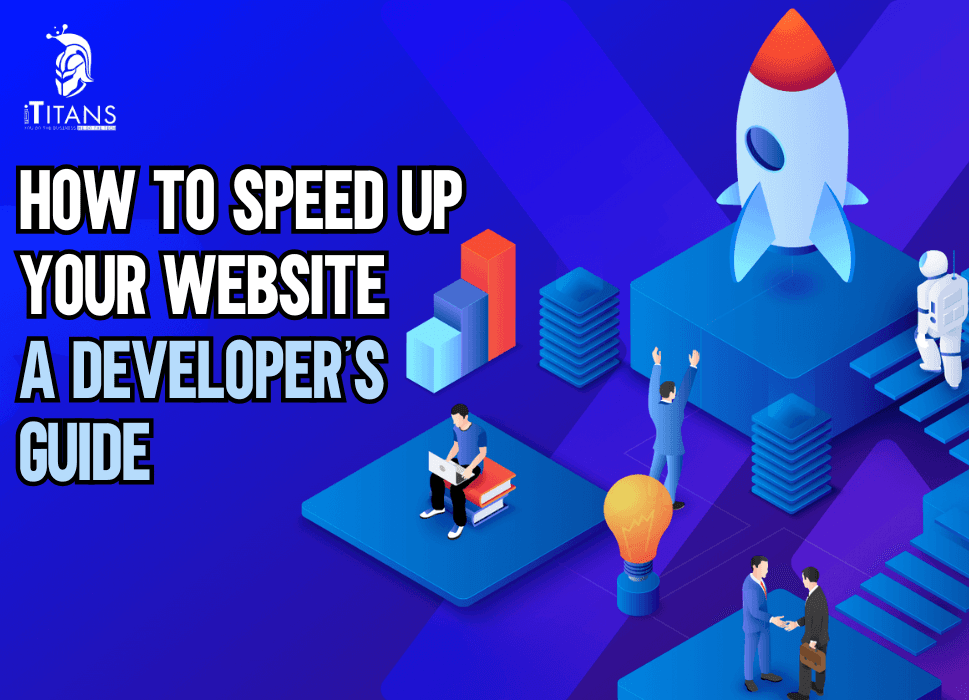
How to Speed Up Your Website | A Developer’s Guide for US-Based Brands
Is your website gaining visitors but not converting them into potential leads or customers? Then probably, your website is lacking the speed/performance element. Webpage speed and performance are very crucial for enhancing the user experience. If a website is slow, then the user can easily get frustrated and bounce off the web page. Besides losing visitors to the website, your business can also lose potential customers.
A website’s speed is also considered a ranking factor by search engines like Google, as it directly impacts the user’s experience. With fluently running, well-optimized websites, your customers will be less irritated and more satisfied. But how can developers increase a website’s speed? In this article, we are going to discuss how to speed up your website by following 9 effective tips.
1. Defer Loading Content
Ajax is a very helpful tool to build webpages that can update asynchronously anytime. With this addition, every time a user interacts with a certain part of the page, instead of reloading the whole page, the website will only update that certain section with which the user interacts.
This method is also called Lazy Loading, which is where developers can utilize jQuery, Prototype, and MooTools to enable deferred loading for the webpages much more easily. With asynchronous loading of a website’s content, the surfing speed becomes much quicker, and loading time decreases substantially.
2. Utilize External JS and CSS Files
When a user first loads any web page, the web browser caches external resources on priority like the CSS and JS files. Therefore, instead of inlining the Java and CSS files, it’s better to place them in external files. Using inline CSS can also increase the rendering time of web pages. But if you define everything in your CSS file, then it becomes easier for the browser to render the web page since it is already familiar with the styling and layout.
Besides improving the overall speed of the website, utilizing external JavaScript and CSS files makes it much easier for developers to maintain the website since all you have to do is maintain the external files that are scattered across multiple web pages.

3. Use the Cache System
If your website is connecting with the database every time when the web page has to generate the same type of content, then its time to utilize the cache system. With a cache system in place, your website will only have to generate the content once in the web browser instead of fetching the content every time a user interacts with it.
More popular content management systems like WordPress are best for business websites that utilize the static cache feature, which converts the dynamically generated images into static HTML files to avoid any unwanted server processing. If you are working on a WordPress website, check out the WP Super Cache extension that enables the cache system.
4. Do Not Resize Images in HTML
Let’s say you have to upload an image on your web page with 400x280px dimensions. But the original size of the image is 1280x900px. In this case, it’s better to resize the image using software like Adobe Photoshop instead of using the HTML’s resizing method, where we change the width and height attributes.
The reason why the HTML method is not effective is because the large image will always remain bigger in the file size as compared to the smaller image. Therefore, it is best to use software to resize the image instead of using the HTML method.
5. Avoid Using Images to Display Text
Using images to display text is completely unnecessary for SEO, and it also increases the load time for the webpage. Heavier images could take more time to load which ultimately becomes useless for your visitors if the image is not fetched properly. Moreover, heavier size images will take quite a while to load the readable content on the webpage.
Instead of images, its better to use custom fonts in your website to make the content visuals more appealing at first glance. Displaying text with custom fonts will keep the website running optimally without consuming loading time. And it goes without saying, always know when to use an image or text.
6. Optimize Image File Size
To save more on the loading times and make the webpage experience more optimal, it is better to optimize the image file size by picking the right format. This way, you won’t lose the image quality while it loads faster on the web page as well. For example, the JPG format often displays photographic images in a smaller file size.

7. Optimize the Code
Webpage loading speed can increase substantially if it can fetch the website code more effectively. This is the point where you have to look around your source code to remove any unnecessary tags or use CSS to help out with the display. Writing code efficiently can reduce the file size of HTML and CSS documents, allowing web pages to easily fetch data and making them easier to maintain.
8. Load Java Script at the End
To increase your website’s loading speed, its better to load the Java Scripts by the end of the document instead of the beginning. This small change will allow browser to render everything from the rest of the files before getting to the JavaScript file.
In this way, your web pages will become more responsive as the JS won’t block anything from loading anymore. A best practice is to place the JavaScript just before the closing body <body> tag of your HTML documents.
9. Utilize Content Delivery Network
The loading speed of a website varies on the user end depending on the distance from the web server on which your website is deployed. The farther your user is from the web server, the longer it will take the website to load on their end.
To make the loading speed more efficient, its better to distribute your content across multiple servers by placing the data strategically across multiple locations. Using a CDN may increase your operational costs but it will certainly give your website a boost of loading speed. Amazon S3 or Amazon Simple Service Storage is a prime example of this service.
Build Well-Optimized Websites With iTitans
iTitans has been serving as the leading software and website development company in the USA for past decade with a team of experienced developers who master the art of revamping the websites. By serving hundreds of small to large scale businesses in the USA, iTitans understands how to deliver a high quality website that performs well across all platforms. Here is how we build your high performance website:
Interactive Design Without Compromising Performance
At iTitans, our team of experts ensures that your website delivers a smooth and interactive experience without compromising on the design elements. Hence your users experience not only a high performance website but also an interactive design.
Website Ready for All Platforms
Web app developers at iTitans ensure to design of the website with desktop and handheld devices in mind. As a result, your audience will always get high performance across any web browser on any device without compromising the quality.
Post Launch Support
iTitans guarantees to deliver quality and excellence in the web app development services by providing post-launch support. By regularly updating designing and performing maintenance, we launch updates to ensure that your website remains up and running without facing any downtime.
FAQs
Which framework is best for designing a custom website?
React or PHP Laravel is two of the most popular yet trending website development frameworks that ensure your users get optimal performance. Moreover, these frameworks make it easier for developers to integrate complex features with proper integrations.
Does website speed matter for SEO?
Website speed is one of the secondary ranking factors considered by famous search engines as it is related to the user experience. With optimal performing websites, you can always deliver better experience than your competitors.
Can I hire a team of website developers from iTitans?
Yes! You can hire a team or a single developer to work on your website from iTitans.
Can iTitans improve the speed of my existing website?
It depends on the framework with which your website has been designed or the extensiveness of its features. Instead, our experts can also suggest migrating the website to a better performing framework without needing to build it from scratch.
Conclusion
Website speed heavily impacts the user experience and it also defines how many conversions your online platform is making from every visitor. By delivering faster loading speeds with the web pages, users won’t feel irritated to wait for the website to load. Moreover, it makes it much easier to access the website’s contents.
Want to get a high-performance custom website for your business? Contact iTitans now and enhance the customer experience for your audience with a fast loading authoritative website.