
Building HIPAA Compliant App Development Solutions | 10-Point Security Checklist
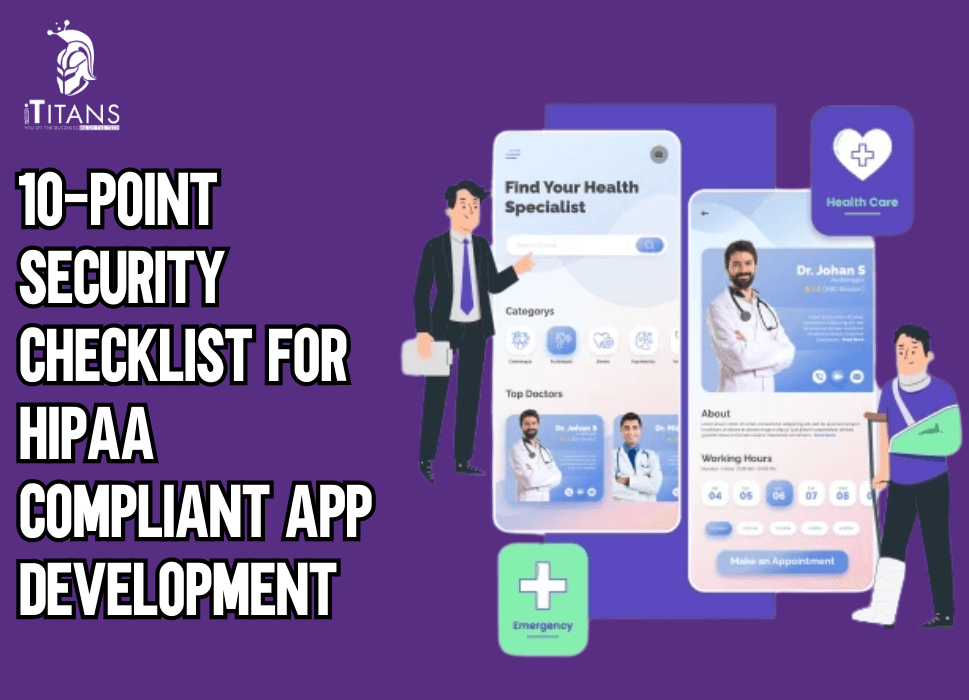
Healthcare founders do not lose sleep over design sprints or feature backlogs. They lose sleep over data breaches, compliance audits, and the possibility that one overlooked security flaw could destroy investor confidence overnight.
When you are building a digital health product, security is not a feature you “add later.” It is the foundation of HIPAA compliant app development, and without it, your roadmap, your funding, and your reputation are all exposed.
In the United States, healthcare data is protected under strict federal regulations. If your application handles Protected Health Information (PHI), you are legally obligated to meet the standards defined under the HIPAA Privacy Rule and Security Rule.
That applies whether you are launching a telemedicine platform, a remote patient monitoring system, a mental health app, or an internal care coordination tool. Understanding healthcare app HIPAA requirements early in the product lifecycle is not optional; it is a strategic necessity.
Many startups rush into development with offshore teams that claim compliance experience, only to discover months later that encryption was misconfigured, audit logging was incomplete, or Business Associate Agreements were never properly executed. Fixing those mistakes late in the cycle is expensive, slow, and credibility-damaging.
This guide walks through what HIPAA compliant software security really requires, and introduces a structured 10-point checklist that aligns legal mandates with engineering reality.

Why HIPAA Compliance Cannot Be an Afterthought
There is a persistent myth in early-stage health tech that compliance is something you “handle once you get traction.” That approach may work in social media or eCommerce. It fails catastrophically in healthcare.
Under HIPAA, any entity that creates, receives, maintains, or transmits PHI must implement Administrative, Physical, and Technical safeguards. For app developers, the technical safeguards are the most visible, but they are not isolated from policy and documentation requirements. If your architecture ignores access control, encryption at rest and in transit, or audit log integrity, you are not just risking a bug. You are risking regulatory penalties that can reach millions of dollars per incident.
For CTOs, the danger is often hidden in architecture decisions made under time pressure. A quick integration with a third-party messaging API that does not sign a Business Associate Agreement. A cloud storage bucket configured without proper encryption.
An authentication layer that does not enforce multi-factor verification for administrative roles. Each of these decisions may seem minor in a sprint review. In a compliance audit, they become critical failures.
Understanding mobile health app HIPAA standards requires a shift in mindset. You are not building a typical consumer app. You are building a regulated system that must prove, document, and continuously validate its security posture.
Understanding HIPAA: What Developers and Executives Must Know
Before diving into the 10-point checklist, leaders need clarity on what HIPAA actually governs.
The Three Core HIPAA Rules
HIPAA compliance revolves around three major components:
1. The Privacy Rule
The Privacy Rule defines how PHI can be used and disclosed. It focuses on patient rights, consent, and limitations around data sharing.
2. The Security Rule
The Security Rule outlines required safeguards for electronic PHI (ePHI). This is where most HIPAA app compliance best practices come into play, especially for software teams.
3. The Breach Notification Rule
This rule mandates how and when covered entities must notify individuals, regulators, and sometimes the media if a breach occurs.
For product owners, the Security Rule is often the most technically demanding. It is structured around three safeguard categories: Administrative, Physical, and Technical.
Administrative, Physical, and Technical Safeguards Explained
To align your roadmap with HIPAA security checklist for apps requirements, you must understand how these safeguards intersect with development.
Administrative Safeguards
These include risk analysis, workforce training, and formal policies governing access to PHI. Even the most secure codebase fails compliance if your organization cannot document how risks are assessed and mitigated.
Physical Safeguards
These relate to facility access, device controls, and workstation policies. If your development team uses unmanaged personal devices without proper controls, you introduce compliance gaps beyond your application code.
Technical Safeguards
This is where engineering teams spend most of their time. Technical safeguards include access control mechanisms, unique user identification, encryption, audit controls, and transmission security. These form the backbone of any HIPAA compliant app development strategy.
Ignoring any of these categories creates structural weaknesses. Compliance is systemic, not modular.
The Real Cost of Getting Compliance Wrong
Many founders approach HIPAA with a narrow question: “How much does compliance add to development cost?” The better question is: “What does non-compliance cost?”
Financial penalties for HIPAA violations vary based on severity and negligence. However, direct fines are often only part of the damage. Indirect costs can be more devastating:
- Loss of investor trust during due diligence
- Terminated enterprise contracts
- Mandatory third-party audits
- Forced system redesigns
- Reputational harm in a trust-sensitive industry
For startups seeking Series A or B funding, compliance posture becomes a due diligence checkpoint. Investors increasingly request documentation of risk assessments, encryption standards, and incident response plans.
If your team cannot demonstrate a structured approach to healthcare app security requirements under HIPAA, negotiations stall.
Worse, remediation often requires rewriting significant portions of your codebase. Retrofitting encryption, restructuring access control, or rebuilding logging systems late in the lifecycle inflates costs dramatically. It is far more economical to design with compliance in mind than to patch your way toward it.
Aligning Product Strategy with HIPAA from Day One
If you are asking, how to build a HIPAA compliant healthcare app, the answer is not simply “add encryption.” It begins at product conception.
Architectural Planning
Your system architecture must assume PHI sensitivity from the outset. This influences decisions around:
- Cloud providers and their willingness to sign Business Associate Agreements
- Data segmentation strategies
- Role-based access design
- API exposure and third-party integrations
When evaluating vendors, do not rely on marketing claims. Verify whether they explicitly support HIPAA workloads and provide contractual documentation.
Risk Assessment as a Continuous Process
One of the most overlooked requirements under HIPAA is documented risk analysis. Conducting a single compliance review before launch is insufficient. A proper HIPAA compliance checklist for healthcare software development includes recurring risk assessments tied to feature releases and infrastructure changes.
Founders often underestimate the documentation burden. Auditors expect evidence that you identified risks, implemented mitigation steps, and reviewed their effectiveness. This requires structured internal processes, not informal Slack discussions.
Secure Development Lifecycle
Incorporating security into your development lifecycle means:
- Secure coding standards
- Code reviews focused on PHI exposure risks
- Static and dynamic application security testing
- Regular penetration testing
Without these measures, you cannot credibly claim alignment with HIPAA compliant software security standards.
Business Associate Agreements: The Hidden Compliance Trap
Even technically sound applications can fail compliance due to contractual oversight.
If your app stores PHI on a cloud platform, uses third-party analytics tools, or integrates messaging services that access patient data, those vendors are considered Business Associates under HIPAA. You must execute a Business Associate Agreement (BAA) with each qualifying vendor.
Many startups mistakenly assume that using a well-known cloud provider automatically guarantees compliance. In reality, you must enable HIPAA-eligible services and formally sign the provider’s BAA. Overlooking this step undermines your entire compliance framework.
From a strategic standpoint, vendor selection should include legal review alongside technical evaluation. This is not administrative overhead; it is risk containment.

The 10-Point Security Checklist for HIPAA Compliant App Development
Compliance does not happen because your team reads a regulation PDF. It happens because you translate legal requirements into enforceable technical and organizational controls. This is where many startups fail. They treat compliance as a document rather than a system.
Below is the operational checklist every CTO and product leader should use when executing HIPAA compliant app development.
1. Formal Risk Analysis and Ongoing Risk Management
Every compliant system begins with documented risk analysis. This is not a one-time spreadsheet exercise. It is a structured evaluation of how PHI flows through your architecture, where vulnerabilities exist, and how those risks are mitigated.
A proper HIPAA risk assessment steps for app developers process includes:
- Identifying where PHI is created, transmitted, stored, and accessed
- Evaluating threat vectors such as unauthorized access, data leakage, insider misuse, and cloud misconfiguration
Assigning likelihood and impact levels - Documenting mitigation strategies and review timelines
Founders often skip this step because it does not produce visible product features. But without it, your compliance claim collapses during audit or investor due diligence.
Risk management must also be continuous. Every new feature, API integration, or infrastructure change should trigger a reassessment. Compliance is not static.
2. Access Control and Role-Based Authorization
Under HIPAA’s Technical Safeguards, access control is mandatory. Not optional. Not “best effort.”
Your application must ensure that only authorized users can access PHI, and that access is limited to the minimum necessary information. This is the core of healthcare app security requirements under HIPAA.
From an engineering perspective, this means:
- Unique user identification for every account
- Role-based access control (RBAC)
- Least-privilege design
- Automatic session timeouts
- Secure password policies
Administrative users represent a major risk surface. Too many early-stage teams grant broad database-level access to engineers or support staff. If those credentials are compromised, you face full exposure.
For startups asking about best practices for HIPAA secure app authentication, multi-factor authentication for privileged roles is no longer optional. It is expected.
3. Encryption of Data at Rest and in Transit
Encryption is one of the most visible components of HIPAA compliant software security, yet it is frequently misapplied.
Data in transit must be encrypted using strong TLS protocols. This covers communication between mobile apps and backend servers, internal microservices communication, and any API integrations.
Data at rest must also be encrypted. That includes:
- Databases
- Backups
- File storage
- Log files containing PHI
A common mistake in offshore development environments is enabling encryption at the infrastructure level but failing to configure it correctly for application-level storage or backups.
When evaluating cloud services for mobile health app HIPAA standards, verify that encryption is enabled and properly managed with secure key management practices. Poor key storage can undermine otherwise strong encryption.
4. Audit Logs and Activity Monitoring
If you cannot see what is happening inside your system, you cannot prove compliance.
HIPAA requires audit controls that record system activity involving ePHI. This includes:
- Login attempts
- Data access events
- Record modifications
- Administrative changes
A complete HIPAA security checklist for apps includes centralized logging, log integrity controls, and monitoring mechanisms that detect suspicious activity.
Audit logs must be tamper-resistant. Storing logs in the same unsecured database as application data is a critical mistake. Mature architectures isolate logging systems and implement restricted write access.
Monitoring is not just about storage. It requires alerting. If your system detects repeated failed login attempts or unusual data export activity, your team should be notified immediately.
5. Secure Hosting Infrastructure and Business Associate Agreements
Cloud infrastructure is central to most healthcare applications. But not every cloud configuration is HIPAA-eligible.
For compliant HIPAA compliant app development, your hosting provider must:
- Offer HIPAA-eligible services
- Sign a Business Associate Agreement
- Provide secure configuration guidance
It is not enough to select a major cloud provider. You must configure services correctly. Misconfigured object storage buckets remain one of the most common breach causes in healthcare startups.
Infrastructure as code helps reduce human error, but it must include security baselines. Security groups, firewall rules, and network segmentation should be deliberately designed to restrict unnecessary exposure.
6. Data Backup and Disaster Recovery Planning
Downtime in healthcare applications is more than inconvenient. It can disrupt patient care.
HIPAA requires contingency planning, including data backup and disaster recovery. For founders focused on product-market fit, this often feels premature. It is not.
Your HIPAA compliance checklist example for healthcare apps should include:
- Automated encrypted backups
- Regular backup integrity testing
- Documented recovery time objectives (RTO)
- Documented recovery point objectives (RPO)
Too many startups discover their backups were misconfigured only after a system failure. Testing recovery procedures is as important as creating backups.
7. Incident Response and Breach Notification Procedures
No system is immune to risk. What matters is how you respond.
Under the Breach Notification Rule, organizations must notify affected individuals and regulators within specific timelines if PHI is compromised. Without a documented response plan, chaos replaces coordination.
A strong incident response plan includes:
- Defined roles and responsibilities
- Internal escalation procedures
- Forensic investigation protocols
- Communication templates
- Legal and compliance coordination
If you are wondering, what happens if a healthcare app violates HIPAA, the answer includes regulatory investigation, public disclosure requirements, and potential civil penalties. Preparation reduces damage.
8. Workforce Training and Access Governance
Technology alone does not ensure compliance. Human behavior often introduces the greatest risk.
Administrative safeguards require workforce training on PHI handling, password hygiene, phishing awareness, and data access policies. Startups often overlook this because their teams are small. That is precisely when discipline matters most.
Access governance should include:
- Onboarding and offboarding procedures
- Immediate revocation of credentials upon role change
- Periodic access reviews
If a former contractor retains backend access to PHI, your technical safeguards become irrelevant.
9. Secure API Design and Third-Party Integrations
Healthcare apps rarely operate in isolation. They integrate with EHR systems, payment gateways, analytics platforms, and messaging services.
Each integration introduces new risk vectors. When asking how to secure healthcare app data under HIPAA, the answer must include API security practices such as:
- Token-based authentication
- Rate limiting
- Input validation
- Encryption enforcement
- Regular vulnerability testing
Third-party vendors accessing PHI require signed BAAs. Without them, your compliance posture is incomplete.
10. Continuous Testing, Validation, and Compliance Audits
Launching a compliant system is not the end of the journey. It is the beginning.
Continuous validation ensures your controls remain effective as your application evolves. This includes:
- Periodic penetration testing
- Vulnerability scanning
- Code reviews focused on PHI handling
- Updating risk assessments
For startups scaling quickly, feature velocity often outruns security review. That imbalance creates exposure.
True HIPAA app compliance best practices integrate compliance checkpoints into sprint cycles and release pipelines. Security becomes embedded in engineering culture, not bolted on after launch.
Turning Compliance Into Competitive Advantage
Founders sometimes view HIPAA as a regulatory burden. In reality, disciplined compliance becomes a trust signal.
Enterprise buyers and hospital systems increasingly demand proof of security maturity before signing contracts. Demonstrating structured HIPAA compliant app development processes reduces sales friction and accelerates procurement cycles.
Investors also scrutinize compliance posture. A documented 10-point security framework reassures stakeholders that your technical foundation supports long-term growth.
In the next section, we will examine common mistakes healthcare startups make when pursuing compliance, along with FAQ-ready insights that address high-intent search queries such as do all healthcare mobile apps need HIPAA compliance and how to test HIPAA compliance for an app.

Common HIPAA Compliance Failures That Derail Healthcare Startups
After working with healthcare founders and CTOs across multiple product stages, a pattern emerges. Very few teams fail because they intentionally ignored HIPAA. Most fail because they misunderstood scope, underestimated complexity, or trusted the wrong technical partner.
If you are building under pressure from investors and early adopters, it is easy to convince yourself that compliance can be “tightened later.” That belief leads to structural flaws that are expensive to correct.
Misunderstanding What Qualifies as PHI
One of the most frequent executive-level questions is: Do all healthcare mobile apps need HIPAA compliance?
The answer depends on whether the app handles Protected Health Information and whether it operates as a covered entity or business associate. PHI includes identifiers such as names, addresses, dates of birth, medical record numbers, appointment data, and even IP addresses when linked to health information.
If your platform collects symptom data tied to identifiable users, stores consultation notes, or transmits lab results, you are handling PHI. Assuming you are exempt because you are “just a startup” is not a defensible position.
Relying on Inexperienced Offshore Teams
Cost pressure often pushes startups toward offshore development teams that promise “HIPAA-ready” builds at aggressive rates. The problem is not geography. The problem is experience.
True HIPAA compliant app development requires architectural understanding, documentation discipline, and knowledge of regulatory nuance. Teams that have never navigated a compliance audit may implement surface-level encryption while ignoring audit logging, access governance, or risk documentation.
When deadlines slip and rework begins, the cost savings evaporate. Worse, technical debt compounds under compliance scrutiny.
Treating Security as a Feature Instead of a Framework
Another failure pattern appears when product teams treat security as a checklist item before launch. They enable TLS, implement password policies, and assume they are compliant.
But HIPAA requires documented policies, risk analysis, and ongoing evaluation. If you cannot show evidence of structured review cycles, your technical safeguards alone are insufficient.
For founders asking, how to test HIPAA compliance for an app, the answer extends beyond automated scans. It includes penetration testing, documented risk analysis updates, vendor contract verification, and policy reviews.
Ready to Build a Secure and Compliant Healthcare Platform?
If you are planning HIPAA compliant app development and want to avoid costly rework, failed audits, or security gaps, our team at ITitans can help you design, validate, and implement a complete compliance-ready architecture.
Schedule a consultation to review your infrastructure.
FAQs
1. Is end-to-end encryption enough to make an app HIPAA compliant?
No. Encryption is only one technical safeguard; HIPAA compliant app development also requires access controls, audit logs, risk analysis, BAAs, and documented policies.
2. Can AWS or Azure automatically make my healthcare app HIPAA compliant?
No cloud provider makes you compliant by default. You must configure HIPAA-eligible services correctly and sign a Business Associate Agreement.
3. Do wellness or fitness apps need to follow HIPAA rules?
Only if they handle Protected Health Information on behalf of a covered entity or business associate; purely consumer wellness apps may not fall under HIPAA.
4. How often should a healthcare startup perform a HIPAA risk assessment?
Risk analysis should be ongoing and updated whenever significant features, integrations, or infrastructure changes are introduced.
5. What is the biggest HIPAA mistake early-stage health tech startups make?
The most common mistake is delaying compliance architecture and attempting to retrofit security controls after launch, which increases cost and risk.
6. Are third-party APIs a HIPAA compliance risk?
Yes. Any vendor that accesses or processes PHI must sign a Business Associate Agreement and follow proper security safeguards.
7. Does storing data anonymously remove HIPAA obligations?
If data can be re-identified or linked back to individuals, it may still qualify as PHI and require HIPAA safeguards.
8. Can a healthcare app pass security testing but still fail HIPAA compliance?
Yes. Passing technical tests does not guarantee compliance if administrative safeguards, documentation, and policies are incomplete.