
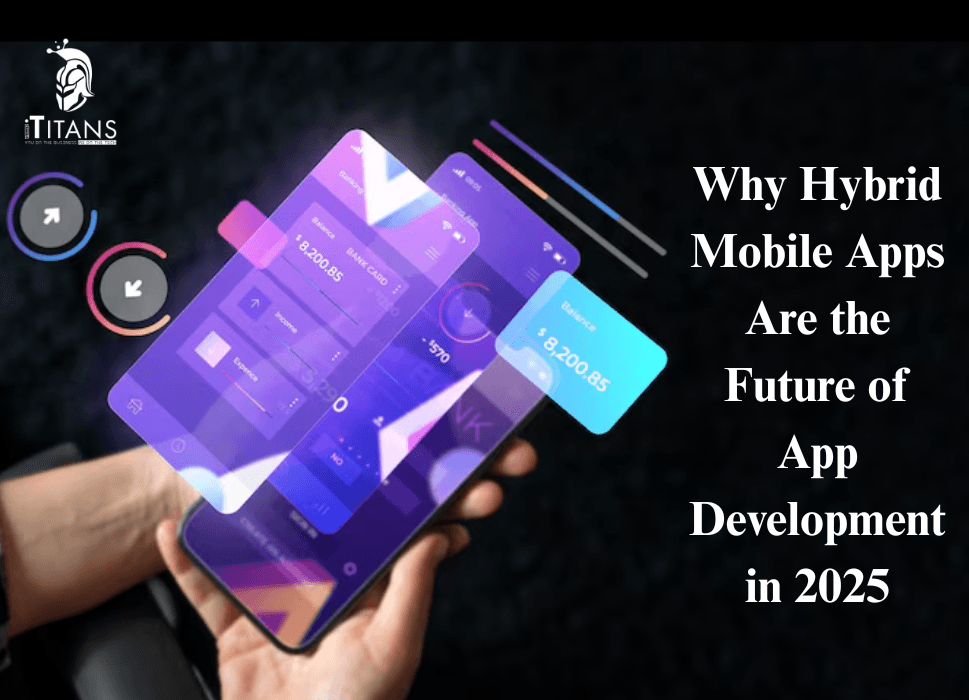
Why Hybrid Mobile Apps Are the Future of App Development in 2025
App development in 2025 doesn’t look like it did five years ago. Consumer expectations have matured. Whether startups or established brands, businesses are no longer just asking if they need a mobile app. They’re asking how quickly they can launch, how lean their tech team can be, and how to maintain one app across platforms without exhausting their budget.
For a long time, the debate was simple: Native meant performance; hybrid meant compromise. But that narrative has changed quietly, steadily, and convincingly. What used to be seen as a shortcut for MVPs has evolved into a serious, scalable, and flexible solution that businesses are actively choosing not because it’s cheap but because it simply works.
If you’re a decision-maker trying to make the smartest investment in mobile app development this year, it’s time to pay close attention to hybrid mobile apps, not as an alternative, but as the way forward.
What Are Hybrid Mobile Apps, Really?
Let’s clear something up first. When we say “hybrid app,” we don’t mean a half-baked solution. We’re talking about apps built using web technologies like HTML, CSS, and JavaScript, wrapped inside a native shell that lets them run across platforms like Android and iOS. One codebase. Two platforms.

Unlike native apps (which are written separately for Android and iOS using platform-specific languages like Swift or Kotlin), hybrid apps share a single codebase and rely on frameworks like:
- React Native
- Flutter
- Ionic + Capacitor
- Framework7
- NativeScript
Each of these offers different capabilities, but they all follow the same idea: code once, run anywhere, and access native features like camera, geolocation, or push notifications without reinventing the wheel twice.
It’s not just startups using hybrid anymore. Think Uber Eats, Instagram (parts of it), Sworkit, Discord, and even Twitter’s old mobile app infrastructure, they’ve all used hybrid or cross-platform technologies to build fast, responsive apps that reach millions.
Why Businesses Are Now Choosing Hybrid on Purpose
So why the shift? Why are businesses that once insisted on native apps now leaning into hybrid?
The short answer: Hybrid finally makes business sense. Here’s what’s driving the change.
Speed to Market
A hybrid app can be developed, tested, and deployed across both iOS and Android in almost half the time it takes to build two separate native apps. In 2025, where rapid iteration is key and markets move fast, getting your app into users’ hands quickly is more valuable than building a pixel-perfect native UI, especially if the performance gap is nearly invisible.
Budget Efficiency
Running two codebases means paying two teams or expecting your one team to stretch itself thin. With hybrid, you’re paying once for both platforms, and updates or bug fixes don’t double your workload or cost.
This is particularly important for small and mid-sized businesses who don’t have the luxury of massive development teams or infinite funding rounds. Hybrid apps allow them to stay competitive without burning through their budget in the first six months.
One Team, Fewer Headaches
When you’re managing one team working on one codebase, collaboration becomes smoother. Testing becomes easier. Product changes roll out faster. No more syncing two separate app builds across platforms.
And yes, the developer experience matters here too. Teams can work in technologies they already know (like JavaScript or Dart), which makes onboarding new devs or scaling up the team significantly easier.
Consistency in UX
You want your app to look and feel the same across platforms. Hybrid frameworks have matured to the point where you can build consistent user experiences without losing the native feel. That’s a big win for brand integrity and user satisfaction.

Performance: Still a Weak Spot or No Longer a Problem?
One of the loudest criticisms of hybrid apps used to be performance. And to be fair, that was true in the early 2010s. Clunky UIs, laggy interactions, and frustrating load times gave hybrid a bad reputation.
But we’re in 2025 now, and a lot has changed.
Frameworks Have Grown Up
React Native and Flutter, two of the most popular hybrid technologies, are no longer “new.” They’ve been battle-tested by thousands of apps and continuously improved with better compilers, rendering engines, and native integrations.
Flutter, for example, uses its own rendering engine, which gives developers precise control over how apps look and feel. React Native, on the other hand, bridges to native components seamlessly and has huge community support behind it.
Hardware and Network Speeds Help
Today’s smartphones are incredibly fast, and users are almost always on 4G or 5G networks. That means hybrid apps don’t face the same hardware limitations that caused performance issues in the past. Animations are smoother, screen transitions are seamless, and data-heavy tasks don’t feel sluggish.
When Native Still Wins
Let’s be clear: if you’re building a mobile-first 3D game, a real-time augmented reality app, or something where hardware-level performance is your top priority, native might still be the better call.
But suppose your app is content-focused, service-oriented, or based around user interaction, booking, messaging, shopping, etc.. In that case, hybrid will get the job done beautifully without making your project more expensive or slower to launch.
Real Talk: Users Don’t Know (or Care)
Your users don’t care whether your app is native or hybrid. They care about speed, simplicity, and whether the app works. If it does, you’ve won. If it doesn’t, it won’t matter what tech you used.
Developer and Maintenance Advantages of Hybrid in 2025
If you run a product team, you know the hardest part of scaling isn’t shipping version 1.0, it’s everything that comes after. Features pile up, deadlines crunch together, and suddenly the overhead of managing two native codebases turns routine updates into calendar-draining projects. Hybrid development changes that equation by letting one team cover both platforms with one codebase.
The benefit shows up first in people costs. A JavaScript or Dart crew can build, ship, and iterate on iOS and Android without splitting into siloed groups. That means no more coordinating two sprint boards, duplicating bug fixes, or rewriting the same feature twice.
Hiring becomes easier, too; JavaScript developers rank among the most common profiles on every major job board, and Flutter’s Dart language has crossed into the top 20 on GitHub for active repositories. When you need fresh talent, the market is there.
Maintenance also gets lighter. Let’s say Apple tweaks a permission flow in iOS 19 or Google changes background-execution limits in the next Android release. In a native setup you patch each version separately.
With a modern hybrid framework, you bump one dependency, run a single regression test suite, and push the fix to both stores, often in the same afternoon. Multiply that time-savings across dozens of minor OS updates each year and the operational upside becomes obvious.

Version control stays tidy as well. Instead of juggling parallel branches that drift out of sync, you’ve got one main branch where product, design, and QA collaborate. Everyone speaks the same language, literally, so communication friction drops. For a growing company, the cultural payoff can be as valuable as the financial one: fewer silos, quicker feedback loops, and a clearer sense of shared ownership.
And then there’s release cadence. Hybrid apps let you ship small, continuous improvements without the drama of coordinating dual release trains. Many teams now push updates every two weeks, or even weekly, because the overhead is low enough to make that pace sustainable. In markets where customer expectations shift fast, that agility is often the edge that keeps a brand in front.
Security, Offline Support, and Native Features: Debunking Old Limits
Critics used to claim hybrid apps couldn’t match native security or hardware integration. That argument has aged out of relevance. The leading frameworks now expose almost every device API through well-maintained plugins backed by Apple and Google’s own SDKs. Camera access, biometric authentication, NFC payments, Bluetooth beacons, if native can do it, hybrid can tap it.
Security first. Encryption libraries like CryptoJS, bcrypt, and platform-level Keychain or Keystore access are fully available through community-vetted wrappers. Compliance workflows have matured, too. Need HIPAA-grade data handling? Capacitor and React Native both support secure storage, certificate pinning, and encrypted SQLite out of the box.
With proper architecture, encrypted data at rest, TLS 1.3 in transit, role-based authentication, hybrid apps clear the same audits native apps face. Major banks and insurance providers are already shipping hybrid code in production; their risk teams wouldn’t sign off if the model were shaky.
Offline functionality is another area where hybrid has caught up. Progressive caching strategies (think Service Workers for web content inside the shell) combine with local databases such as Room, Hive, or SQLite to keep critical screens live even when the signal drops.
Grocery delivery apps now pre-cache cart data; field-service platforms let technicians sync job details once they’re back online. Users don’t care what framework makes that possible—they just appreciate an app that works when the elevator loses reception.
Performance and graphics? Flutter compiles to native ARM code and renders with Skia, bypassing the older WebView bottleneck entirely. React Native’s new architecture swaps its legacy bridge for a leaner, multi-threaded model that lifts animation FPS to native levels.
Games and high-frame-rate AR apps may still lean native, but for 95 percent of business cases—e-commerce, social, productivity, logistics—benchmark differences are now measured in milliseconds, not seconds.
Finally, consider push notifications and background tasks. Hybrid frameworks hook straight into Firebase Cloud Messaging, Apple Push Notification Service, and WorkManager. You can schedule background syncs, download updates, or trigger location-based alerts exactly as you would in Swift or Kotlin. The user experience is identical; the engineering workload is half.

Future-Proofing Your Tech Stack with Hybrid
We’re entering an era where devices fold, roll, and merge with wearables. New screen ratios and input modes appear every year, and maintaining perfect parity across them threatens to balloon budgets. A single hybrid codebase is inherently more adaptable: update your component library once, and your UI scales from a six-inch phone to a 12-inch foldable without recoding the logic twice.
Integration stories look brighter, too. Need on-device AI for voice commands? TensorFlow Lite plugins for Flutter or React Native can bundle those models inside the app. Want to add a watch companion or a car display? Shared business logic means you plug in a fresh UI layer instead of cloning the entire project. And because hybrid projects live in the same Git repository, automated tests can cover every form factor in one pipeline, catching regressions early.
The community momentum behind hybrid ecosystems ensures continued evolution. Google pours resources into Flutter; Meta keeps React Native advancing alongside its social products. Capacitor’s open governance brings steady plugin updates. For a business owner, that translates into reduced risk: if one framework stalls, forked community versions or migration guides keep you moving.
When Hybrid Might Not Be the Right Fit
No tech approach is perfect. While hybrid development fits the needs of most businesses, there are still edge cases where native development makes more sense. Here are a few:
- Graphics-heavy games – Think fast-paced 3D shooters or real-time AR games that require intense hardware optimization. Unity or Unreal is still your go-to there.
- Device-specific hardware integrations – Apps requiring very low-level access to hardware sensors, such as professional-grade camera apps or Bluetooth mesh networks for medical devices, may benefit from direct native SDKs.
- Ultra-custom animations – If your app relies heavily on nuanced, fluid transitions that define your brand (like Tinder’s swipe), it might be easier to get pixel-perfect results natively—though even that gap is closing quickly.
But for 95% of consumer and business apps? Hybrid delivers all the speed, access, and UI/UX you need, often at half the development cost and time.
How to Choose the Right Hybrid Framework
The top hybrid contenders in 2025 remain Flutter, React Native, and Capacitor. Here’s how to think about your choice:
Flutter
- Built by Google
- Uses Dart
- Great for pixel-perfect UI and custom designs
- Excellent performance (Skia rendering engine)
- Strong for startups building new apps from scratch
React Native
- Backed by Meta (Facebook)
- Uses JavaScript (or TypeScript)
- Massive developer pool
- Great community plugins and third-party tools
- Ideal for teams already using React on the web
Capacitor (by the Ionic team)
- Web-first mindset
- Works great for teams familiar with Angular, Vue, or standard web development
- Best for content-heavy or business apps with many shared components
There’s no universal “winner.” Pick based on your in-house team skills, long-term maintenance plans, and the complexity of your UI.

The Cost Equation: Why Hybrid Wins the Budget Game
Let’s talk dollars, because no mobile strategy conversation is complete without bringing the budget into focus.
When you build natively, you’re essentially building two separate apps: one for iOS, one for Android. That means two teams, two timelines, two codebases, and often double the cost.
Hybrid development flips that model. With one shared codebase, you’re:
- Slashing dev hours by up to 50%
- Speeding up time-to-market, especially useful if you’re testing MVPs
- Cutting QA and testing costs, since you’re debugging once, not twice
- Saving on long-term maintenance, because updates are deployed across platforms together
This matters most to SMBs and startups who can’t afford to waste time or money chasing perfection on two separate platforms. But even enterprises love this model, it reduces overhead and simplifies resourcing.
If you’re looking at a $150K native build, expect to do it for half to two-thirds the cost with a hybrid solution, without losing core performance or user experience.
The Talent Pool: Easier Hiring, Faster Scaling
Another advantage no one talks about enough? Hiring developers for hybrid frameworks is way easier.
Think about it: native iOS (Swift) and Android (Kotlin) developers are specialized, expensive, and harder to recruit. But React Native and Flutter developers?
- Huge global communities
- Cross-platform skill sets
- Plenty of freelancers and agencies available
- Easier onboarding for internal teams familiar with web technologies
If your goal is to scale or iterate fast, choosing a tech stack with accessible talent makes all the difference.
At iTitans, we’ve seen businesses struggle to find two strong native teams and delay launches for months. When they switch to hybrid, they’re able to build faster, scale smarter, and reduce HR headaches.
Why Hybrid Isn’t a Trend, It’s a Strategy
Hybrid development isn’t a passing phase. It’s becoming the new normal. Major frameworks are getting better every year, thanks to strong community support and major investments from companies like Google and Meta.
Here’s what makes hybrid a smart long-term strategy in 2025 and beyond:
- Platform updates? Hybrid tools adapt quickly. Flutter and React Native often support the latest OS features within weeks.
- Device evolution? Whether it’s foldables, wearables, or smart TVs, hybrid stacks are evolving to support these too.
- Scalability? You can easily plug in backend services, integrate with APIs, and scale to enterprise-grade deployments.
You’re not just building an app. You’re investing in a flexible, efficient way to keep your mobile product alive and evolving with minimal overhead.
So if you’re planning your roadmap for 2025 and beyond, going hybrid isn’t just a choice—it’s a move toward long-term agility.
Where It’s All Headed
Hybrid apps have passed the point of debate. They’re not a workaround or a compromise anymore. They’re a legitimate, mature, and often smarter choice for businesses that need to launch fast, iterate quickly, and reach users wherever they are—without doubling the effort or burning through budgets on parallel native builds.
In 2025, with tighter delivery timelines, rising engineering costs, and ever-changing device standards, hybrid development offers one of the clearest paths to sustainable product growth.
If you’re still wondering whether it’s the right move for your business, let’s talk. At iTitans, we’ve helped companies in retail, healthcare, logistics, and fintech make confident decisions about their mobile strategy.
Contact us today.
Related Posts