
Multi-Tenant SaaS Architecture: Shared Database vs Isolated Instances
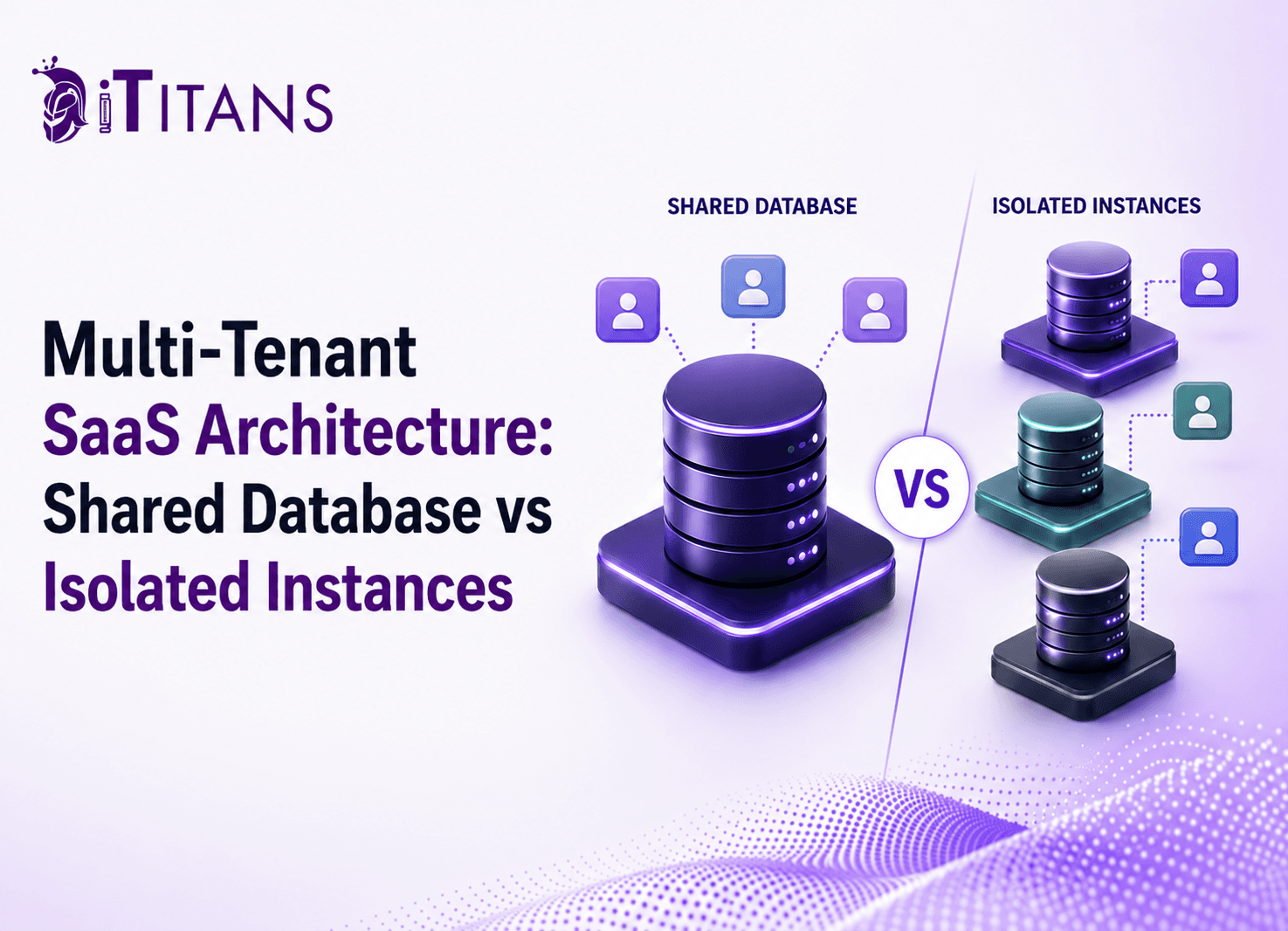
For a B2B SaaS company, choosing a multi-tenant SaaS architecture: shared database vs isolated instances is an architectural decision with direct consequences for security, infrastructure cost, scalability, deployment, customer onboarding, compliance, and engineering workload.
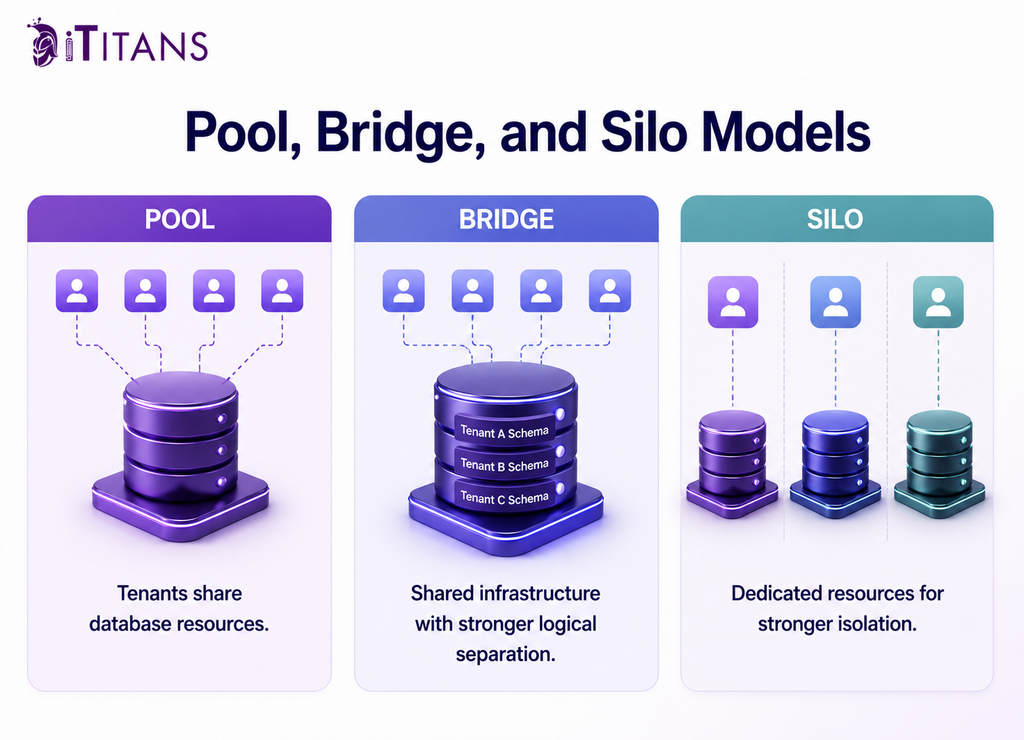
The choice is often presented as shared database versus separate database. In practice, the decision is broader. AWS groups SaaS isolation into three patterns: pool, bridge, and silo. A pool shares resources across tenants, a silo gives tenants dedicated resources, and a bridge combines the two approaches.
AWS also notes that regulatory requirements, noisy-neighbor behavior, customer tiering, cost efficiency, and legacy technology can influence which model makes sense.
What Is Multi-Tenant SaaS Architecture?
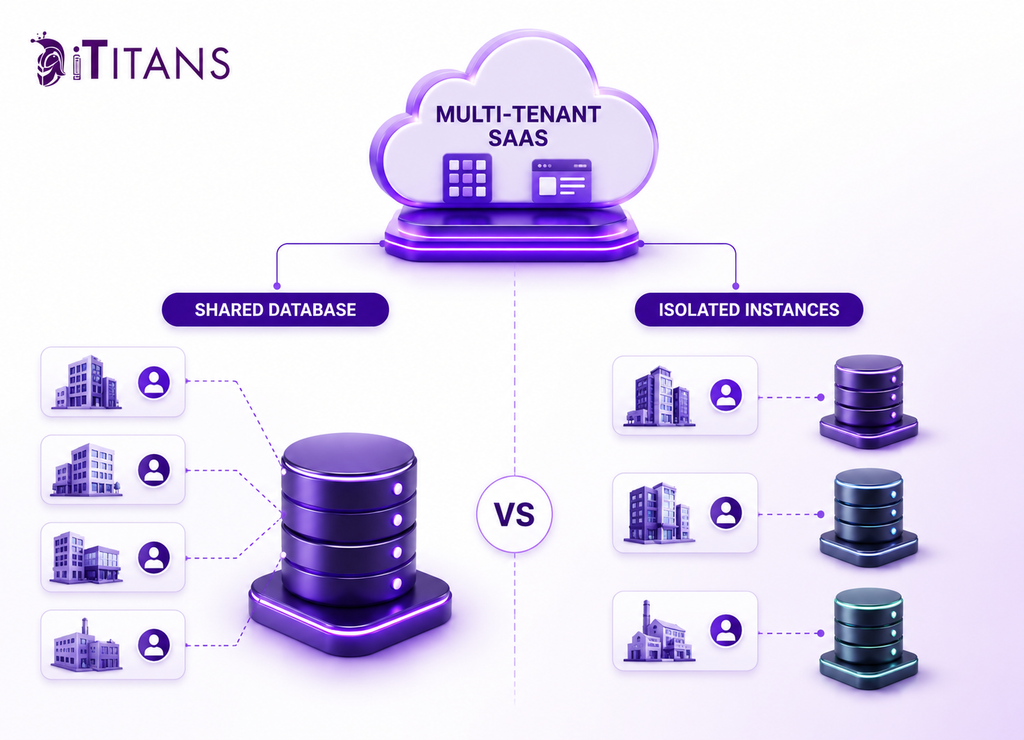
What is multi-tenant SaaS architecture? It is a software architecture in which one SaaS product serves multiple customer organizations, called tenants, while controlling access to each tenant’s data, configuration, resources, and workloads.
A tenant is normally a customer organization rather than an individual user. One tenant might have 20 employees, while another might have 20,000. Both can use the same SaaS product, but their data must remain isolated according to the access rules defined by the provider.
That makes tenant identity a core architectural concern. The application needs a reliable way to determine which tenant owns a request and then carry that tenant context through authentication, authorization, database queries, background jobs, APIs, reports, file operations, and administrative functions.
AWS identifies tenant identity as one of the foundational building blocks of SaaS architecture. Its guidance emphasizes designing isolation so that tenant boundaries are consistently enforced rather than depending on individual developers to remember isolation requirements for every feature.
Database architecture is therefore only one layer of the problem. A shared database does not automatically mean weak isolation, and a dedicated database does not automatically mean the entire SaaS platform is isolated.
A well-designed SaaS platform can share application infrastructure while separating sensitive data stores. It can also provide dedicated databases to selected enterprise customers while keeping the web and management layers shared. AWS describes this mixed approach as the bridge model.
This distinction matters because architecture decisions should follow actual business and technical requirements rather than the assumption that every tenant needs exactly the same infrastructure.
Shared Database vs Isolated Instances: How the Models Differ
Shared database vs isolated database for SaaS becomes easier to evaluate when the models are separated into their actual resource boundaries.
Shared Database Architecture
In a pooled architecture, multiple tenants use the same database instance and database objects. Tenant records are stored together, with a tenant identifier used to distinguish ownership.
For example, an orders table might contain records belonging to hundreds of organizations. Each record includes a tenant identifier, and application requests are expected to return only records belonging to the authenticated tenant.
AWS identifies this as the pool model. It can reduce infrastructure duplication and provide economies of scale because tenants share database resources.
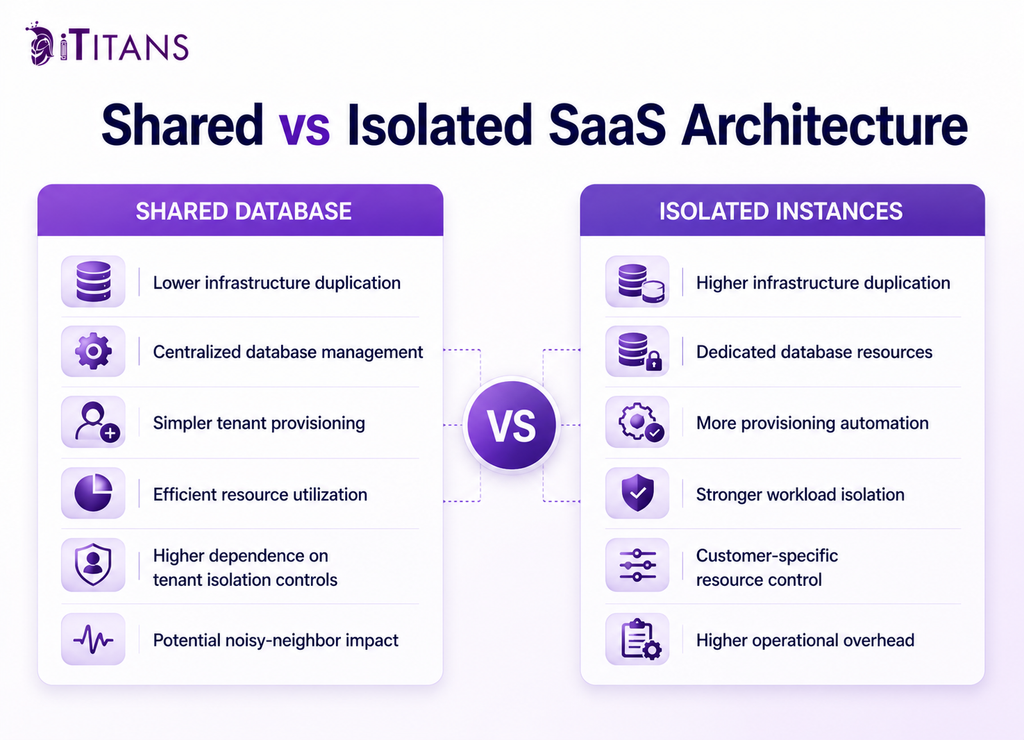
The advantage is operational efficiency. The engineering team manages fewer database resources, fewer infrastructure configurations, and fewer provisioning workflows. Database migrations can also be applied centrally rather than individually across every tenant database.
The risk is that tenant isolation becomes a critical control that must be enforced correctly.
If an application query retrieves records without applying the correct tenant restriction, data belonging to another organization can potentially become accessible. AWS specifically warns that shared models can place too much responsibility on application developers when isolation is enforced only through SQL conditions.
For PostgreSQL, row-level security can move an important part of tenant isolation into the database. AWS Prescriptive Guidance states that RLS is required for maintaining tenant data isolation in a pooled PostgreSQL model because the tenants do not have separate infrastructure, databases, or schemas.
Even then, RLS should not be treated as the only security measure. AWS recommends combining database policies with secure coding practices and explicit tenant filtering.
Isolated Database Instances
The silo model gives each tenant a dedicated resource boundary. In the database example, each tenant receives a separate database instance.
AWS describes this as the strongest isolation model among the three primary patterns, but also notes that it comes with higher infrastructure costs and more complicated tenant setup.
With dedicated databases, tenant data does not sit alongside another customer’s records in the same database. This can simplify certain security reviews, customer-specific backup requirements, database restoration, and workload isolation.
The tradeoff appears in operations. Every tenant database has to be provisioned, monitored, backed up, migrated, secured, and eventually retired. Without automation, database-per-tenant can turn onboarding into an infrastructure task rather than a product workflow.
The Bridge Model
Between pooled and siloed architectures is the bridge model.
A common implementation gives tenants separate schemas while allowing them to share the same database instance. AWS describes this pattern as a way to combine resource sharing with stronger logical separation.
The bridge model can also be applied at the service level. A SaaS platform may share its web tier while giving selected customers dedicated application or storage resources.
This flexibility becomes increasingly useful as a B2B SaaS product develops different customer segments.
| Architecture | Database boundary | Main advantage | Main tradeoff |
| Pool | Shared database and objects | Lowest resource duplication | Isolation requires strong controls |
| Bridge | Shared instance with separate schemas or resources | Balance between sharing and separation | More operational complexity |
| Silo | Dedicated database or stack | Strong tenant separation | Higher cost and provisioning effort |
The models are not mutually exclusive across an entire product. AWS explicitly recommends considering isolation at a more granular service level, especially when different services have different performance, regulatory, or cost requirements.
The Real Cost Difference Between Shared and Isolated SaaS Architecture
What is the best database architecture for multi-tenant SaaS? Cost is one of the most important factors, but infrastructure pricing alone does not answer the question.
A shared database reduces resource duplication. Instead of maintaining a separate database environment for every customer, the SaaS provider operates a common database infrastructure that serves many tenants.
That can be attractive during the early stages of a SaaS product when customer workloads are relatively small and similar.
However, shared infrastructure creates other costs that may appear later. Database queries have to remain efficient as tenant data accumulates. Indexes need to support important access patterns. Heavy workloads need to be controlled. Background jobs need tenant-aware processing. Reporting workloads may need separation from transactional workloads.
The financial calculation should therefore include engineering and operations, not just the monthly database bill.
A database-per-tenant design reverses part of that equation. Each tenant receives a separate database boundary, but provisioning and maintaining those databases becomes part of the SaaS operating model.
AWS explicitly identifies the additional infrastructure cost and tenant setup complexity associated with a separate database instance for each tenant.
Microsoft’s Azure SQL documentation provides an important alternative for teams considering database-per-tenant. Elastic pools allow multiple databases to share compute resources while retaining separate databases, and Microsoft states that this can improve cost efficiency while providing performance isolation between databases.
That illustrates why “shared versus isolated” should not be treated as a simple pricing comparison.
A company can have separate databases without assigning each database an entirely independent compute footprint. Likewise, a shared database can require additional infrastructure for caching, queues, replicas, monitoring, or workload isolation.
When calculating the architecture cost, account for:
- Database and compute resources
- Provisioning and onboarding automation
- Backup and restore operations
- Monitoring and alerting
- Database migration processes
- Engineering maintenance
- Incident response
- Customer-specific requirements
- Capacity planning
- Data export and deletion workflows
The correct architecture is the one whose total operating model fits the economics of the product.
Security and Tenant Isolation Are the Critical Decision Points
Security is where the difference between a convenient architecture and a safe architecture becomes most visible.
In a pooled database, tenant isolation cannot be treated as a naming convention. The system needs enforceable controls that prevent one tenant from accessing another tenant’s records.
Preventing Cross-Tenant Data Access
A common PostgreSQL approach is to store a tenant identifier with each relevant record and use row-level security to restrict which rows a database session can access.
AWS explains that RLS can compare a tenant identifier in a table with a value representing the current tenant. This allows the database itself to enforce access rules instead of depending entirely on application code.
However, AWS also notes that RLS implementation requires careful handling of the tenant context and should be combined with secure coding practices.
This matters because tenant boundaries extend beyond ordinary page requests.
A SaaS team should evaluate tenant isolation across:
- API endpoints
- Background workers
- Scheduled jobs
- Data exports
- Reporting systems
- File storage
- Caching
- Search indexes
- Messaging systems
- Administrative tools
A developer may correctly protect a customer dashboard while an export endpoint or background worker uses a different access path that lacks the same tenant restriction.
The database model should therefore be supported by a broader authorization strategy.
Managing Noisy Neighbors
Performance isolation is another major concern.
In a shared environment, one tenant can generate unusually heavy database activity. Large imports, expensive reports, high transaction volumes, or inefficient queries can compete for shared resources.
AWS specifically identifies noisy-neighbor behavior as a factor that can motivate dedicated infrastructure.
The response does not always need to be a dedicated database. Rate limits, workload controls, queue isolation, query optimization, resource quotas, and workload scheduling can address some cases.
Microsoft’s Azure SQL documentation provides another example through elastic pools, where multiple tenant databases share resources while the platform provides mechanisms for monitoring and managing performance at both pool and database levels.
The architectural question is therefore whether the tenant’s workload should compete for shared resources or receive a stronger performance boundary.
When Should a SaaS Use Isolated Database Instances?
When should a SaaS use isolated database instances? The answer becomes stronger when customer requirements justify the additional operating cost.
Compliance is one important consideration. Some enterprise customers may have requirements concerning data separation, access controls, audit processes, or infrastructure arrangements. AWS identifies compliance as one of the factors that can lead a SaaS provider toward siloed infrastructure.
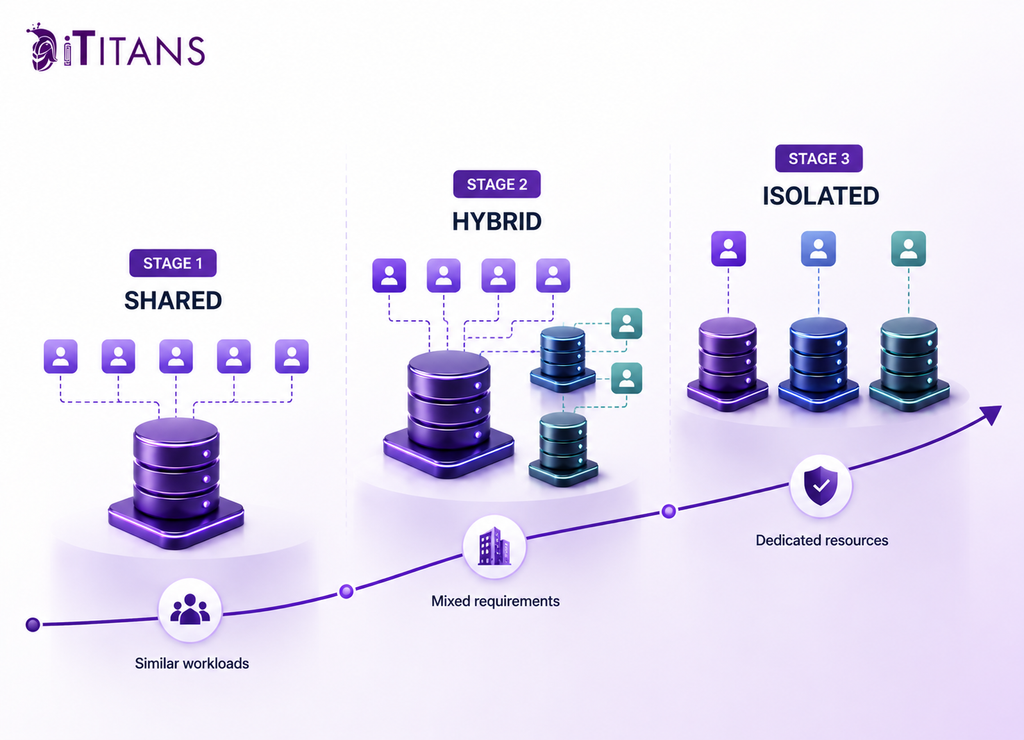
Customer tiering can also justify isolation. A SaaS company may offer pooled infrastructure to standard customers while providing dedicated resources to enterprise accounts.
This can turn architecture into part of the commercial model. Instead of paying the infrastructure cost of dedicated resources for every customer, the provider can reserve that model for customers whose contracts or workloads justify it.
Isolated databases can also make certain customer-specific operations easier. If a large enterprise needs a database restored to a particular point, exported independently, or handled according to a different operational policy, a dedicated database can reduce the complexity involved.
Performance is another consideration. When a tenant’s workload is materially different from the rest of the customer base, giving it dedicated database resources can reduce the potential impact on other tenants.
Still, isolated instances should not become the default simply because separation appears safer.
AWS states that siloed models provide stronger isolation but sacrifice some of the cost and operational efficiencies available from pooled infrastructure.
A useful decision test is whether the business requirement can be satisfied through logical controls and resource management. If it can, pooling may be appropriate. If the requirement demands a stronger resource boundary, isolation becomes more compelling.
How Scalability Changes the Architecture Decision
Scalability is often misunderstood as a question of how many tenants a database can technically support.
For a B2B SaaS, the more useful question is how tenant behavior changes as the customer base grows.
A hundred tenants with similar workloads create a different architecture problem from a hundred tenants where five customers generate most of the database activity.
The distribution of tenant size matters. So does data growth, transaction frequency, reporting behavior, retention requirements, and peak workload timing.
A pooled architecture can be highly efficient when tenants have relatively predictable workloads. Shared capacity can absorb variations across customers without requiring every tenant to receive resources sized for its individual peak.
Database-per-tenant can provide more control when workloads vary significantly. Microsoft documents how Azure SQL elastic pools can allow separate tenant databases to share resources while still providing database-level performance management. Individual databases can also be moved between pools when different resource requirements emerge.
This creates an important architectural option: separate the data boundary without necessarily creating completely independent infrastructure for every customer.
Scalability also affects migrations. A shared database may allow one migration to update every tenant, but that migration must be safe for every tenant simultaneously. A database-per-tenant architecture allows more tenant-specific control but requires migration orchestration across many databases.
Neither approach removes migration risk. It changes where that risk appears.
For founders and CTOs, the key planning question is how much operational automation the team is prepared to build. If tenant provisioning, migrations, backups, monitoring, and deprovisioning are manual, database-per-tenant becomes increasingly expensive to operate.
If these workflows are automated through infrastructure-as-code and centralized management services, the operational burden can be reduced substantially.
AWS emphasizes that even fully siloed SaaS environments should maintain unified onboarding, management, and operational processes rather than becoming a collection of manually managed customer installations.
That distinction is important. Dedicated resources do not mean every customer should receive a separately maintained version of the product.
Common Architecture Mistakes That Increase SaaS Costs
Architecture mistakes often become expensive because they are discovered after customers, integrations, and operational dependencies have accumulated.
One common mistake is choosing an architecture around an imagined future enterprise requirement before validating whether customers actually need it. A startup can spend engineering capacity building isolated infrastructure for customers who ultimately have no requirement for it.
The opposite mistake is also common: designing a pooled system without considering how selected customers could later move to stronger isolation.
A good architecture should leave room for controlled evolution.
Other problems include:
- Manual tenant provisioning that depends on engineers
- Database migrations that cannot be automated safely
- Tenant isolation implemented inconsistently across services
- No controls for unusually heavy tenant workloads
- Customer-specific infrastructure that creates permanent maintenance work
- Security decisions made separately by each development team
- Reporting and analytics workloads competing with transactional traffic
- No defined process for tenant backup, restore, export, or deletion
These problems can produce cost overruns without appearing on the initial infrastructure estimate.
They can also cause delayed launches. For example, if every enterprise customer requires a custom database configuration, onboarding becomes a project rather than a repeatable SaaS process.
Technical debt is especially dangerous when the original architecture does not support a clean transition between isolation levels. Retrofitting tenant boundaries after years of development can involve database migrations, application changes, API changes, testing, data movement, and operational redesign.
The architecture should therefore be judged not only by how well it works today, but by how easily the business can change its isolation strategy later.
How to Choose the Right Multi-Tenant SaaS Architecture
The decision should start with customer requirements rather than database preferences.
For each customer segment, evaluate the expected workload, data sensitivity, compliance requirements, performance expectations, recovery requirements, and commercial value.
| Requirement | Suitable starting approach |
| Similar workloads across customers | Pool |
| Strong logical tenant boundaries | Bridge or pool with database controls |
| Customer-specific database requirements | Silo |
| Enterprise tier requiring dedicated resources | Silo for selected tenants |
| Mixed customer requirements | Bridge or hybrid |
| Separate databases with shared capacity | Database-per-tenant with resource pooling |
The architecture can also differ between services. AWS specifically describes bridge architectures where some services are pooled and others are siloed according to their individual requirements.
That is often more practical than forcing the entire SaaS platform into one isolation model.
Questions CTOs Should Answer Before Choosing
Before implementation, the architecture review should establish:
- How many tenant types will the product support?
- What is the expected workload distribution between tenants?
- Which customer requirements are contractual?
- Which data requires stronger separation?
- How will tenant identity be propagated through every request?
- How will tenant provisioning be automated?
- How will database migrations operate at scale?
- How will noisy-neighbor behavior be detected?
- Can selected customers move from pooled to isolated resources?
- What happens when a tenant is suspended, deleted, restored, or exported?
These questions expose hidden operating costs before they become production problems.
For example, if enterprise customers may eventually require dedicated databases, the product should be designed so that tenant-specific connection management and data movement are possible without rewriting the entire application.
Likewise, if a pooled PostgreSQL architecture is selected, tenant isolation should be designed into the database access layer from the beginning rather than added after multiple teams have created independent query paths.
Choose the Right SaaS Architecture With iTitans
Your database architecture should match your customers’ security, scalability, compliance, workload, and operating requirements. iTitans can help you evaluate shared, schema-based, isolated, and hybrid approaches before costly architectural decisions become difficult to change.
Frequently Asked Questions
1. Should I use one database for all tenants or a database per tenant?
Use a shared database when tenants have similar workloads and standard isolation requirements, and choose a separate database when customers need stronger data isolation, dedicated performance, or specific compliance controls.
2. Is a shared database secure for a multi-tenant SaaS application?
Yes, a shared database can be secure when tenant isolation is enforced at every data-access layer. PostgreSQL row-level security can provide an additional database-level control for restricting tenant access.
3. What happens when one tenant becomes much larger than the others?
A large tenant can create a noisy-neighbor problem by consuming disproportionate shared database resources. Monitoring tenant workloads can help determine when that customer should move to dedicated resources.
4. Can I start with a shared database and move enterprise customers later?
Yes, SaaS companies can start with pooled infrastructure and move selected enterprise tenants to dedicated databases as their requirements change. Tenant-aware application and data architecture makes this migration easier.
5. Is database-per-tenant better for enterprise SaaS?
Database-per-tenant can provide stronger isolation and greater control over customer-specific requirements, but it also increases provisioning, migration, monitoring, backup, and maintenance responsibilities.
6. Does a separate database per tenant improve SaaS scalability?
A separate database can improve workload isolation, but scalability still depends on automating provisioning, migrations, connections, monitoring, backups, and recovery across tenant databases.
7. What is the middle ground between a shared and separate database?
A schema-per-tenant architecture provides separate database schemas while allowing tenants to share the underlying database infrastructure. It can offer stronger logical separation without the full infrastructure overhead of a database-per-tenant model.
8. How do I prevent a multi-tenant database from leaking customer data?
Enforce tenant ownership across database queries, APIs, background jobs, exports, and other data-access paths. Database controls such as row-level security can add another layer of protection against cross-tenant data access.