
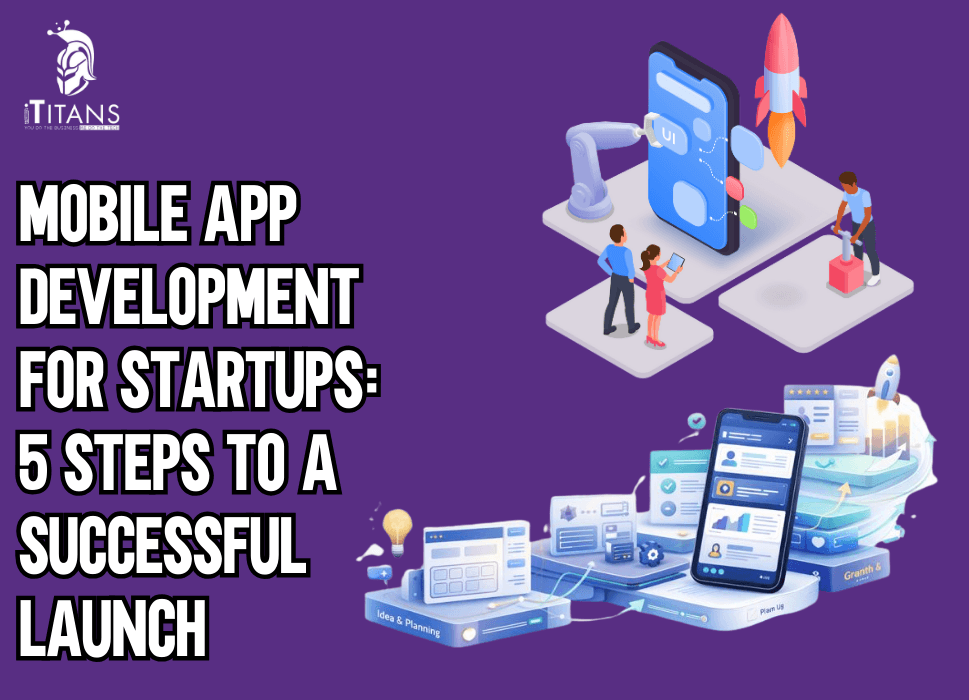
Mobile App Development for Startups | 5 Steps to a Successful Launch
For startups, a mobile app is not just a product. It is often the entire business model. One wrong decision in mobile app development for startups can burn months of runway, delay investor confidence, and push users toward competitors who moved faster and smarter.
What many founders get wrong is assuming that app success is tied only to features or design. In reality, success comes from planning, validation, execution, and launch discipline. Apps fail because founders rush development, skip validation, choose the wrong tech stack, or build features users never wanted in the first place.
Statistics consistently show that more than 90 percent of startup apps fail, not because the idea was bad, but because the execution ignored real-world constraints like budget, timelines, scalability, and user behavior. This is exactly where a structured mobile app development process becomes critical.

The Reality of Mobile App Development for Startups
Before jumping into development, founders need to face one hard truth: building an app is easy, building the right app is hard.
Most startups fail because they:
- Build too many features too early
- Ignore mobile app user acquisition strategies for startups
- Underestimate the cost of mobile app development
- Choose tools that do not scale
- Launch without a real mobile app launch checklist
A successful startup app is not the most complex one. It is the one that solves one clear problem better than anyone else.
This is why every successful startup follows a structured mobile app development timeline for startups, instead of random development sprints.
Step 1: Define the Problem, Not the App
Why This Step Matters More Than Code
The first and most important step in mobile app development for startups is not choosing a framework or hiring developers. It is defining the problem your app solves.
Many founders start with “We want an app that does X, Y, and Z.”
Successful founders start with “Users struggle with this exact issue.”
If the problem is unclear, no amount of features will save the app.
Identify a Single Core Pain Point
Every winning startup app begins with one sharp pain point. Not a vague inconvenience. A real problem that users actively want solved.
Ask yourself:
- What task frustrates users today?
- What are they currently doing to solve it?
- Why is that solution slow, expensive, or inefficient?
This clarity sets the foundation for startup MVP app development.
Validate Before You Build
Validation protects your budget and timeline. Before writing a single line of code, startups should validate demand using low-cost methods such as:
- Landing pages
- Surveys
- User interviews
- Clickable mockups
This step directly impacts how much does a startup app cost to build, because validated ideas reduce rework.
Skipping validation is one of the biggest reasons founders later complain about wasted development budgets.
Define Your MVP Scope Clearly
Your MVP is not a smaller version of your final app. It is a problem-solving version.
A strong MVP answers three questions:
- Does the user understand the app instantly?
- Does it solve the main problem effectively?
- Will users come back after the first use?
This approach aligns directly with MVP mobile app development tips used by high-growth startups.
Avoid adding features that feel “nice to have.” Every feature must justify its existence.
Align MVP With Business Goals
A startup app must serve business goals, not just users. At this stage, founders should define:
- Monetization logic
- Growth strategy
- Engagement goals
This ensures the app supports mobile app marketing for startups from day one.
Set Clear Success Metrics
Without metrics, you are guessing. Before development begins, define:
- User activation goals
- Retention benchmarks
- Conversion actions
These metrics guide product decisions throughout the mobile app development process.
Understanding the Cost and Timeline Early
One of the most searched questions is how much does a startup app cost to build, and the honest answer is: it depends on clarity.
Apps with a clear MVP, defined scope, and validated problem always cost less and launch faster.
Key cost drivers include:
- Feature count
- Platform choice (iOS, Android, or both)
- Backend complexity
- Third-party integrations
Understanding this early helps founders plan realistic mobile app development timelines for startups.
Laying the Foundation for Step 2
Once the problem is defined and validated, startups are ready to move into planning and technical decisions.
This includes:
- Choosing between native and cross-platform
- Selecting frameworks
- Defining backend requirements
- Planning scalability
These decisions form the backbone of best frameworks for startup app development and determine whether the app grows smoothly or struggles later.
We’ll break this down in the next section.
Step 2: Planning the Mobile App Development Process the Right Way
Once the problem is defined and validated, startups enter the most underestimated phase of mobile app development for startups: planning. This is where many founders quietly lose control of budget, timelines, and product direction.
Planning is not about documentation. It is about decision clarity.
Choosing the Right App Type: Native vs Cross-Platform
One of the first decisions in the mobile app development process is choosing how the app will be built.
Native App Development
- Built separately for iOS and Android
- Strong performance and smoother user experience
- Higher development and maintenance cost
Native apps work best when:
- Performance is critical
- Hardware access is required
- Long-term scalability is a priority
Cross-Platform App Development
- Single codebase for multiple platforms
- Faster development
- Lower upfront cost
This option is popular in startup MVP app development because it allows faster validation without doubling costs.
Founders often ask which approach is “better.” The real answer depends on:
- MVP scope
- Budget
- Speed-to-market requirements
Choosing wrong here can impact the mobile app development timeline for startups by months.
Selecting the Best Frameworks for Startup App Development
Framework selection directly affects speed, cost, and scalability. Startups should choose tools that balance flexibility with reliability.
Popular choices include:
- React Native for faster MVP launches
- Flutter for consistent UI across platforms
- Swift or Kotlin for native performance
The key is not choosing what is trending, but what supports:
- MVP iteration
- Future updates
- Team scalability
This decision also impacts how to develop an app for a startup step by step, because frameworks dictate workflow.
Backend Architecture: Build Only What You Need
Startups often overbuild backend systems before they have users. This is a costly mistake.
A smart backend setup focuses on:
- Authentication
- Data storage
- Basic analytics
- API structure
Complex microservices can come later. Early-stage apps should prioritize stability over complexity to reduce mobile app development costs.
Planning for Security Without Overengineering
Security must exist from day one, but startups do not need enterprise-level systems initially.
Essential security considerations include:
- Secure authentication
- Encrypted data transfer
- Basic role-based access
Ignoring security early leads to painful fixes later and affects trust during mobile app launch strategy execution.
Setting a Realistic Mobile App Development Timeline for Startups
Timelines fail when founders assume “development starts after planning.” In reality, planning is development.
A realistic timeline includes:
- 2–4 weeks for planning and architecture
- 8–12 weeks for MVP build
- 2–3 weeks for testing and fixes
Rushed timelines almost always result in:
- Feature bloat
- Bugs
- Delayed launches
This is why structured planning is essential in mobile app development for startups.

Step 3: Build the MVP With Focus, Testing, and Feedback
This is where most startup apps either gain momentum or quietly collapse.
The goal of startup MVP app development is not perfection. The goal is learning.
What an MVP Should and Should Not Be
A strong MVP should:
- Solve one problem clearly
- Be easy to understand
- Collect user behavior data
An MVP should NOT:
- Include advanced personalization
- Support every edge case
- Compete feature-for-feature with large apps
Ignoring this principle leads to delays and inflated cost of mobile app development.
Feature Prioritization That Actually Works
Founders should prioritize features using this rule:
If a feature does not help users complete the core action, it waits.
This discipline keeps the MVP lean and aligns with proven MVP mobile app development tips.
Common MVP features include:
- User onboarding
- Core action flow
- Basic notifications
- Simple analytics
Everything else can come after validation.
Building for Iteration, Not Finality
One major difference between startup apps and enterprise apps is iteration speed.
Your MVP should be easy to:
- Update
- Improve
- Adjust based on feedback
This flexibility is essential for applying agile app development for startups, where feedback drives progress.
Testing Is Not Optional for Startups
Skipping testing is one of the fastest ways to destroy early trust.
MVP testing should cover:
- Core user flows
- Login and sign-up
- Payment flows (if applicable)
- Performance on multiple devices
This step reduces negative reviews during mobile app launch strategy execution.
Collecting Feedback the Right Way
After MVP testing, startups must actively collect feedback using:
- In-app prompts
- Early user interviews
- Analytics tools
Feedback should focus on:
- Confusion points
- Drop-off stages
- Feature requests
This data shapes future development and supports mobile app user acquisition strategies for startups.
Preparing for Launch While Still Building
Smart startups prepare for launch during MVP development, not after.
This includes:
- App store descriptions
- Screenshots
- Keyword research for ASO
- Early marketing messaging
This preparation directly impacts how to launch a mobile app successfully.
Why Steps 2 and 3 Decide Long-Term Success
Many startups believe growth problems come after launch. In reality, growth problems start during planning and MVP development.
- Poor framework choices slow updates.
- Overbuilt systems waste budget.
- Unfocused MVPs confuse users.
When mobile app development for startups follows a disciplined approach, the app launches faster, costs less, and adapts better.
Step 4: Build a Mobile App Launch Strategy That Gets Real Users
A launch is not a button you press. It is a process you prepare for weeks in advance. Many startups invest heavily in mobile app development for startups and then quietly launch without visibility, traction, or feedback.
A successful launch is not about going viral. It is about getting the right first users.
Why Most Startup App Launches Fail
Startup app launches fail because:
- No pre-launch audience exists
- App Store Optimization is ignored
- No clear value proposition is communicated
- User onboarding is confusing
This is where a structured mobile app launch strategy becomes essential.
Pre-Launch Preparation That Actually Matters
Before submitting your app to the App Store or Play Store, make sure the following are in place:
- Clear app positioning
- Simple onboarding flow
- Defined success action (signup, booking, order, etc.)
- Analytics tracking
This groundwork directly supports how to launch a mobile app successfully.
App Store Optimization Is Not Optional
ASO determines whether users discover your app organically.
Key ASO elements include:
- App title and subtitle
- Keyword-rich description
- High-quality screenshots
- Clear feature explanation
Using phrases related to mobile app development process, startup MVP app development, and problem-focused messaging improves discoverability.
Ignoring ASO leads to low impressions even if the app is solid.
Build Early Trust With Social Proof
Early users are cautious. To reduce friction:
- Add early testimonials
- Highlight beta user feedback
- Show numbers where possible
Trust accelerates downloads and supports mobile app user acquisition strategies for startups.
Soft Launch Before Full Release
A soft launch allows startups to:
- Monitor real usage
- Fix critical issues
- Improve onboarding
Launching in a limited region or to a specific audience reduces risk and improves feedback quality.
This step is often skipped but plays a major role in mobile app development timeline for startups.
Create a Mobile App Launch Checklist
A simple mobile app launch checklist should include:
- App store approval readiness
- Crash-free testing
- Analytics verification
- Customer support setup
- Marketing assets prepared
Founders who follow a checklist avoid rushed launches and bad first impressions.
Step 5: User Acquisition, Retention, and Scaling After Launch
Launching the app is not success. Retaining users is.
Most startup apps lose users within the first week because retention planning is ignored during mobile app development for startups.
User Acquisition Starts With One Channel
Do not spread efforts across ten channels. Start with one that matches your audience.
Examples:
- Content marketing for B2B apps
- Paid ads for consumer apps
- Community-driven growth for niche platforms
This focus improves efficiency and supports mobile app marketing for startups.
Onboarding Is Your First Retention Tool
Users decide whether to stay within minutes.
Strong onboarding should:
- Explain value quickly
- Reduce steps
- Guide users to the core action
If users don’t reach value fast, they leave. This is one of the biggest hidden killers of startup apps.
Retention Comes From Habit, Not Features
Retention improves when apps:
- Solve recurring problems
- Use reminders thoughtfully
- Offer consistent value
Features do not retain users. Outcomes do.
This mindset separates apps that grow from those that stall.
Measure What Actually Matters
Vanity metrics mislead founders.
Focus on:
- Daily active users
- Retention rate
- Conversion events
- Drop-off points
These metrics guide improvements and support long-term mobile app development process decisions.
Iterate Based on Data, Not Opinions
Post-launch development should be driven by:
- Usage data
- Real feedback
- Behavior patterns
This aligns perfectly with agile app development for startups, where iteration replaces assumptions.
Scaling the App Without Breaking It
Scaling should only happen after:
- Core feature validation
- Stable retention
- Predictable acquisition
Scaling too early increases cost of mobile app development and technical debt.
Smart scaling includes:
- Backend optimization
- Feature expansion based on demand
- Performance improvements
This approach keeps growth sustainable.

Common Mistakes Startups Must Avoid
Even strong ideas fail when execution slips.
Avoid these mistakes:
- Building too many features: Wastes budget, delays launch, and confuses users instead of solving problems.
- Ignoring user feedback: Leads to irrelevant features and poor retention after initial downloads.
- Overcomplicating architecture: Increases costs, slows updates, and creates scaling problems early.
- Delaying marketing until after launch: Results in low visibility, weak traction, and slow user acquisition.
- Each mistake adds friction and slows momentum: Small errors compound quickly, reducing growth speed and market impact.
Ready to Build a Startup App That Actually Works?
If you’re planning your next app or refining an existing one, ITITans can help you navigate every stage of mobile app development for startups, from idea to launch and beyond.
Build with clarity. Launch with confidence. Grow with purpose.
FAQs
1. How long does mobile app development for startups usually take?
The timeline depends on MVP scope, but most mobile app development for startups takes 10–16 weeks from planning to launch. Apps with unclear requirements often take longer due to rework and scope changes.
2. What is the biggest mistake startups make during MVP app development?
The most common mistake in startup MVP app development is adding too many features before validating user demand. This increases cost, delays launch, and reduces early user adoption.
3. Should startups choose native or cross-platform app development for their MVP?
Cross-platform is often better for mobile app development for startups because it reduces cost and speeds up launch. Native development works best when performance or hardware access is critical.
4. How much does it cost to build a mobile app for a startup MVP?
The cost of mobile app development for a startup MVP typically ranges based on features, platforms, and backend needs. Clear planning and a focused MVP can significantly reduce unnecessary expenses.
5. What should be included in a mobile app launch checklist for startups?
A solid mobile app launch checklist includes testing, analytics setup, onboarding flow, ASO assets, and support readiness. Skipping any of these increases the risk of poor early reviews.
6. How can startups get their first users after launching an app?
Early users usually come from focused mobile app user acquisition strategies for startups, such as niche communities, targeted ads, or early-access campaigns. Broad marketing too early often wastes budget.
7. Why do most startup apps struggle with user retention after launch?
Retention drops when onboarding is confusing or value is not delivered quickly. Successful mobile app development for startups prioritizes fast value discovery in the first user session.
8. When should a startup start scaling its mobile app?
Scaling should only begin after stable retention and consistent user behavior are achieved. Premature scaling increases technical debt and long-term mobile app development costs.