
Manual QA vs Automated Testing: Where the Break-Even Point Really Sits
For B2B software companies, the decision between manual QA and automated testing is not simply about speed. It is a financial decision involving release frequency, labor, maintenance, product stability, and risk. The key question is when should you automate testing so that the investment actually pays back.
The U.S. Bureau of Labor Statistics reported a median annual wage of $104,300 for software quality assurance analysts and testers in May 2025, before benefits and other employer costs. Meanwhile, research involving Siemens and Saab found that verification and validation can account for 20% to 50% of software development costs.
Automation can reduce repeated execution work, but only when its development and maintenance costs remain below the value it replaces.
Manual QA vs Automated Testing: The Cost Structure Is Different
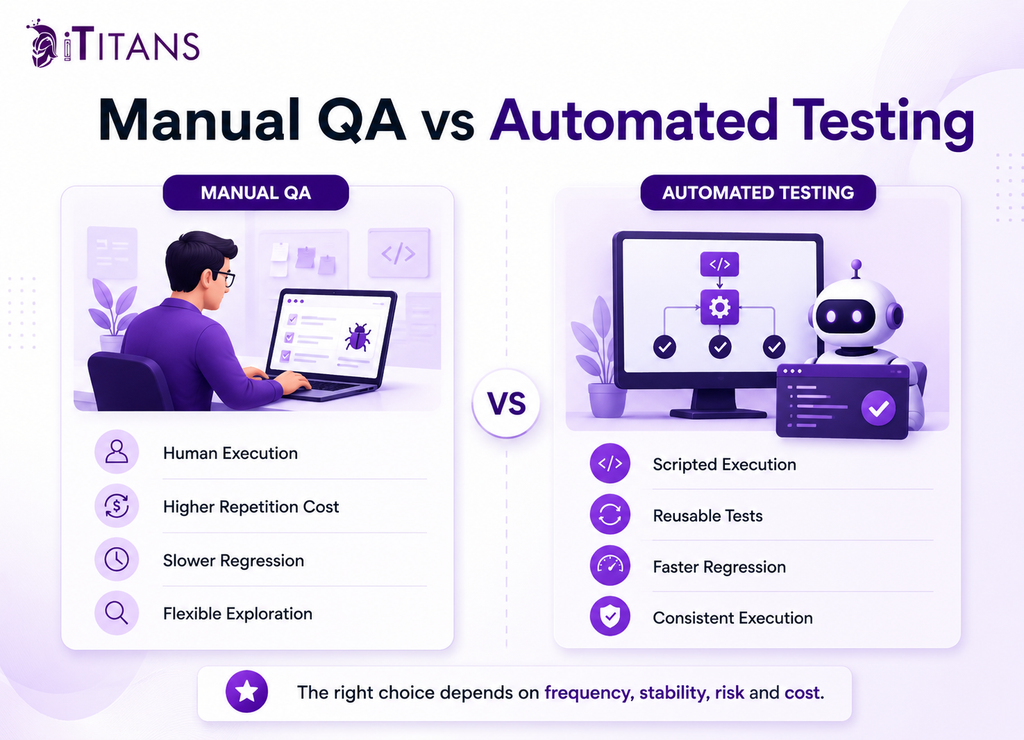
Manual QA and automated testing do not create costs in the same way.
With manual testing, much of the expense is recurring. A tester executes the same regression scenarios after each release, records results, investigates failures, and repeats selected checks after defects are fixed. As release frequency increases, the number of testing hours can increase with it.
Automation changes that pattern. The company incurs a larger initial investment to create the framework and scripts, but subsequent executions can require substantially less human effort. The economic benefit therefore accumulates over repeated test cycles.
That makes the number of executions one of the most important variables in an automation business case.
Consider a regression suite requiring 40 hours of manual execution. If the company runs it 24 times a year, that represents 960 hours of execution. Using the May 2025 BLS median wage as a simple benchmark, $104,300 divided across 2,080 working hours produces an hourly wage equivalent of approximately $50.14. The 960 hours therefore represent about $48,134 in direct wage value before benefits, payroll costs, management, equipment, recruiting, and other employment expenses.
That $48,134 should not be presented as the guaranteed savings from automation. Automation will not eliminate every hour. Test maintenance, failure investigation, exploratory testing, and other QA activities remain necessary.
The calculation demonstrates something more important: repeated manual execution creates an accumulating cost.
Automation has its own cost structure:
- Initial framework and test development
- Test data and environment preparation
- CI and deployment integration
- Browser, device, or infrastructure costs
- Test maintenance
- Failure investigation
- Human review of automated results
A meaningful comparison must include both sides.
When Should You Automate Testing?
The answer to when should you automate tests depends on four practical variables: frequency, stability, effort, and risk.
A test that takes three hours to execute manually but runs twice a year may not justify a large automation investment. A test taking the same three hours but running before every weekly release has a very different economic profile.
Frequency creates opportunities to recover the initial investment.
Stability matters because automation works best when expected behavior does not constantly change. If a product team redesigns the same workflow every sprint, automated scripts can require almost continuous modification. The organization may spend more maintaining the automation than it saves through automated execution.
Effort matters because automation is not free. A technically complicated test may require extensive framework work, test data, integrations, or environment setup.
Risk matters because some tests are worth automating even when their direct labor savings are modest. A payment, authentication, permissions, data integrity, or revenue-critical workflow can justify automation because a defect may have consequences beyond the testing cost itself.
The strongest automation candidates usually combine several of these characteristics.
A practical automation test
Before automating a scenario, ask:
- How many times will it run during the expected life of the feature?
- How many human hours does each manual execution require?
- How stable is the workflow?
- What will development and maintenance cost?
- What business risk does the test protect?
If the answers indicate frequent repetition, predictable behavior, substantial manual effort, and manageable maintenance, the financial case becomes stronger.
This is more useful than setting a target such as 80% automation coverage. Coverage percentage says how much has been automated. It does not say whether the automation is economically valuable.
When Does Test Automation Pay for Itself?
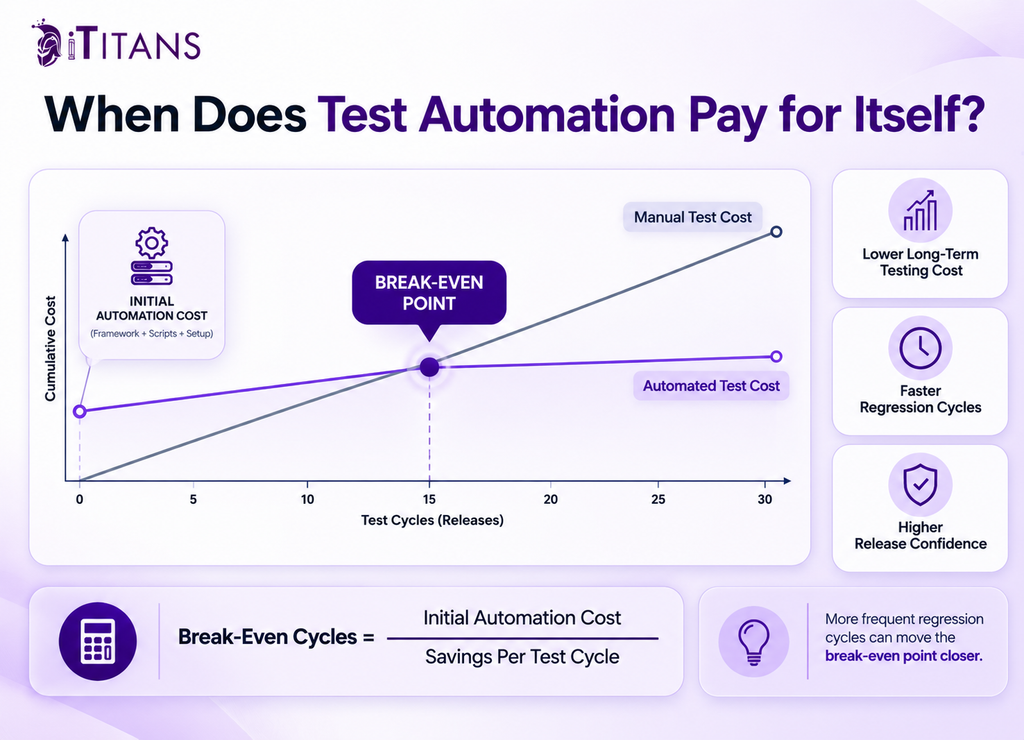
When does test automation pay for itself? It reaches its labor-cost break-even point when cumulative savings from avoiding manual execution equal the initial automation investment and the recurring cost of automated testing.
A practical formula is:
Break-even test cycles = Initial automation cost / (Manual cost per cycle minus automated cost per cycle)
For example, suppose a company spends $15,000 creating an automation suite. Manual regression costs $2,000 per cycle, while the automated equivalent costs $500 per cycle after accounting for recurring human effort and infrastructure.
The savings per cycle are $1,500.
The calculation becomes:
$15,000 / ($2,000 – $500) = 10 test cycles
The company reaches the labor-cost break-even point after 10 cycles.
If the regression suite runs weekly, the break-even point arrives after approximately 10 weeks. If it runs monthly, the same investment takes approximately 10 months to recover.
| Metric | Example |
| Initial automation investment | $15,000 |
| Manual regression cost per cycle | $2,000 |
| Automated regression cost per cycle | $500 |
| Savings per cycle | $1,500 |
| Break-even point | 10 cycles |
| Weekly execution schedule | Approximately 10 weeks |
| Monthly execution schedule | Approximately 10 months |
Treat this calculation as a business model, not a universal industry benchmark. Real companies need to substitute their own fully loaded labor costs, implementation hours, maintenance hours, infrastructure expenses, and remaining manual effort.
The formula also reveals why release frequency matters so much. Two companies can spend the same $15,000 on automation and achieve completely different ROI simply because one runs its regression suite every week while the other runs it four times a year.
What Tests Should Be Automated First?
The question what tests should be automated should be answered according to business value rather than technical convenience.
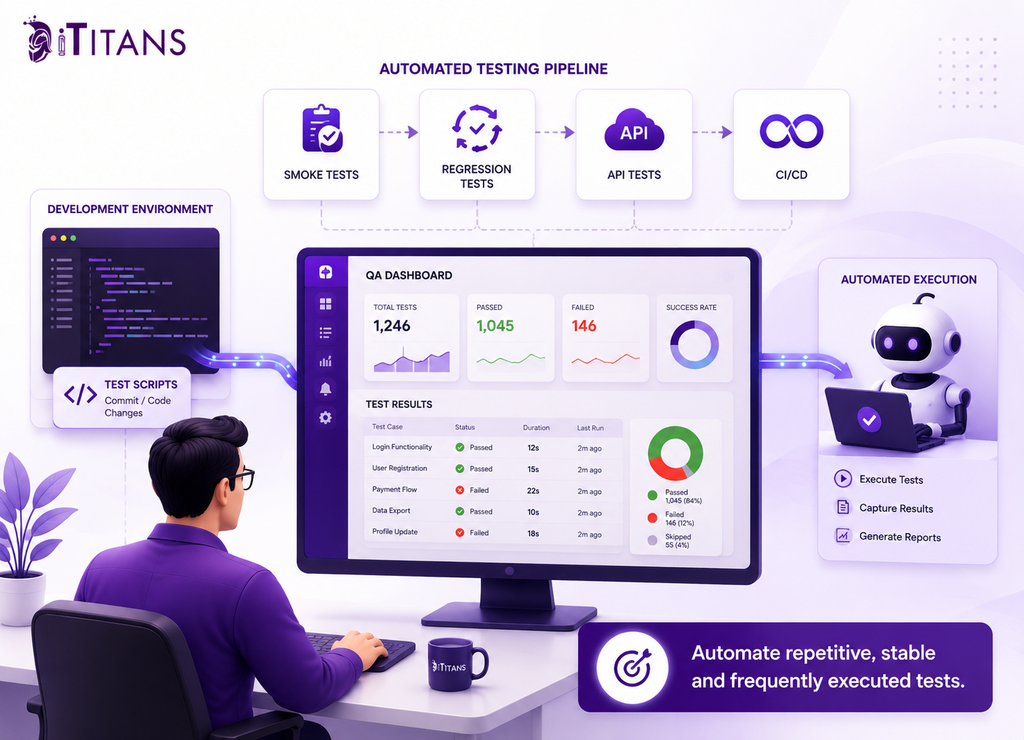
Stable regression tests are usually among the strongest candidates because they are repeatedly executed after product changes. Authentication, permissions, billing calculations, API behavior, data processing, and critical business workflows can also be strong candidates when their expected outcomes are deterministic.
Smoke tests can be useful when a company needs fast feedback about whether a build is suitable for deeper testing. API tests may also offer favorable economics because they can validate application behavior without requiring every scenario to be reproduced through a browser interface.
Research on test automation ROI has identified repetitive testing, including regression, smoke, load, and stress testing, as areas where automation can produce value because repeated execution allows the initial investment to be distributed across multiple cycles.
A useful prioritization method is to score each candidate according to execution frequency, manual effort, business risk, stability, and expected automation effort.
High-value candidates
A frequently executed billing regression may be worth automating even if development takes considerable effort.
A rarely executed administrative workflow may remain manual even if it is technically simple to automate.
A workflow that changes every two weeks may need to remain manual until product requirements stabilize.
The point is to automate the work that creates recurring cost, not simply the work that can be automated.
What Should You Test Manually vs Automate?
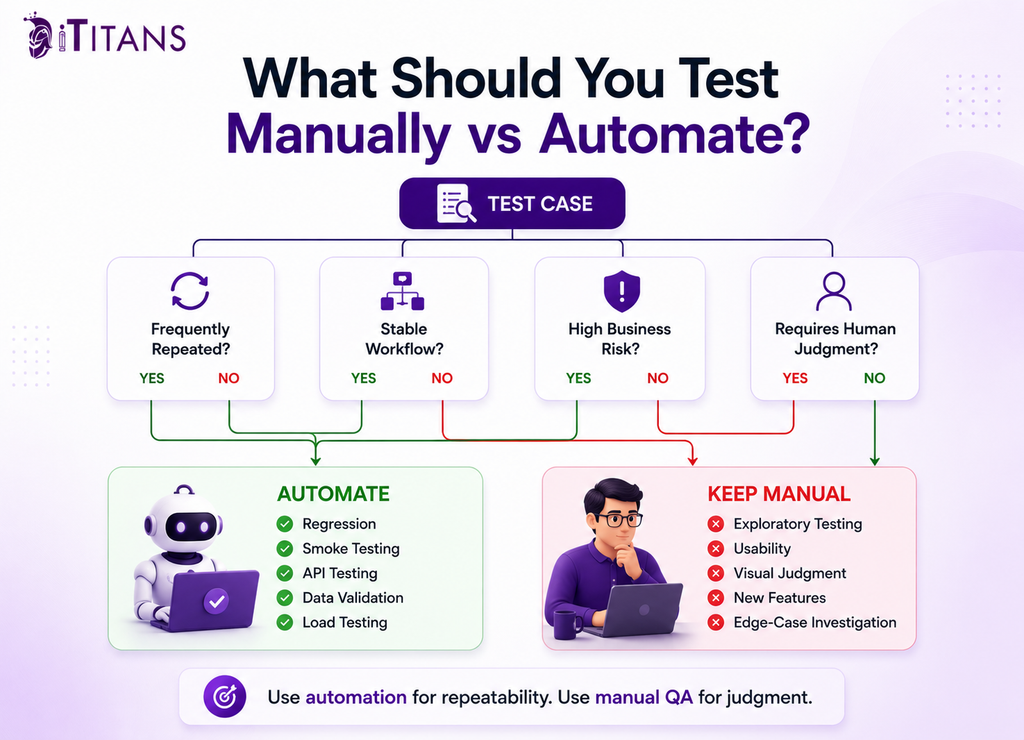
The question what should you test manually vs automate is where many QA strategies become unbalanced.
Automation is excellent at repeating known checks. It is not a replacement for human investigation.
Exploratory testing remains important because testers can investigate unexpected behavior and change their testing path based on what they discover. Usability testing also requires human judgment. A script can confirm that a button works, but it cannot reliably determine whether a customer understands what the button is supposed to do.
Manual testing is generally better suited to:
- Exploratory investigation
- Usability evaluation
- Subjective visual assessment
- Rapidly changing functionality
- One-time scenarios
- New features with unstable requirements
Automation is generally stronger for:
- Stable regression checks
- Repeatable smoke tests
- Deterministic API tests
- Data-driven scenarios
- High-frequency workflows
- Critical checks required across many releases
This creates a hybrid model rather than an either-or decision.
For founders and CTOs, that distinction is important. Replacing skilled QA work with automation indiscriminately can reduce the company’s ability to discover defects that were never anticipated during test design.
The goal should be to remove repetitive execution from human workloads while preserving human judgment where it creates more value.
Is Automated Testing Cheaper Than Manual Testing?
The answer to is automated testing cheaper than manual testing changes depending on the evaluation period.
For one execution, manual testing may be cheaper because there is no automation investment to recover. Across repeated releases, automation can become less expensive per execution.
Suppose a regression scenario requires 10 manual hours and the product ships 26 times per year. That produces 260 hours of manual execution.
Using the BLS May 2025 median wage of $104,300 for software quality assurance analysts and testers, the direct wage equivalent is approximately $13,036 for those 260 hours. This excludes employer overhead.
Now suppose automating the relevant scenarios requires 60 hours of development and another 40 hours of maintenance during the year. At the same $50.14 wage benchmark, those 100 hours represent approximately $5,014 in direct wage value.
The difference is approximately $8,022 before infrastructure, tooling, investigation, and remaining manual work.
This is an illustration rather than a promised saving. Real automation economics depend on the company’s compensation structure and actual maintenance burden.
The important lesson is that automation should be evaluated across the period in which the tests will repeatedly run.
How Much Does Test Automation Cost After Implementation?
A credible how much does test automation cost calculation continues after the first script works.
Automated tests are software assets. Application changes can break selectors, assertions, test data, authentication flows, integrations, and environment assumptions. Framework upgrades and browser changes can create additional work.
Research involving Siemens and Saab identified 13 factors associated with automated GUI test maintenance, including tester experience and test-case complexity. The study also found that maintenance effort is an important part of the economics of automated testing.
This is why maintenance should be included in the original business case rather than treated as an unexpected expense.
There is another hidden cost: false failures.
An automated test may fail because of a product defect, but it can also fail because of an unstable environment, timing problem, expired data, unavailable dependency, or broken selector. Someone still needs to determine what happened.
A 20-minute test that produces trustworthy results can therefore be more valuable than a five-minute test that generates frequent false alarms.
For a CTO, test reliability should be treated as an economic metric. Teams should track failed runs, false positives, investigation time, maintenance hours, and tests removed because they no longer provide useful coverage.
Automation that produces unreliable information can increase technical debt instead of reducing QA cost.
Common Mistakes That Delay the Break-Even Point
The first mistake is trying to automate everything.
A broad automation initiative can quickly become a scope-management problem. Teams add browser coverage, mobile coverage, integrations, edge cases, performance checks, and increasingly complex workflows without calculating the economic return of each addition.
The second mistake is automating unstable functionality.
When product requirements are changing rapidly, test scripts can become outdated before their investment has been recovered. Manual testing can be more economical during this period.
The third mistake is ignoring ownership.
Automation needs clear responsibility for framework health, test failures, maintenance, test data, and obsolete scenarios. Without ownership, broken tests accumulate.
The fourth mistake is ignoring integration complexity.
Automated testing can depend on databases, APIs, authentication services, CI pipelines, browsers, devices, and external systems. A failure in any dependency can create misleading results and consume investigation time.
The fifth mistake is measuring success by test count.
Adding 500 automated tests does not necessarily create more value than automating 50 high-frequency tests. Test count is an activity metric. Reduced manual effort, trustworthy feedback, defects detected, and release impact are closer to business outcomes.
Finally, companies can create problems by treating automation as a replacement for QA rather than a change in how QA work is allocated.
A Practical Framework for Founders and CTOs
For decision-makers, automation should begin with measurement.
Start by identifying the regression scenarios that consume the most manual time. Record how long each takes, how frequently it runs, and how much effort is required for preparation and re-testing.
Then identify which scenarios are stable enough to automate.
Estimate development time using the actual team’s experience rather than an optimistic assumption. Include framework work if the organization does not already have a suitable automation capability.
Next, estimate recurring maintenance. Look at how frequently the application changes and which parts of the test suite are likely to be affected.
Finally, calculate the break-even point and review it against the product roadmap.
A useful decision table looks like this:
| Factor | Favors automation | Favors manual testing |
| Execution frequency | High | Low |
| Expected behavior | Stable | Frequently changing |
| Test outcome | Deterministic | Subjective |
| Business risk | High | Low |
| Manual execution effort | High | Low |
| Maintenance requirement | Manageable | High |
| Release frequency | High | Low |
This framework also helps control cost overruns. Instead of approving a large automation program upfront, companies can begin with high-value scenarios, measure actual results, and expand based on evidence.
That approach reduces the risk of scope creep and makes automation investment easier to justify to leadership.
The Break-Even Point Depends on Your Release Cycle
There is no reliable rule stating that automation becomes worthwhile after a fixed number of test cases.
A SaaS company releasing weekly has 52 potential regression cycles in a year. A company releasing quarterly has only four. The same automation investment can therefore have completely different economics.
Release frequency is not the only factor. A highly regulated product may justify automation because repeatable evidence and consistent verification are important. A rapidly changing startup may delay some automation until workflows stabilize.
Business risk also changes the equation.
A test protecting payment processing may justify automation because the cost of a production defect can exceed the cost of manual execution. A low-risk internal feature may not.
This means ROI should include more than labor savings. Faster feedback, reduced regression windows, lower release risk, and greater release confidence can have business value, but those benefits should be measured or clearly defined rather than assumed.
The Right QA Strategy Is Usually a Hybrid
The strongest conclusion from manual testing vs automated testing is that manual QA and automation are complementary.
Automation should handle predictable, repeatable verification where repeated human execution creates a measurable cost. Manual QA should focus on areas where investigation, judgment, exploration, and customer context matter.
For founders and CTOs, the starting point should therefore be a small group of high-frequency, high-value, stable tests.
Measure their manual execution cost. Automate them. Track implementation time, maintenance, failure investigation, execution frequency, defects detected, and release impact.
Then calculate whether the actual results support expansion.
This approach also helps prevent delayed launches. Automation should provide faster and more reliable feedback rather than becoming an oversized project that blocks product delivery.
The most mature QA organizations do not pursue automation for its own sake. They continuously evaluate where human time creates the most value and where software can reliably perform repetitive verification.
Ready to Find Your Testing Break-Even Point?
Stop guessing whether manual QA or automation is the better investment for your product. Talk to iTitans to evaluate your testing workflow, identify the right automation opportunities, and build a QA strategy that supports faster, more reliable releases.
Frequently Asked Questions
How many times should a test be run before automating it?
There is no fixed number that guarantees automation will pay off. The stronger signal is repeated execution combined with high manual effort, stable requirements, and manageable maintenance.
How do you calculate test automation ROI?
Compare the initial automation investment and recurring automation costs with the manual testing cost avoided over the same period. The break-even point can be estimated by dividing initial automation cost by the savings generated per test cycle.
What types of tests should not be automated?
Exploratory testing, usability evaluation, subjective assessment, rapidly changing functionality, and rarely executed scenarios are often weaker automation candidates. Human judgment can provide more value than scripted repetition in these situations.
Is test automation worth it for a small SaaS company?
It can be worthwhile when the company releases frequently and repeatedly tests a stable set of critical workflows. Smaller companies should generally begin with a focused automation scope instead of attempting broad coverage immediately.
Does automated testing reduce QA costs?
It can reduce recurring execution effort, but automation introduces development, maintenance, infrastructure, and investigation costs. The actual saving depends on whether the manual effort eliminated is greater than those ongoing expenses.
What is the biggest hidden cost of test automation?
Maintenance is one of the most important hidden costs. Application changes, test-data problems, environment instability, dependency changes, and framework updates can all require additional QA or engineering time.
Should regression testing be automated first?
Stable regression testing is often a strong starting point because the same scenarios are repeated across releases. High-frequency regression checks around critical business workflows generally provide a clearer economic case than rarely executed tests.
Can manual QA and automated testing work together?
Yes. Automation can handle predictable regression and smoke checks while manual QA focuses on exploratory testing, usability, new functionality, and investigation. A hybrid model avoids treating automation as a complete replacement for human testing.