App Store Optimization: Ranking Factors That Actually Move Downloads
Most app teams treat App Store Optimization ranking factors like a one-time checklist. Pick a few keywords, update the screenshots, wait for downloads to climb. That approach worked in 2020. It does not work anymore.
App Store Optimization ranking factors fall into two groups. Relevance signals, your title, keyword field, and screenshot text, decide which searches your app is eligible to appear in. Quality signals, conversion rate, ratings, download velocity, and retention, decide how high you climb once you are in the race. Apple and Google now score both groups together, so weak retention can outrank a keyword-perfect listing.
In this guide, we are going to break down exactly which factors move the needle in 2026, which ones only help you convert, and where iOS and Google Play rules split apart.
What Are App Store Optimization Ranking Factors?
App Store Optimization, or ASO, is the practice of improving an app’s visibility inside the App Store and Google Play so more of the right people find it and download it. Ranking factors are the specific signals Apple and Google use to decide which apps surface first for a given search.
Search is not a small channel. It is the main channel. Roughly 65% of iOS downloads and 58% of Google Play downloads start with a search typed directly into the store, based on 2026 ASO benchmarking data.
That means a genuinely good app with weak App Store Optimization ranking factors stays invisible to most of its potential audience, no matter how solid the product is underneath.
Position matters more than most teams realize. Apps holding a top 3 keyword position earn roughly 4.6 times the daily installs of apps ranked 8 to 15, and over 11 times the installs of apps ranked 16 to 30. Page four is not a slow start. It is a dead end.
How the App Store and Google Play Algorithms Actually Score Your App
Neither Apple nor Google publishes its exact ranking formula. In March 2026, Apple published a research paper on scaling search relevance that confirmed something ASO practitioners had suspected for years: the algorithm evaluates two signals side by side, not one.
Textual Relevance
This is the metadata layer. Apple and Google read your title, subtitle, keyword field or description, and increasingly your screenshot captions, to decide what your app does and which searches it qualifies for.
Get this layer wrong and no amount of strong reviews will save you. The algorithm will not even consider your app for the right queries in the first place.
Behavioral Relevance
This is the human layer. Taps, installs, conversion rate, retention, and session activity tell Apple and Google whether real users actually wanted what they found.
An app with average copy but strong retention can now outrank a keyword-perfect listing with weak engagement. That is the single biggest mindset shift teams need heading into 2026.
On-Metadata Ranking Factors You Control Directly
These fields sit inside App Store Connect and Google Play Console right now, ready for you to edit.
App Title and Subtitle
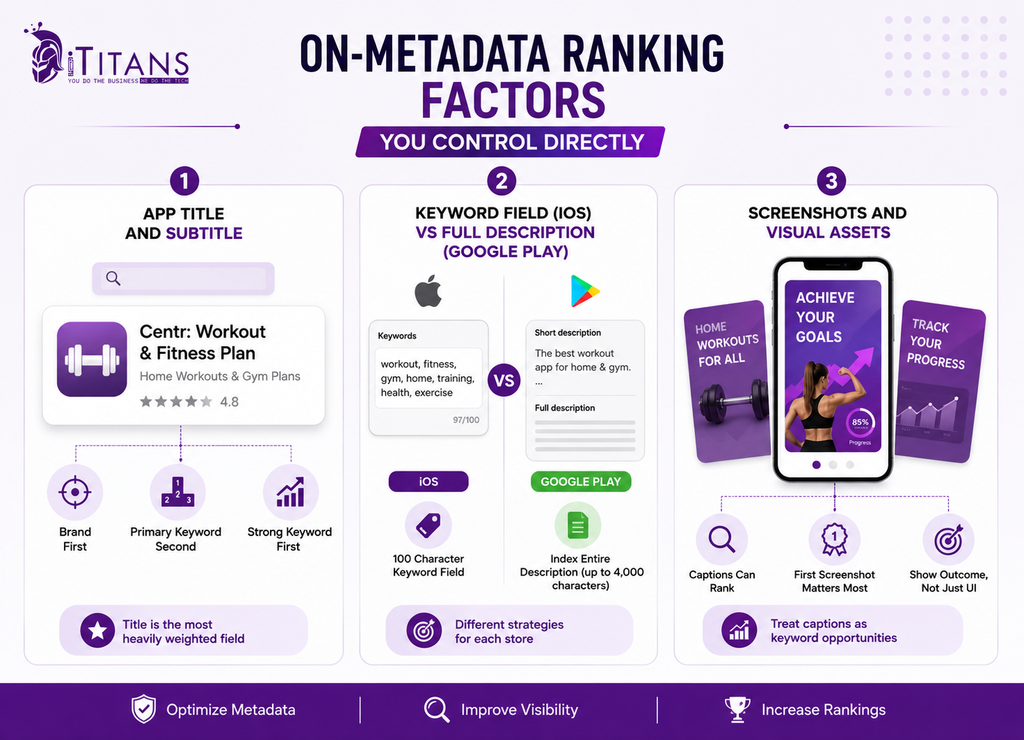
Your app name is the most heavily weighted text field in the entire ranking system. Apple gives you 30 characters for the title and 30 for the subtitle. Google gives you 30 characters for the app name.
The pattern that performs best across categories is simple: brand name first, primary keyword second.
- “Centr” tells the algorithm almost nothing on its own.
- “Centr: Workout and Fitness Plan” immediately signals relevance for fitness-related searches.
Position inside those characters matters too. The first keyword in your title carries more ranking weight than the last one, so lead with your strongest term rather than burying it.
Keyword Field (iOS) vs Full Description (Google Play)
Apple’s hidden keyword field has stayed capped at 100 characters since 2016. It works as a token list rather than a sentence, so commas beat spaces and repeating a word already in your title wastes space you cannot get back.
Google Play has no hidden field. Google indexes your entire description, up to 4,000 characters, which behaves closer to traditional web SEO than anything on iOS. Your primary keyword should open the short description and repeat naturally two or three times through the body copy, never back to back.
Running one identical keyword strategy across both stores is one of the most expensive App Store Optimization mistakes a team can make.
Screenshots and Visual Assets
Screenshots used to be a pure conversion tool. That changed in 2025. Practitioners across multiple categories documented apps ranking for terms that appeared only in screenshot captions, never in the title, subtitle, or keyword field.
Apple has not officially confirmed screenshot text as a direct ranking input, but the pattern shows up consistently enough to act on. Treat every caption as a keyword placement opportunity, not just a design choice.
The first screenshot carries outsized weight because it appears directly in search results before anyone taps through. Show an outcome, not just an interface, since a progress screen with a result-driven caption consistently outperforms a plain dashboard shot.
Off-Metadata Signals That Decide Who Wins the Top Spots
Download Velocity
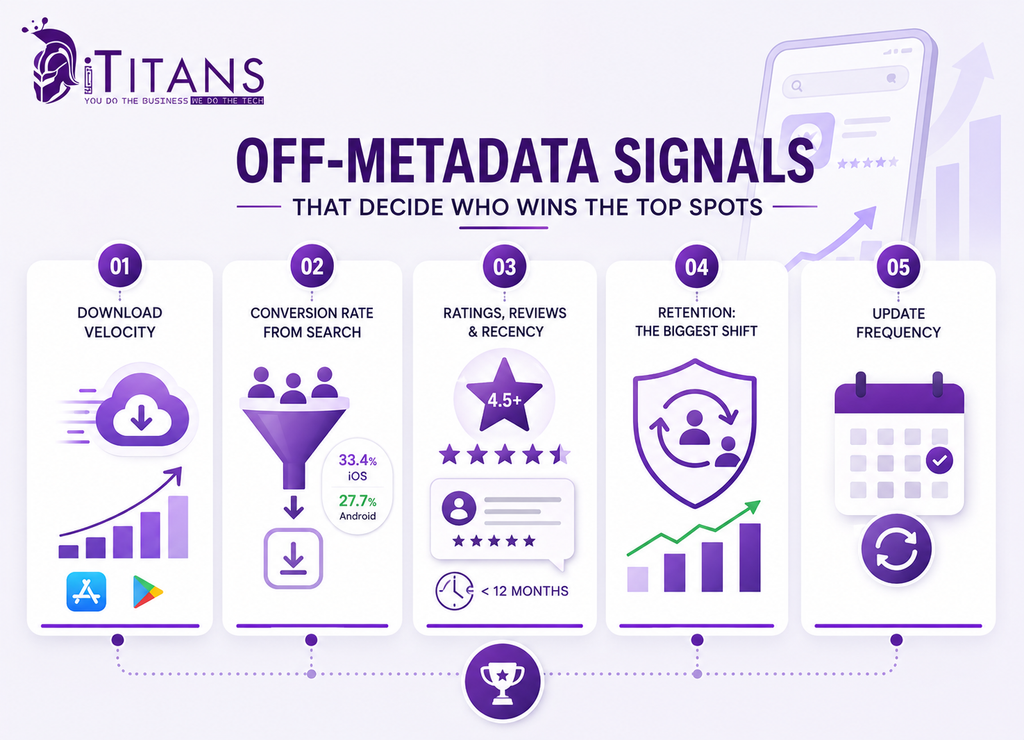
Recent install momentum carries more ranking weight than lifetime downloads. An app with 2,000 installs last week can outrank a competitor sitting on 500,000 lifetime downloads but only 200 installs last week.
This builds a feedback loop. Higher velocity lifts rankings, better rankings drive more impressions, more impressions produce more installs. Apple Search Ads is the cleanest legal way to start that loop, but bought or incentivized traffic backfires badly. A spike in installs followed by a spike in uninstalls reads as a quality failure to the algorithm, not a win.
Conversion Rate From Search
This measures the share of people who see your app in results and tap install directly, without opening the full product page first. Average tap-through-to-install sits around 33.4% on iOS and 27.7% on Google Play across categories.
Three elements drive this number, in order of impact:
- The first screenshot, since it is the largest visual element visible before any tap.
- A rating above 4.0, visible right in the results screen as instant credibility.
- Title clarity, so users understand the app’s value without tapping through.
Ratings, Reviews, and Recency
Apps rated below 3.5 stars see measurably reduced search visibility on both stores. Above 4.0, the link between star rating and keyword position strengthens steadily, and apps holding top 3 spots for competitive terms almost always carry ratings above 4.5.
Volume matters as much as the score. A 4.8 rating built on 200 reviews carries less algorithmic weight than a 4.6 built on 12,000, because volume proves sustained quality rather than a lucky snapshot. Both stores also down-weight ratings older than 12 months, so recent review flow needs constant attention, not a one-time push at launch.
Retention: The Biggest Shift in 2026
This is the change every ASO team needs to internalize. Google Play now weighs 30-day retention more heavily than raw install volume. Apps that keep users coming back get rewarded. Apps that spike in downloads and then bleed users get suppressed, even with strong keyword rankings.
Apple’s own 2026 research pointed in the same direction: post-install behavior, not just pre-install keyword matching, increasingly decides who holds the top spots.
Update Frequency
High-ranking apps across both stores tend to release updates every two to four weeks. This is not about Apple or Google counting commits. Regular, well-tested updates produce fewer crashes and steadier sessions, and both feed directly into the behavioral signals covered above.
App Store vs Google Play: Where the Rules Diverge
Running one ASO playbook across both stores is one of the fastest ways to leave organic installs on the table. The two platforms do not index metadata the same way, and they do not weigh signals the same way either.
| Ranking Factor | App Store (iOS) | Google Play |
|---|---|---|
| App / Title Name Length | 30 characters | 30 characters |
| Subtitle / Short Description | 30 characters | 80 characters |
| Hidden Keyword Field | 100 characters | Not applicable |
| Description Indexed for Ranking | No | Yes, up to 4,000 characters |
| Developer Review Responses | Indirect signal | Direct ranking signal |
| Technical Performance Weight | Moderate | High, ANR errors penalized |
| Native A/B Testing | Product Page Optimization | Store Listing Experiments |
What This Means for Your Strategy
On iOS, your ASO work is an allocation problem: fitting the maximum number of unique, high-intent terms into a handful of constrained fields.
On Google Play, it is closer to a content problem: writing copy that naturally reads well while placing target keywords at the right density across thousands of characters.
Google Play also weighs technical performance more heavily. Application Not Responding errors are tracked in Play Console and penalized more aggressively than equivalent crash rates on iOS, so Android vitals deserve a weekly look alongside keyword rankings.
Keyword Position and Install Volume: Why Rank 4 Still Hurts
Numbers make this easier to internalize than theory alone. The table below shows how sharply organic installs drop as keyword rank slips, based on 2026 benchmarking across high-volume search terms.
| Keyword Rank | Share of Daily Installs | Lift vs Ranks 8-15 |
|---|---|---|
| Rank 1 | 34% | 6.2x |
| Ranks 2-3 | 27% | 4.6x |
| Ranks 4-7 | 18% | 2.4x |
| Ranks 8-15 | 12% | Baseline |
| Ranks 16-30 | 6% | 0.4x |
| Rank 31+ | 3% | Under 0.1x |
The takeaway is simple. Ranking factors are not a nice-to-have polish step. The difference between rank 3 and rank 10 is roughly the difference between a channel that funds growth and one that barely registers.
Common ASO Mistakes That Quietly Kill Rankings
Most ranking problems come from a short list of repeated mistakes, not a mystery algorithm change. Watch for these:
- Copying the same title and keywords across iOS and Google Play instead of building store-specific metadata.
- Burying your primary keyword at the end of the title instead of leading with it.
- Ignoring screenshot captions and treating visuals as pure decoration.
- Buying installs or running incentivized campaigns that spike downloads and then uninstalls.
- Prompting for ratings the moment someone opens the app, before they have experienced any value.
- Going quiet for months between updates, then wondering why rankings drifted.
- Localizing the app description but not the screenshots, or the other way around.
Fixing even two or three of these consistently produces a visible ranking shift within a few weeks.
Frequently Asked Questions
What are the most important App Store Optimization ranking factors in 2026?
Keyword relevance in your title and metadata, conversion rate from search, download velocity, ratings, and retention. Google Play now weighs 30-day retention more heavily than raw installs, which is the year’s biggest shift.
Do ratings and reviews really affect app store ranking?
Yes. Apps below 3.5 stars see reduced visibility on both stores. Above 4.0, higher ratings correlate with stronger keyword positions, and review volume and recency both add extra weight.
How is Google Play ranking different from Apple App Store ranking?
Apple relies mainly on title, subtitle, and a hidden keyword field. Google Play indexes your full description and weighs technical stability, like crash and ANR rates, more heavily.
Does running Apple Search Ads improve organic ranking?
Not directly. Apple has not confirmed a direct organic boost from ads. Paid installs can lift velocity signals and sharpen keyword data, which can indirectly support organic performance over time.
How long does it take to see App Store Optimization results?
Keyword changes typically take two to four weeks to fully stabilize after an update. Give any new title, keyword field, or description at least three weeks before judging the results.
What is download velocity and why does it matter for ASO?
Download velocity is install momentum over a short period. Both stores weigh recent installs more heavily than lifetime totals, since fast momentum signals current demand rather than past popularity.
How iTitans Helps You Win at App Store Optimization
Knowing the ranking factors is one part of the job. Building an app, listing, and update process around them is the harder part, and it is where most in-house teams run out of time.
Mobile App Development Built Around Discoverability
iTitans mobile app development teams build iOS and Android apps with App Store Optimization in mind from day one, not bolted on after launch. That includes structuring app names, metadata fields, and category placement correctly before the first submission, so the app is not fighting an avoidable ranking gap out of the gate.
Whether the build is native iOS, native Android, or cross-platform, the underlying app architecture affects crash rates, load times, and session stability, all of which feed directly into the behavioral ranking signals covered earlier in this guide.
App Design That Converts Search Traffic Into Installs
A strong keyword strategy only pays off if the listing converts once people see it. iTitans app design work focuses on the exact conversion levers covered above: a first screenshot built around outcomes, a caption strategy that supports discoverability, and an icon and screenshot sequence tested for tap-through rather than guessed at.
Ongoing Maintenance to Protect Rankings After Launch
App Store Optimization ranking factors like update frequency, crash rates, and retention are not one-time wins. They need continuous attention, and this is exactly the gap iTitans mobile app maintenance and support services are built to close, with scheduled releases, bug triage, and performance monitoring that keep the behavioral signals feeding the algorithm in the right direction.
For businesses that need visibility across both app stores and the open web, iTitans search engine optimization services extend the same keyword discipline used inside app metadata to the website and content driving traffic toward the app listing in the first place. Teams evaluating a build from scratch can also review how much a new app typically costs before scoping an ASO-ready launch plan.
Ready to Turn Rankings Into Downloads?
App Store Optimization ranking factors are not a mystery once you separate them into two groups: the metadata you control directly, like title, keyword field, and screenshots, and the behavioral signals users generate, like conversion rate, ratings, velocity, and retention. Winning in 2026 means treating both as ongoing work, not a launch-day checklist, since Apple and Google now score relevance and quality together rather than rewarding keyword-stuffed listings alone.
If your app’s downloads have plateaued, the fix usually sits inside this guide already, whether that means rewriting a buried title, fixing a caption strategy, or shipping updates on a real cadence instead of an occasional one. iTitans works with businesses across the United States to build, design, and maintain apps that are structured to rank and convert from launch onward. Contact iTitans today to get a free ASO-focused review of your current app store listing.