
AI in Software Development | Opportunities and Challenges
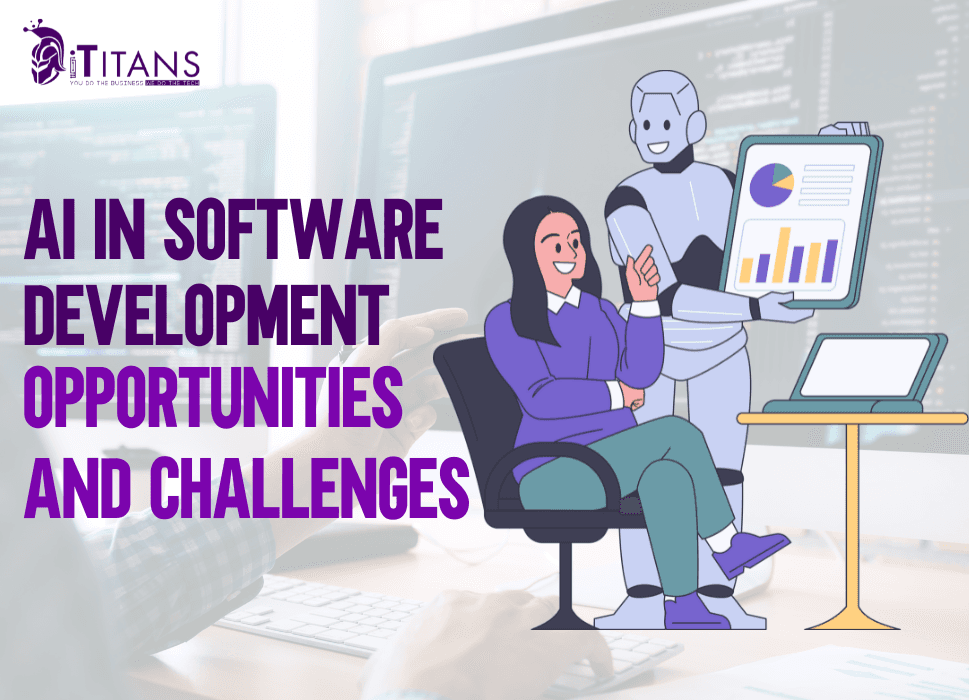
Artificial Intelligence (AI) is no longer the future, it has become the present of the technological innovation which is influencing everything. With the help of automation and other technologies, AI is reshaping the landscape of software development as well.
By automating repetitive tasks to optimizing complex procedures, AI is innovating how software developers approach design and development. But is it going to replace the developers? Where AI brings a lot of convenience and exciting opportunities, this technology is also facing a lot of challenges in the modern-day world. In this article, we are going to explore how AI is bringing new opportunities in the field of software development.

Opportunities AI Brings in Software Development
First let’s talk about the good stuff: how AI can help the field of software development with many new opportunities, and here we have mentioned the most prominent ones:
Automatic Code Generation With Bug Detection
One of the major benefits of using AI in software development is its ability to automatically write code. The AI driven codes can now write code and optimize it by themselves. And that’s not all, these AI tools are even able to detect bugs on their own before hitting the production phase. This ability of AI has drastically reduced the time and effort invested by the developers in performing mainstream tasks. So now, the developers can focus more on problem solving and less on writing code and bug detection.
How is AI Influencing?
Software development related tools like GitHub Copilot and DeepCode are prime examples of AI-powered coding assistants that provide suggestions on coding snippets, guide with writing syntax, and provide alerts to developers to find potential bugs as they write. As a result, developers can achieve faster development cycles, reduce the chances of human errors, and enhance productivity.
Enhances Software Quality Assurance and Testing
AI is bringing a new revolution in the world of software testing and quality assurance by providing smarter and quicker ways of initiating the testing process. Traditional software testing methods often require a lot of manpower, which also makes it more time-consuming. But with the help of AI powered tools like Testim and Applitools, you can automatically generate test cases and prioritize them to predict any failure points in the future.
How is AI Influencing?
These tools are not just improving the testing method accuracy but also helping with continuous integration and delivery to make the processes more efficient in the pipeline. As a result, software developers can get higher quality software, faster testing cycles, and save on manual testing costs.
Better Decision Making With Predictive Analysis
AI is becoming more capable of analyzing large datasets to lay out the patterns, anomalies, and latest trends that are leading the new-age technology. In the field of software engineering, this predictive analysis can help to make better decisions regarding project deadlines and timelines. Moreover, software developers can identify the potential risks for better resource allocation.
How is AI Influencing?
AI models are great for predicting the likelihood of how a project will progress in terms of failure or success. By assessing the performance factors, the quality assurance team can allocate resources more efficiently. With the help of data-driven decision making, software developers can get more accurate project forecasting and even better risk management.
Intelligent Debugging and Maintenance Options
Maintaining or debugging software can get hectic due to the time it requires. Especially for large enterprise-based systems, it is difficult to maintain the right resources. But with the help of AI-powered debugging tools, we can leverage machine learning technology to identify code behavior, which assists in detecting and fixing the issues.
How is AI Influencing?
Debugging tools powered by AI like CodeSense provide predictive maintenance, which helps engineers learn when software may suffer from a bug or an error. With this predictive analysis, it becomes much easier for developers to reduce downtime and maintain the software in a timely manner.
Customized User Experience
With the right AI integration, you can get the best personalization experience in software or website development. These AI integrations can adapt to user behavior and show the preferences in real time to provide an interactive user experience.
How is AI Influencing?
An example can be taken from Spotify’s AI algorithms which analyze the user listening preferences to recommend a playlist based on the same genre or category. Similarly, Netflix follows this practice to provide suggestions based on the user’s viewership history. With this enhanced user engagement and loyalty, it becomes much easier to retain users with an interactive experience.

Challenges AI Brings in Software Development
Despite having dozens of benefits, there are some challenges and limitations to using AI in software development, which we have mentioned below:
Ethical Concerns and Biases
AI systems are generally good at providing suggestions and solutions for a problem. However, if the training data is biased or insufficient to make a decision, then AI models can produce certain outcomes that seem like a one-way decision. In the field of software development, this bias can lead to discrimination of algorithms that favor the demographics of a certain party.
How to Tackle This Challenge?
To avoid the bias factor, the developers should remain more vigilant to ensure that AI models are trained properly with unbiased and complete data sets. Managing these ethical concerns is necessary to avoid biases so the transparency of AI models can be maintained.
Lack of Interpretation
AI models, especially deep learning models, can get really complex, which makes them difficult to interpret. Since Artificial Intelligence has a black box nature, it can get pretty problematic for the developers, and things can go wrong real quick.
How to Tackle This Challenge?
Due to complications of learning models, developers may struggle to understand why an AI system has made certain decisions or has given certain results. This is the point where debugging and optimization can become much more complex.
Dependency on AI Tools
It is true that AI can make things easier for developers. However, this dependency on the AI tools can hinder the learning process for the new developers which can limit their skillset to certain technologies. This limitation of skillset can later make it difficult for businesses to find developers who can truly deliver custom software development services.
How to Tackle This Challenge?
To overcome this challenge, developers should focus on developing skillsets in custom software development while balancing the AI adoption to work on machine learning and relevant skillsets.
Security Risks
Software Development in AI has revealed many security risks which also include adversarial attacks where malicious viruses can force AI models to behave in a certain way. In the field of software development, this security risk can compromise the integrity of AI, which may lead to security vulnerabilities.
How to Tackle This Challenge?
AI also makes it easier for hackers to automate attacks and identify system weaknesses faster than ever before. It is important to establish robust security protocols for AI-driven systems to prevent exploitation by malicious actors.
Resource Intensive With Higher Costs
Implementing AI in software development requires significant resources in terms of computing power, data storage, and human expertise. Smaller organizations may find it challenging to adopt AI-driven solutions due to these high costs.
How to Tackle This Challenge?
Moreover, maintaining AI systems and keeping them updated with new data can be resource-intensive, requiring continuous investment. It is vital to balance the cost of AI integration with the expected return on investment.
FAQs
How is AI used in software development?
AI is used in software development for tasks like code generation, bug detection, software testing, predictive analytics, and automation. It assists developers by offering intelligent code suggestions, automating repetitive tasks, and improving software security. AI-powered tools like GitHub Copilot and ChatGPT enhance productivity by reducing development time and improving code quality.
Will AI replace software developers?
AI is unlikely to replace software developers completely. Instead, it will augment their abilities, helping them write better code, automate repetitive tasks, and enhance security. Human expertise is still crucial for creative problem-solving, decision-making, and designing complex systems.
What are the future prospects of AI in software development?
The future of AI in software development looks promising, with advancements in generative AI, automated coding, and intelligent debugging. AI is expected to enhance collaboration between developers and machines, leading to faster innovation. As AI continues to evolve, it will play a crucial role in creating more adaptive, secure, and user-friendly software solutions.
Conclusion
The influence of Artificial Intelligence in the field of software development will only improve the efficiency and productivity of the development process. Moreover, it makes debugging and optimization more accurate with better chances of accuracy. But at the same time, it comes with its own set of challenges and each one of them requires the attention and skillset of an actual human. With the factors mentioned in this article, hopefully, you have learned how the future of AI will lead to software development.
Looking for a reliable software development company? Contact iTitans now and let us turn your idea into a digital reality with bespoke software designing and development.
Related Post