

Ultimate Guide to EMR Software Development That Healthcare Needs
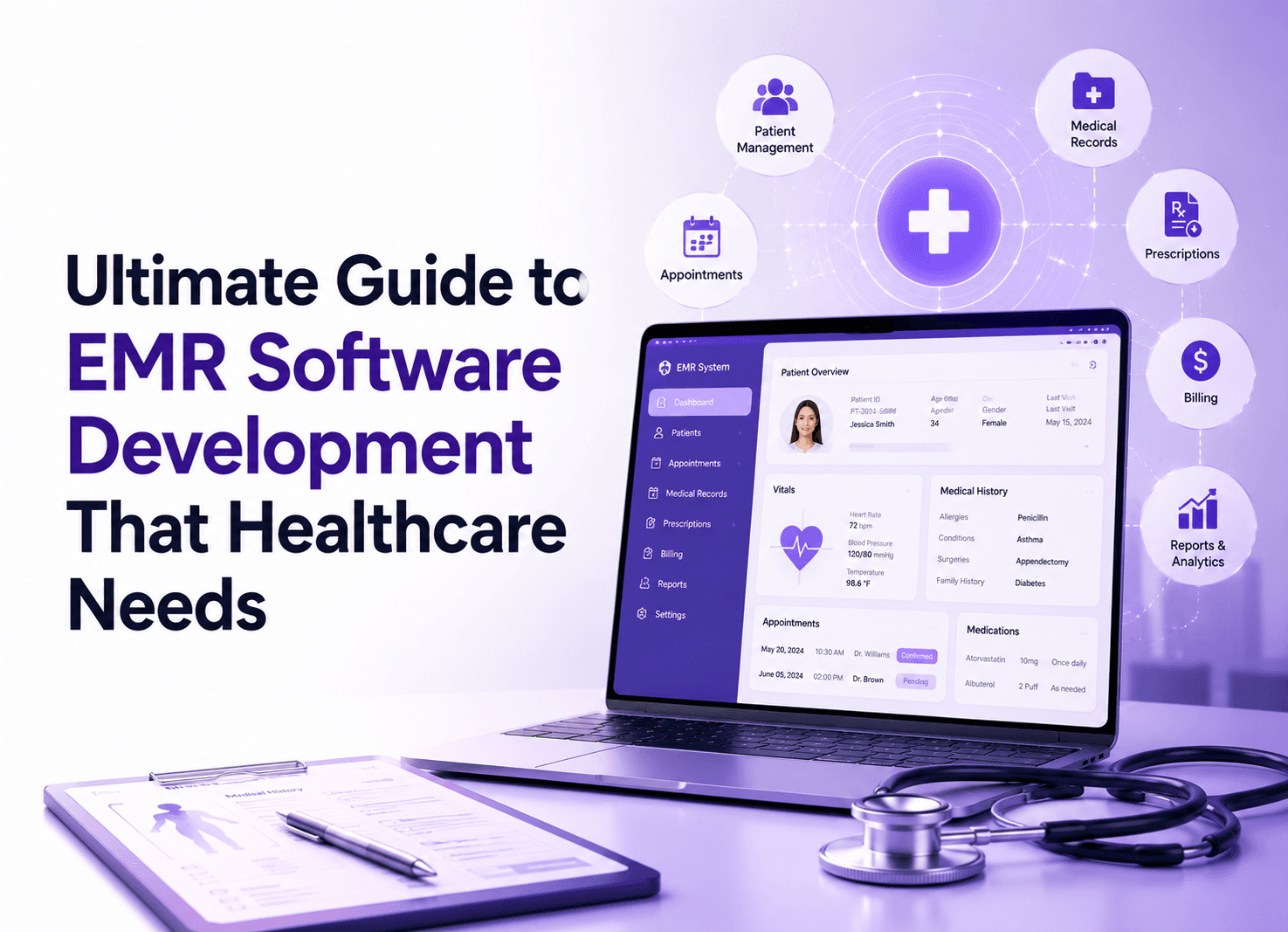
Healthcare organizations are under growing pressure to improve patient outcomes while managing rising operational costs, stricter compliance requirements, and increasing volumes of clinical data.
Paper-based records and disconnected systems can no longer support the speed and accuracy expected by modern healthcare providers. As a result, investing in EMR software development has become a strategic decision rather than a technology upgrade.
Whether you’re launching a health-tech startup, modernizing an existing platform, or building a digital system for hospitals and clinics, developing an EMR system requires more than writing code.
This guide explains what businesses need to know before investing in EMR software development, from core features and architecture to compliance, integrations, and development planning.

What Is EMR Software and Why Does It Matter?
EMR software is a digital system used by healthcare providers to create, store, manage, and update patient medical records within a single healthcare organization. It replaces paper charts with electronic records that improve accessibility, documentation accuracy, and day-to-day clinical operations.
Although the terms EMR and EHR are often used interchangeably, they are not identical.
An EMR is designed primarily for use within one hospital, clinic, or medical practice. It focuses on maintaining patient histories, diagnoses, prescriptions, laboratory results, treatment plans, and physician notes for internal use. An Electronic Health Record (EHR), on the other hand, is built to exchange patient information across different healthcare organizations through standardized interoperability protocols such as HL7 and FHIR.
For organizations considering custom software, understanding this distinction helps determine the project’s scope. A standalone clinic may only require an EMR, while multi-location healthcare networks often need EHR capabilities that support secure data sharing between providers.
Beyond replacing paper records, EMR systems help healthcare teams:
- Reduce documentation errors
- Improve clinical decision-making
- Speed up patient visits
- Track treatment history more accurately
- Improve coordination between departments
- Support regulatory compliance
The value of an EMR ultimately depends on how well it aligns with existing clinical workflows. Software that forces physicians to change established processes often creates resistance, while systems designed around real healthcare operations typically see faster adoption.
Why Organizations Choose Custom EMR Software Development
Many healthcare providers begin with off-the-shelf EMR platforms. These products work well for standardized processes but often become limiting as organizations expand, introduce specialized services, or require deeper integrations.
Custom EMR software gives organizations greater control over functionality, workflows, security policies, and future enhancements.
Instead of adapting operations to match software limitations, healthcare providers can build features around their own processes. This is particularly valuable for specialty clinics, telehealth providers, diagnostic centers, rehabilitation facilities, and organizations operating across multiple locations.
Some common reasons businesses invest in custom development include:
- Integration with existing hospital information systems
- Specialty-specific workflows
- Advanced reporting requirements
- AI-assisted clinical documentation
- Custom patient portals
- Multi-location management
- Integration with wearable devices and remote monitoring tools
Custom development also reduces dependence on vendor roadmaps. Organizations decide when new features are introduced instead of waiting for third-party releases that may not address their priorities.
However, custom development is not automatically the better choice. It requires larger upfront investment, longer planning cycles, and ongoing maintenance. Businesses should evaluate expected growth, operational complexity, compliance obligations, and long-term ownership costs before making this decision.
Core Features Every Modern EMR Should Include
An EMR platform should support healthcare professionals without adding unnecessary administrative work. Every feature should improve efficiency, reduce manual tasks, or strengthen patient care.
Patient Records Management
The foundation of any EMR is centralized patient record management.
Each patient profile typically includes:
- Medical history
- Allergies
- Diagnoses
- Medications
- Laboratory reports
- Imaging results
- Immunization history
- Physician notes
Healthcare professionals should be able to access this information quickly while maintaining strict access controls.
Appointment and Scheduling
Scheduling modules simplify patient booking, physician calendars, appointment reminders, cancellations, and follow-ups.
Modern scheduling systems often integrate with patient portals to reduce administrative workload and improve attendance rates.
Clinical Documentation
Clinical documentation allows physicians to record consultations, treatment plans, diagnoses, prescriptions, and progress notes.
Many organizations are now introducing AI-assisted documentation that converts voice conversations into structured clinical notes, helping reduce physician burnout caused by excessive administrative work.
E-Prescribing
Electronic prescribing enables physicians to send prescriptions directly to pharmacies while checking medication interactions, dosage recommendations, and allergy conflicts.
This minimizes prescription errors and improves patient safety.
Billing and Revenue Cycle Management
Financial workflows are closely connected to clinical documentation.
A modern EMR should support:
- Insurance verification
- Claims processing
- Coding support
- Payment tracking
- Invoice generation
Integrating billing into the EMR reduces duplicate data entry and improves reimbursement efficiency.
Patient Portal
Patients increasingly expect digital access to their healthcare information.
A secure portal typically provides:
- Appointment booking
- Test results
- Prescription history
- Secure messaging
- Medical records
- Online payments
Patient portals also reduce routine administrative inquiries by allowing patients to manage many tasks independently.
Analytics and Reporting
Healthcare organizations rely on reporting to measure operational efficiency, clinical outcomes, physician productivity, and regulatory compliance.
Custom dashboards help administrators monitor key performance indicators without manually collecting information from multiple systems.

Planning an EMR Development Project
Many software projects fail long before development begins because planning focuses on features rather than business objectives.
Successful EMR projects begin by identifying operational problems that software should solve. This includes interviewing physicians, nurses, administrative staff, compliance officers, and IT teams to understand how patient information moves through the organization.
Rather than building every requested feature immediately, experienced development teams prioritize functionality based on clinical value and implementation complexity.
A practical planning process usually includes:
- Defining business objectives
- Mapping clinical workflows
- Identifying user roles
- Listing required integrations
- Establishing compliance requirements
- Prioritizing core features
- Creating phased release plans
Starting with a minimum viable product often reduces project risk. Organizations can validate workflows, gather user feedback, and improve adoption before expanding functionality.
Another common planning mistake is underestimating data migration. Moving years of patient records from legacy systems requires careful validation to avoid incomplete records, duplicate information, or formatting inconsistencies.
Stakeholder involvement should continue throughout development rather than ending after requirements gathering. Regular reviews help identify workflow issues before they become expensive changes later in the project.

Choosing the Right Technology Stack for EMR Software Development
Technology decisions influence performance, scalability, maintenance costs, and future integrations. Instead of selecting frameworks based on popularity, organizations should evaluate technologies against their long-term business goals.
Most modern EMR platforms use cloud-based architectures because they simplify deployment, disaster recovery, and infrastructure management. Cloud environments also make it easier to support multiple healthcare locations while maintaining centralized data management.
Backend development commonly relies on technologies such as .NET, Java, Node.js, or Python, while frontend applications are often built using React or Angular to provide responsive user interfaces across desktop and mobile devices.
Database selection depends on application complexity, expected patient volume, reporting needs, and transaction frequency. PostgreSQL, Microsoft SQL Server, and MySQL remain common choices because they support structured healthcare data and high reliability.
Interoperability should never be treated as an afterthought. Healthcare systems rarely operate in isolation, making API-first development increasingly important. Supporting standards such as FHIR integration and HL7 allows EMR platforms to exchange information with laboratories, pharmacies, imaging systems, insurance providers, and other healthcare applications without extensive custom development for every connection.
A well-planned architecture also considers future expansion. Features such as telemedicine, remote patient monitoring, AI-assisted documentation, and wearable device integrations are becoming standard expectations rather than optional additions.
Ensuring Compliance, Security, and Interoperability
Healthcare software operates in one of the most regulated industries, making security and compliance essential from the earliest stages of development. Addressing these requirements after deployment often leads to higher costs, delayed releases, and unnecessary rework.
For organizations serving patients in the United States, compliance with the Health Insurance Portability and Accountability Act (HIPAA) is a fundamental requirement. Depending on where the software will be used, additional regulations such as GDPR or local healthcare privacy laws may also apply.
Compliance is not limited to encrypting patient records. It involves protecting sensitive health information throughout its lifecycle, from collection and storage to sharing and deletion. A secure EMR should include role-based access controls, multi-factor authentication, audit logs, encrypted data transmission, automated backups, and disaster recovery procedures. These measures reduce the risk of unauthorized access while helping organizations demonstrate compliance during audits.
Interoperability is another critical consideration. Healthcare providers rely on a wide range of digital systems, including laboratory information systems, pharmacy platforms, radiology software, billing applications, insurance portals, and telemedicine solutions. An EMR that cannot exchange data with these systems creates operational bottlenecks and forces staff to enter the same information multiple times.
This is why interoperability standards such as HL7 and FHIR have become central to modern healthcare software. FHIR, in particular, simplifies API-based communication between applications, allowing organizations to integrate new technologies without replacing their entire ecosystem. Designing for interoperability from the beginning is generally more cost-effective than retrofitting integrations after deployment.
How Much Does EMR Software Development Cost?
One of the most common questions organizations ask is, “How much does EMR software development cost?” There is no universal answer because the final investment depends on project scope, technical complexity, compliance requirements, and the number of integrations involved.
A basic system designed for a small clinic requires significantly fewer resources than an enterprise platform supporting multiple hospitals, thousands of users, and advanced analytics. Features such as patient portals, e-prescribing, AI-assisted documentation, mobile applications, billing systems, and third-party integrations also influence development effort.
Several factors typically affect project costs:
- Number of user roles and permissions
- Complexity of clinical workflows
- Integration with existing healthcare systems
- Data migration from legacy platforms
- Security and compliance requirements
- Mobile application development
- Reporting and analytics
- Ongoing maintenance and support
Organizations sometimes focus only on initial development costs while overlooking long-term ownership expenses. Infrastructure, security updates, regulatory changes, feature enhancements, technical support, and performance optimization all require ongoing investment. Planning for these costs early helps avoid budget overruns later.
Another important consideration is feature prioritization. Attempting to build every requested capability in the first release often leads to scope creep, extended timelines, and higher development costs. A phased approach allows organizations to launch sooner, validate workflows with real users, and introduce additional functionality based on measurable business needs.
Common Challenges in EMR Software Development and How to Avoid Them
Building healthcare software is more complex than developing a typical business application because every decision can affect patient care, compliance, and operational efficiency.
One of the biggest challenges is poorly defined project requirements. Healthcare organizations often involve physicians, nurses, administrators, and IT teams, each with different priorities. Without structured requirements gathering, development teams may build features that do not reflect actual clinical workflows.
Integration is another frequent obstacle. Many healthcare providers still rely on older systems that were not designed for modern APIs. Connecting these platforms with a new EMR may require custom interfaces, data mapping, and extensive testing to ensure information remains accurate across systems.
Data migration also deserves careful attention. Patient histories accumulated over many years often contain inconsistent formats, duplicate records, or incomplete information. Migrating this data without validation can affect clinical decision-making and reduce user confidence in the new system.
User adoption is another area where organizations often struggle. Even technically sound software may fail if physicians find it difficult to navigate or if documentation takes longer than existing processes. Involving end users throughout design and testing usually produces interfaces that better support daily clinical work.
Technical debt can become an expensive long-term issue when development teams prioritize speed over maintainability. Poor architecture decisions, inconsistent coding practices, or shortcuts taken to meet deadlines often increase future maintenance costs and make new feature development more difficult.
Organizations can reduce these risks by establishing realistic timelines, prioritizing essential functionality, conducting frequent stakeholder reviews, and investing in quality assurance throughout development rather than treating testing as a final step.
The Growing Role of AI in EMR Software Development
Artificial intelligence is changing how healthcare organizations manage patient information, but its value lies in improving everyday clinical tasks rather than replacing healthcare professionals.
Many providers now use AI to reduce repetitive documentation. Instead of manually entering consultation notes, clinicians can review AI-generated summaries based on voice conversations or structured clinical inputs. This saves time while allowing physicians to focus more on patient interactions.
AI also supports clinical decision-making by identifying potential drug interactions, highlighting abnormal laboratory results, and recommending evidence-based treatment options. These tools assist healthcare professionals without replacing their judgment.
Predictive analytics is another area gaining attention. By analyzing historical patient data, AI models can identify individuals at higher risk for hospital readmissions, chronic disease progression, or complications that require earlier intervention.
Administrative functions also benefit from automation. AI can assist with appointment scheduling, coding recommendations, insurance verification, billing workflows, and document classification, helping organizations reduce manual effort and improve operational efficiency.
Despite these advantages, AI should be introduced thoughtfully. Healthcare organizations must validate model accuracy, monitor performance, and ensure recommendations remain transparent and explainable. Strong governance becomes increasingly important as AI capabilities expand.
Choosing the Right EMR Development Partner
Selecting a development partner involves more than evaluating technical skills. Healthcare projects require an understanding of clinical operations, regulatory requirements, and long-term software maintenance.
A capable development team should begin by understanding business objectives before discussing technology choices. They should ask questions about workflows, user roles, existing infrastructure, compliance obligations, reporting requirements, and future growth plans.
Experience with healthcare integrations is equally important. Teams familiar with FHIR, HL7, billing systems, laboratory platforms, telemedicine applications, and patient portals are generally better prepared to handle the technical realities of healthcare environments.
Transparency throughout the project also contributes to successful outcomes. Organizations should expect clear communication, realistic delivery timelines, documented milestones, and structured change management processes. Frequent demonstrations and stakeholder reviews help ensure the software continues to align with business goals as development progresses.
Finally, consider the relationship beyond launch. Healthcare software requires continuous monitoring, security updates, compliance adjustments, infrastructure management, and feature enhancements. A development partner that provides ongoing support can help organizations adapt to changing regulations and evolving business needs without rebuilding the system every few years.

Build a Secure, Scalable EMR Solution with iTitans
iTitans helps healthcare organizations build secure, compliant, and scalable software that aligns with real clinical workflows.
FAQs
1. Can an EMR system integrate with existing hospital software?
Yes. A well-designed EMR can integrate with laboratory systems, billing platforms, pharmacy software, radiology systems, telemedicine applications, and other healthcare tools using standards like HL7 and FHIR APIs.
2. What’s the difference between building a custom EMR and customizing an existing EMR platform?
Customizing an existing platform is usually faster and less expensive but may limit flexibility. Custom EMR software development gives you complete control over workflows, integrations, scalability, and future enhancements.
3. How do healthcare organizations migrate patient data to a new EMR safely?
Successful data migration involves data cleansing, mapping, validation, and multiple testing cycles before launch. This helps preserve patient records, reduce errors, and maintain compliance throughout the transition.
4. What role does FHIR play in EMR software development?
FHIR is an interoperability standard that allows EMR systems to exchange healthcare data securely with hospitals, pharmacies, laboratories, insurance providers, and third-party healthcare applications through standardized APIs.
5. How can AI improve an EMR system without replacing healthcare professionals?
AI can automate clinical documentation, identify potential medication interactions, summarize patient records, and assist with predictive analytics while leaving medical decisions to qualified healthcare providers.
6. What are the biggest reasons EMR development projects exceed their budget?
Projects often run over budget due to unclear requirements, expanding feature requests, legacy system integration challenges, compliance updates, and underestimating testing and data migration efforts.
7. How long does it typically take to develop a custom EMR solution?
A basic EMR may take around 4 to 8 months, while enterprise-grade platforms with advanced integrations, compliance requirements, and custom modules can require 12 months or more depending on project complexity.
8. What should businesses look for when choosing an EMR software development company?
Look for experience in healthcare software, HIPAA compliance, HL7 and FHIR integrations, scalable architecture, security best practices, transparent project management, and ongoing maintenance support.