
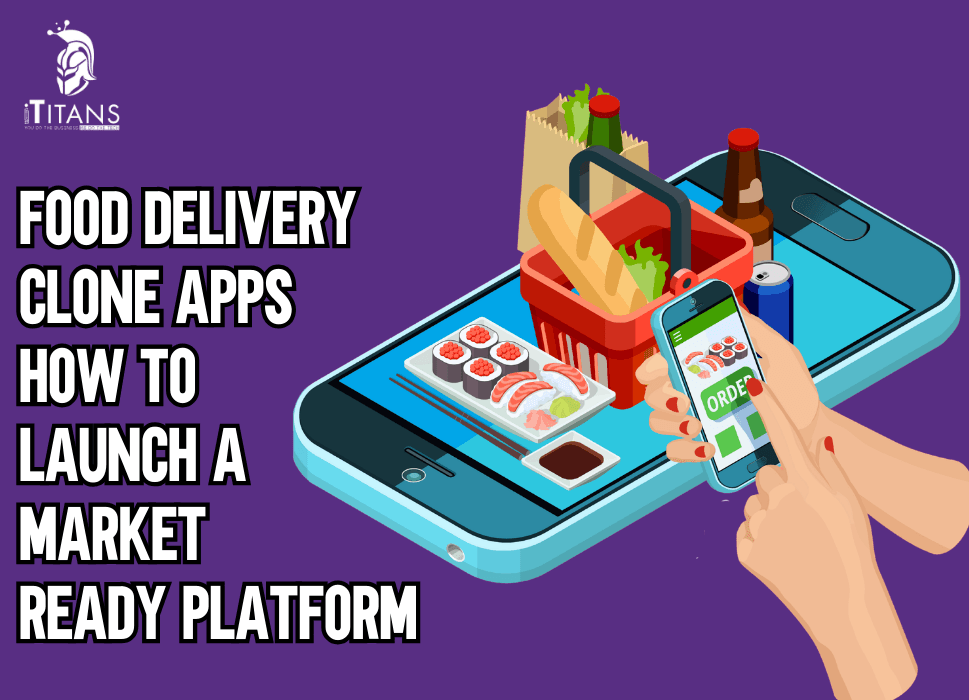
Food Delivery Clone Apps | How to Launch a Market-Ready Platform
The demand for on-demand delivery has permanently shifted consumer behavior. What began as a convenience layer is now a competitive battlefield where startups, restaurant chains, and logistics operators fight for retention, margins, and market control.
For founders and product leaders evaluating their entry strategy, food delivery clone app solutions have emerged as a faster path to launch compared to building from zero.
But speed alone doesn’t guarantee market success.
Too many startups rush into development with incomplete product thinking, underqualified offshore teams, and unrealistic cost projections.
Six months later, they are stuck with broken order flows, unreliable real-time tracking, escalating server bills, and frustrated restaurant partners. The problem isn’t the concept. The problem is execution.

Understanding the Business Logic Behind a Food Delivery Clone App
A food delivery clone app is a pre-built software framework modeled after established platforms like UberEats or Zomato. It typically includes three interfaces: customer app, restaurant dashboard, and delivery partner app, supported by an admin backend.
However, founders often misunderstand what “clone” really means. It does not mean copying features blindly. It means replicating a proven operational model while customizing workflows, monetization structure, and branding to fit a specific market.
The appeal is obvious. Instead of spending 9 to 14 months building an MVP from scratch, companies can accelerate development by using a structured base architecture. But here is the critical insight: not all clone scripts are equal. Many are UI replicas with weak backend architecture and limited extensibility.
Choosing incorrectly leads to expensive rebuilds.
Why Startups Choose Clone-Based Development
Speed to Market vs. Long-Term Control
Launching early has competitive value. In hyperlocal delivery markets, first movers capture restaurant contracts and user habits quickly. A well-executed on-demand food delivery solutions model allows startups to validate demand without overinvesting in engineering during the earliest stage.
Yet speed should not override architectural planning.
A poorly structured clone script may limit:
- Integration with advanced payment gateways
- Real-time order tracking reliability
- API connectivity with POS systems
- Multi-city expansion capability
If your ambition includes geographic growth or marketplace complexity, your restaurant delivery software must support those scenarios from day one.
Cost Efficiency and Resource Allocation
One of the most searched queries is how to build a food delivery clone app from scratch. The honest answer depends on scope.
Custom marketplace builds typically range from $40,000 to $150,000 depending on complexity, infrastructure decisions, and region of development. A clone-based model can reduce initial investment, but hidden customization costs often emerge if the architecture is poorly documented.
Founders frequently underestimate:
- DevOps and cloud infrastructure costs
- Ongoing maintenance and version updates
- Security patching
- Performance optimization under peak load
If your clone provider disappears or fails to provide structured code, your CTO inherits technical debt immediately.
Core Architecture of a Market-Ready Platform
Customer Application Layer
The user-facing app must do more than display restaurant menus. It must deliver reliability during high traffic windows. That means optimized load times, intelligent caching, and clear order status transitions.
Key functional expectations include:
- Real-time order tracking software
- Integrated payment gateways
- Ratings and review systems
- Promo and loyalty modules
Without these features functioning smoothly, retention drops rapidly.
Restaurant Panel
Restaurant onboarding is often overlooked in early builds. An effective restaurant dashboard should enable:
- Menu management
- Order acceptance or rejection logic
- Sales analytics
- Commission tracking
When restaurants cannot manage their operations efficiently, they churn. Your food delivery marketplace app development checklist must prioritize restaurant experience as heavily as customer UX.
Delivery Partner App
The delivery module determines operational credibility. Real-time GPS tracking, route optimization, and automated payout systems are not optional enhancements; they are operational necessities.
If delivery partners experience app crashes, inaccurate location tracking, or payout delays, the system collapses from the logistics layer outward.
Clone Script vs. Custom Development: Strategic Trade-Offs
When Clone Scripts Make Sense
Clone solutions work best when:
- You are targeting a niche geography
- You want to validate a concept quickly
- You have budget constraints in the early stage
- You require a structured baseline rather than complex customization
In such cases, using clone app development services reduces time-to-launch.
When Custom Architecture Is Non-Negotiable
If your strategy includes advanced AI-based dispatching, predictive demand forecasting, POS integration across chains, or multi-country expansion, off-the-shelf scripts may create more friction than value.
Enterprise-level food delivery app development demands a structured backend, microservices architecture, and dedicated DevOps planning.
Many founders choose clone scripts only to realize later that core systems cannot handle user growth. Rebuilding costs more than building correctly the first time.
Essential Features That Define a Competitive Platform
When analyzing food delivery clone app features & cost to develop, founders should categorize features into three layers:
- Must-have operational features
- Retention-driving features
- Revenue optimization features
Must-have features include real-time tracking, payment integration, and order notifications.
Retention features include saved addresses, one-click reorder, loyalty rewards, and referral bonuses.
Revenue features include dynamic pricing, surge delivery fees, subscription-based delivery plans, and featured restaurant placements.
Ignoring revenue mechanisms during development forces rushed integrations later, often increasing technical complexity.
Technology Stack Considerations
One of the most common decision-stage queries is what tech stack is best for food delivery clone apps. The answer depends on scale projections.
For early-stage MVPs, a stable backend framework such as Node.js or Django combined with a cross-platform mobile framework can reduce cost.
However, infrastructure must support:
- Cloud hosting with auto-scaling
- Secure payment compliance
- API-first architecture
- Load balancing
Poor technology decisions lead to downtime during peak hours, which directly impacts brand perception.
Hidden Risks Founders Overlook
Communication Breakdowns with Offshore Teams
Cost reduction through offshore development is attractive. However, poorly defined scopes and limited product ownership often result in:
- Feature misalignment
- Timeline extensions
- Documentation gaps
- Code quality issues
When deadlines slip, investor confidence erodes.
Incomplete Documentation
Many clone vendors provide access to the code but not proper system documentation. Without documentation, onboarding new developers becomes expensive and time-consuming.
This risk alone has forced many startups to rebuild platforms entirely.
Planning for Market Readiness
A market-ready platform is not simply a functional app. It includes:
- Load-tested backend
- Data security compliance
- Admin reporting dashboards
- Customer support integrations
- Backup and disaster recovery planning
When evaluating best food delivery clone scripts for startups, look beyond demo videos. Ask about database architecture, server load simulations, and post-launch technical support.
The difference between a prototype and a revenue-generating marketplace lies in operational reliability.
Launch Strategy: From Clone Script to Revenue-Generating Platform
Founders often believe that once the application is developed, the hard part is over. In reality, development is only one phase of launching a viable food delivery clone app. The real challenge lies in orchestrating technology, operations, restaurant acquisition, delivery logistics, and user growth into a coordinated launch plan.
If this phase is poorly managed, even technically sound platforms fail.
Step 1: Market Validation Before Technical Commitment
Before expanding your food delivery app development budget, validate the operational assumptions in your target region. Many startups underestimate the density of restaurant supply required to make a marketplace viable.
A delivery platform with 12 restaurants in a city of 800,000 people is not a marketplace. It is a limited directory.
You must assess:
- Restaurant digital readiness
- Average order value in your region
- Consumer delivery behavior
- Competitive saturation
- Delivery partner availability
Founders searching for a step by step guide to launch food delivery platform often skip this validation layer because clone-based systems create an illusion of readiness. Software is not a substitute for market density.
Step 2: Define the Monetization Framework Early
Revenue design must be embedded into the architecture from day one. Retrofitting monetization modules after launch is expensive and disruptive.
Most online food ordering platform models rely on:
- Commission per order
- Delivery fees
- Surge pricing
- Subscription-based free delivery plans
- Restaurant advertising placements
However, margins are thinner than most projections suggest. After payment gateway fees, promotions, refunds, and delivery partner payouts, contribution margins shrink quickly.
A serious food delivery marketplace app development checklist should include a profitability simulation before development finalization. Founders who ignore this stage often discover post-launch that they are subsidizing growth without a viable path to break-even.
Cost Breakdown: What It Actually Takes to Launch
When evaluating how much does a food delivery clone app cost, most vendors provide a flat number. That number rarely reflects full lifecycle expenses.
Development Costs
Clone-based builds typically include:
- Customer mobile app
- Delivery partner mobile app
- Restaurant web dashboard
- Admin backend
The initial build may range widely depending on customization, language support, and integrations. But development cost is only the visible portion.
Infrastructure & Ongoing Expenses
Recurring costs often include:
- Cloud hosting and storage
- SMS and push notification services
- Payment gateway charges
- Maintenance contracts
- Security monitoring
If the backend is not optimized for efficiency, cloud costs can double within months as order volume increases.
This is why the question is not just about the food delivery clone app features & cost to develop, but about the sustainability of the architecture under load.

Technical Foundation: Avoiding Structural Weakness
Backend Reliability and Load Testing
Many founders fail to demand performance benchmarks from vendors. Before launch, your system should undergo:
- Load testing simulations
- Database query optimization
- Failover testing
- Backup restoration validation
Without stress testing, a marketing campaign can overwhelm servers within hours.
One crash during peak dinner time damages user trust immediately.
Security and Compliance
Food delivery platforms process payment data, personal addresses, and restaurant financial records. Security breaches can permanently damage brand credibility.
Your architecture should include:
- Encrypted data storage
- Secure authentication protocols
- Admin access controls
- Compliance with payment security standards
Clone scripts lacking structured security layers are a major liability.
Operational Design: Beyond Code
Technology alone does not create a functioning restaurant delivery software ecosystem. Operations determine whether your platform runs efficiently.
Restaurant Onboarding Workflow
An effective onboarding system includes:
- Contract digitization
- Menu digitization assistance
- Pricing synchronization
- Commission structure clarity
Restaurants are often hesitant to join new platforms. If onboarding requires excessive manual coordination, growth slows significantly.
Delivery Network Structuring
A well-designed delivery partner app must include:
- Clear payout cycles
- Order assignment transparency
- Route optimization support
- Incentive tracking
Delivery partner dissatisfaction leads to cancellations, delays, and inconsistent service quality.
This is why on-demand food delivery solutions must treat logistics as a core competency rather than an afterthought.
Growth Strategy: Post-Launch Execution
Once the platform is technically ready, founders face a new challenge: acquiring both sides of the marketplace simultaneously.
Restaurant Acquisition
Without restaurant variety, marketing spend is wasted. Prioritize:
- Local restaurant partnerships
- Commission incentives during early stages
- Featured placement offers
Strong restaurant density builds credibility faster than aggressive advertising.
User Acquisition
For customer growth:
- Launch region-specific promotions
- Encourage referrals
- Highlight exclusive restaurants
Paid ads can generate initial traction, but retention depends on service reliability and order accuracy.
Retention Metrics That Matter
Track:
- Repeat order frequency
- Order completion rate
- Average delivery time
- Customer support ticket volume
These metrics reveal operational weaknesses faster than vanity metrics such as app downloads.
Scaling Considerations
As order volume grows, performance issues emerge if architecture planning was weak. Many founders searching for how to scale a food delivery marketplace app underestimate infrastructure complexity.
Scaling involves:
- Database sharding
- CDN integration
- Multi-region server deployment
- Microservices separation
If your clone script was not built for growth, scaling becomes a rebuild project.
Decision Framework: Choosing the Right Development Partner
The vendor you choose determines your risk exposure.
When evaluating clone app development services, consider:
- Code ownership clarity
- Post-launch maintenance structure
- Version upgrade roadmap
- Technical documentation quality
Avoid vendors that provide only demo access without architectural transparency.
Ask direct questions about:
- Database design
- API architecture
- Third-party integrations
- Load capacity benchmarks
Vague answers indicate future complications.
Common Founder Mistakes
- Prioritizing UI over backend structure
- Choosing lowest-cost vendor without technical audit
- Ignoring legal compliance
- Launching without operational SOPs
- Underestimating support infrastructure
Each of these errors increases burn rate and reduces runway.
Building Long-Term Advantage: From Launch to Market Leadership
Launching a food delivery clone app is not the finish line. It is the beginning of an operational marathon. Founders who survive beyond the first 12 months are not necessarily those who launched first, but those who built intelligently, monitored aggressively, and improved relentlessly.
If your ambition is to create a platform that competes seriously in your region, you must think beyond deployment and focus on defensibility.
Markets evolve quickly. Consumer expectations rise as global platforms introduce new standards. What worked at launch will not sustain momentum after year one.
Continuous improvement should focus on:
- Reducing average delivery time
- Improving search and restaurant discovery
- Refining recommendation logic
- Enhancing real-time order tracking software reliability
Many startups stall because they treat version 1.0 as a finished product rather than a baseline.
If you initially chose a clone-based structure, your roadmap should include phased architectural refinement. This prevents long-term stagnation while maintaining operational stability.
Advanced Monetization Models Beyond Basic Commission
Most early-stage platforms rely on commission-based revenue. However, relying solely on commissions creates vulnerability, especially when competing with established players.
To increase resilience, consider layered revenue models:
- Subscription-based premium delivery plans
- Sponsored restaurant placements
- Featured category visibility
- Data-driven promotions for restaurant partners
- White-label integrations for restaurant chains
These additions require careful integration into your restaurant delivery software backend. If monetization modules were not anticipated during development, integration becomes complex and risky.
This is why serious founders consider revenue architecture during the earliest planning stages of food delivery app development.
Data Ownership and Analytics as a Competitive Asset
One overlooked opportunity in on-demand food delivery solutions is data intelligence.
Your platform accumulates valuable insights:
- Peak ordering hours
- Cuisine demand trends
- Customer reorder patterns
- Geographic delivery density
If your admin dashboard lacks advanced analytics, you are operating blind.
A strong backend should provide:
- Order frequency reports
- Revenue by restaurant
- Delivery partner performance metrics
- Customer retention trends
Founders often ask, how to scale a food delivery marketplace app. The real answer lies in data visibility. You cannot scale what you cannot measure.
Managing Technical Debt Proactively
Technical debt accumulates quietly. It appears in the form of duplicated code, slow APIs, inconsistent database schemas, and undocumented changes.
Clone-based platforms are particularly vulnerable when:
- Customizations are added hastily
- Multiple developers modify core files
- Documentation is neglected
To prevent collapse under growth pressure:
- Conduct quarterly code audits
- Refactor inefficient modules
- Maintain strict version control
- Separate business logic from UI layers
Without disciplined oversight, your platform becomes fragile.
Avoiding the Most Expensive Rebuild Scenario
Many founders begin with low-cost scripts marketed as the best food delivery clone scripts for startups. After gaining moderate traction, they discover the architecture cannot support expansion.
The result? A complete rebuild while maintaining live operations.
This scenario is financially and operationally exhausting. Marketing pauses. Restaurants grow impatient. Delivery partners lose trust.
To avoid this:
- Demand backend documentation before signing contracts
- Verify code quality with independent audits
- Ensure database normalization standards are followed
- Clarify code ownership legally
Short-term savings should never compromise structural integrity.
Regional Expansion and Multi-City Rollout
Expanding beyond your initial city introduces new complexity:
- Region-based tax configurations
- Variable delivery pricing
- Multi-language support
- Centralized vs decentralized dispatching
Your online food ordering platform must handle geographic segmentation without degrading performance.
Founders who plan for expansion during the first architecture phase avoid painful reconfiguration later.
Operational Excellence: The Real Differentiator
While many competitors replicate features, few master operations.
Operational discipline includes:
- Strict order dispatch protocols
- Real-time support escalation
- Delivery partner incentive balancing
- Refund resolution speed
These factors influence ratings more than UI aesthetics.
If your system processes payments quickly but customer complaints remain unresolved, churn increases.
A market-ready platform is defined by reliability, not design alone.
Strategic Technology Decisions for Long-Term Control
When founders research what tech stack is best for food delivery clone apps, they often focus only on language frameworks. The more important question is ownership and flexibility.
Ask:
- Can new modules be added without rewriting the backend?
- Does the API architecture support integration with POS systems?
- Is the database structured for high concurrency?
- Are cloud costs optimized through auto-scaling?
The wrong technology decision compounds costs every quarter.
Aligning Development with Business Goals
Technology should serve strategy.
If your goal is hyperlocal dominance, your roadmap should emphasize:
- Fast delivery radius optimization
- Local restaurant partnerships
- Geo-targeted promotions
If your goal is multi-region expansion, prioritize:
- Multi-city database segmentation
- Centralized analytics
- Distributed server architecture
Your development plan must align with your growth vision.

Internal Expertise vs External Dependency
Some founders attempt to manage everything through offshore contractors. While cost savings are attractive, overreliance on external teams creates long-term vulnerability.
A balanced structure includes:
- In-house product ownership
- Clear documentation standards
- Dedicated maintenance planning
- Structured communication protocols
Without internal oversight, knowledge remains fragmented across vendors.
Ready to Launch a Market-Ready Food Delivery Platform?
iTitans design and develop production-grade food delivery app development solutions aligned with real business objectives, not just demo-ready features.
Contact us today to evaluate your concept and build a platform engineered for long-term growth.
FAQs
1. Is it profitable to start a food delivery business in a saturated market?
Yes, but profitability depends on niche targeting, operational efficiency, and strong restaurant density rather than competing broadly with global platforms.
2. How long does it take to launch a food delivery clone app?
A structured clone-based build typically takes 8 to 16 weeks depending on customization, integrations, and testing depth.
3. What is the break-even timeline for a food delivery startup?
Most platforms require 12 to 24 months to approach break-even, depending on order volume, commission rates, and marketing spend control.
4. Do food delivery clone scripts include real-time tracking by default?
Many scripts include basic tracking, but accuracy and performance under heavy traffic depend on backend architecture and server configuration.
5. How many restaurants do I need before launching?
A strong initial launch generally requires at least 40 to 100 active restaurant partners in a focused region to ensure customer retention.
6. What are the biggest technical risks in food delivery app development?
Common risks include poor database structuring, weak API performance, lack of load testing, and incomplete documentation.
7. Can I rebrand and customize a clone app fully?
Yes, but deep customization may require backend refactoring if the original script was not built with modular architecture.
8. What percentage commission is sustainable for new platforms?
New platforms typically charge 15 to 25 percent commission, but sustainability depends on delivery cost structure and competitive pressure.