
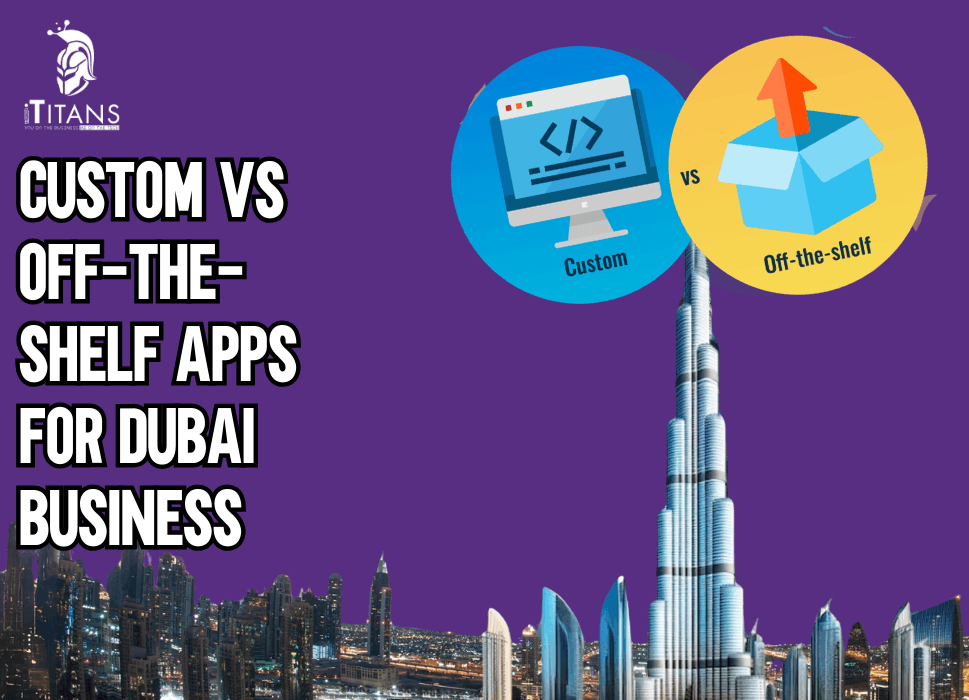
Custom vs Off-the-Shelf Apps | Dubai Business Decision Guide
Dubai’s business ecosystem moves fast. Founders launch in weeks, not months. Investors expect traction, not prototypes. Enterprise buyers demand integration with legacy systems that were never designed for modern APIs.
In that environment, the decision between custom vs off-the-shelf apps is not a technical preference. It is a strategic move that affects cost structure, operational control, and long-term competitiveness.
If you are a founder, CTO, or product owner evaluating custom software vs off-the-shelf, this guide is written for you. Not from a theoretical lens, but from the perspective of teams who have seen projects derail due to misaligned technology decisions, underestimated complexity, offshore delivery failures, and budget forecasts that collapsed under change requests.
This is not a feature comparison. This is a business decision framework.

Why This Decision Is So Critical for Dubai-Based Businesses
Dubai’s regulatory environment, multilingual customer base, tax compliance requirements, and sector-specific licensing frameworks introduce layers of complexity that generic software rarely anticipates.
Many startups begin with what seems like a rational shortcut: subscribe to a ready-made solution, launch quickly, validate the idea, and worry about customization later.
In reality, “later” arrives much sooner than expected.
When companies search for best choice custom or off-the-shelf apps for business, what they are really asking is this:
- Will this system support my growth?
- Will it integrate with my existing ERP or CRM?
- Will I own my data and architecture?
- What will this cost me three years from now?
These are commercial-intent questions. And the wrong answer can lock you into years of technical debt.
Where Custom Development Makes Strategic Sense
Custom software becomes strategically viable when:
- Your processes are not standard.
- Your revenue model depends on platform differentiation.
- You require integration with multiple internal systems.
- Data control is a competitive asset.
- Regulatory compliance demands customization.
For many UAE companies exploring custom app development for UAE businesses, localization is not cosmetic. Arabic language support, region-specific payment gateways, VAT compliance, and industry licensing workflows must function without workarounds.
Off-the-shelf platforms often handle these requirements partially. Rarely comprehensively.
The Financial Reality of Custom Builds
One of the most searched commercial-intent queries is how much does custom app cost vs off-the-shelf. The short answer: custom costs more upfront. The longer answer: that upfront investment frequently stabilizes long-term cost curves.
Custom software shifts expenditure from recurring subscription fees and per-user licensing into controlled development phases. Instead of paying indefinitely for features you do not use, you invest in infrastructure aligned to your business.
However, the real risk is not the price tag. It is execution.
Poorly managed custom projects lead to scope creep, missed deadlines, communication breakdowns with offshore vendors, and code quality issues that become expensive to refactor. That is where many CTOs hesitate.
The question is not whether custom is powerful. The question is whether your implementation partner understands business logic as deeply as technical architecture.
What Are Off-the-Shelf Applications?
Commercial off-the-shelf software refers to pre-built applications designed for mass-market use. These platforms address common business functions such as accounting, CRM, HR, or eCommerce.
They offer quick deployment, lower upfront investment, and predictable subscription pricing. For early-stage startups validating product-market fit, this speed can be appealing.
Searches for off-the-shelf app benefits often highlight rapid launch cycles and reduced development complexity. And that is accurate—at first.
Why Founders Choose Off-the-Shelf Solutions
For many early-stage businesses in Dubai:
- Time-to-market is urgent.
- Capital is limited.
- Technical teams are small or nonexistent.
- Investors prioritize traction metrics over backend sophistication.
Off-the-shelf tools allow founders to assemble a tech stack quickly. But as traction grows, operational cracks begin to show.
Hidden Limitations That Surface at Scale
Companies researching off-the-shelf app scalability issues usually discover constraints after growth begins. These include:
- Limited customization of workflows.
- Inflexible data schemas.
- Integration challenges with third-party APIs.
- Licensing fees that increase sharply with user growth.
- Dependency on vendor roadmaps.
At 50 users, the system works. At 500, performance degrades. At 5,000, architectural limits become business constraints.
In sectors such as logistics, fintech, or healthcare, these limitations are not minor inconveniences. They impact compliance, reporting accuracy, and customer experience.
Custom vs Off-the-Shelf Apps: Core Structural Differences
When executives compare custom vs off-the-shelf mobile apps for startups, the conversation often becomes superficial: cost versus speed.
The real comparison must examine five structural dimensions:
1. Ownership and Control
With custom systems, you control the codebase and architecture. With off-the-shelf platforms, you operate within vendor-defined boundaries.
Ownership affects everything from feature prioritization to data portability.
2. Integration Depth
Dubai enterprises frequently rely on ERP systems, payment gateways, HR tools, and analytics dashboards. Integration is not optional.
Custom development allows deep system integration from day one. Off-the-shelf solutions may support APIs, but often with constraints that limit complex automation.
3. Long-Term Cost Curve
Initial subscription pricing appears attractive. But over time, user-based pricing, premium add-ons, and integration tools accumulate.
This is where founders evaluating custom vs off-the-shelf app pros and cons must look beyond year-one budgets and model five-year projections.
4. Competitive Differentiation
If your application is customer-facing and central to your brand experience, differentiation matters. Off-the-shelf platforms rarely support significant UX or feature divergence.
Custom development supports business models that cannot be replicated easily by competitors.
5. Risk Distribution
With off-the-shelf platforms, risk shifts to vendor dependency. With custom builds, risk shifts to development execution.
The smart decision is not ideological. It is contextual.
The Dubai Business Reality: Where Theory Meets Execution
The UAE market presents unique pressures:
- Government digitization mandates.
- Industry licensing compliance.
- Multilingual customer bases.
- High expectations for digital experience.
- Strong regional competition.
When companies search UAE business custom software vs ready-made solutions, they are not asking about theory. They are asking what works here.
In hospitality, real estate, fintech, logistics, and healthcare, workflow complexity is rarely generic. Licensing workflows, document verification processes, and region-specific integrations require deeper customization than many SaaS platforms can accommodate.
Yet not every business needs a custom build from day one.
The strategic question becomes: where are you in your growth lifecycle?
Are you validating an idea? Or are you building infrastructure intended to support years of expansion?
That is where the decision begins to crystallize.
Cost, Risk, and ROI: The Real Business Calculation
When executives type how much does custom app cost vs off-the-shelf, they are usually expecting a pricing comparison. What they actually need is a risk-adjusted ROI analysis.
The upfront cost of custom development in Dubai can range widely depending on complexity, integrations, security requirements, and compliance scope. Off-the-shelf platforms typically require lower initial investment, often structured as monthly or annual subscriptions.
But the financial model does not end there.
Upfront Investment vs Compounding Subscription Costs
Off-the-shelf pricing appears manageable because it spreads cost over time. However:
- Per-user licensing increases as your team grows.
- Premium modules are often required for advanced features.
- API access may sit behind higher-tier plans.
- Integration connectors may require third-party middleware.
Over three to five years, these costs accumulate. Many founders underestimate this curve because they model cost based on current headcount and transaction volume, not projected growth.
Custom development, in contrast, demands higher initial capital. But once deployed, operational costs are generally tied to hosting, maintenance, and incremental upgrades rather than user-based fees.
The more your business grows, the more financially logical ownership becomes.
Cost Overruns and Offshore Delivery Failures
The darker side of custom projects is execution failure. CTOs often carry scars from previous engagements where:
- Offshore teams underestimated scope.
- Communication breakdowns delayed milestones.
- Poor documentation led to inconsistent implementation.
- Code quality made scaling difficult.
- Timelines slipped repeatedly without accountability.
These are not theoretical risks. They are recurring patterns in outsourced development projects.
When founders evaluate when to choose custom app, the decision must include vendor governance capability. Custom development without disciplined project management is where cost overruns occur.
The problem is not custom development itself. The problem is fragmented ownership and unclear accountability.
Timeline and Time-to-Market Considerations
Off-the-shelf software wins on immediate deployment. In many cases, you can launch in weeks. That speed is attractive for MVP validation.
But speed without alignment creates future rework.
Many Dubai startups begin with ready-made solutions to launch quickly. Within 12 to 18 months, they outgrow their platform. Migration then becomes unavoidable.
Migration is rarely simple. Data transformation, system downtime, retraining teams, rebuilding integrations, and re-engineering workflows can exceed the cost of starting custom earlier.
When analyzing custom vs off-the-shelf mobile apps for startups, founders must ask whether early speed justifies future transition risk.

Development Timelines for Custom Applications
One of the most common informational queries is how long does custom app development take.
Realistically, enterprise-grade custom applications can take several months depending on scope, regulatory compliance, security audits, and third-party integrations.
However, modular development strategies can reduce initial release timelines. Instead of building everything at once, structured phase-based delivery allows core functionality to launch earlier while advanced modules follow.
The critical difference is planning.
Custom development done without structured roadmap discipline will stretch indefinitely. Custom development governed by business objectives and measurable milestones remains predictable.
Scalability, Architecture, and Technical Debt
Scalability is often treated as a buzzword. In reality, it means one thing: can your system handle growth without architectural collapse?
Search intent around off-the-shelf app scalability issues typically reflects companies already experiencing system strain.
Architectural Constraints of Ready-Made Platforms
Off-the-shelf vendors design software for broad audiences. Their data structures must accommodate thousands of businesses across industries.
This generalization creates constraints:
- Limited workflow flexibility.
- Database schema restrictions.
- Performance bottlenecks during peak usage.
- Feature prioritization dictated by vendor roadmap.
If your competitive advantage depends on complex business logic, vendor-imposed limits become strategic bottlenecks.
Custom Architecture and Long-Term Flexibility
Custom systems allow businesses to define architecture around real-world usage patterns.
That includes:
- Designing databases for specific transaction flows.
- Optimizing performance for expected peak loads.
- Building integrations that automate cross-system processes.
- Structuring code to accommodate expansion into new markets.
For enterprises in logistics, fintech, or healthcare in Dubai, regulatory changes alone justify architectural control.
Scalability is not just about user count. It is about adaptability.
Security, Compliance, and Data Governance in the UAE
Security concerns often shift decision-making dynamics. Data sovereignty laws, industry-specific compliance frameworks, and client confidentiality requirements introduce non-negotiable constraints.
When evaluating UAE business custom software vs ready-made solutions, executives must consider:
- Where is data hosted?
- Who controls encryption standards?
- How are compliance updates implemented?
- Can audit requirements be integrated into workflows?
Off-the-shelf vendors may offer compliance certifications. However, customization for sector-specific audit trails or government-mandated reporting may be limited.
Custom systems allow organizations to embed compliance into core architecture rather than adapting business processes around vendor limitations.
Competitive Differentiation and Customer Experience
Many startups underestimate how much their software experience influences brand perception.
Off-the-shelf platforms often standardize user interfaces and workflows. For internal tools, that may be acceptable. For customer-facing applications, uniformity erodes differentiation.
Companies searching custom app development advantages often focus on unique features. But differentiation goes deeper:
- Custom onboarding flows aligned with sales process.
- Industry-specific dashboards.
- Integrated analytics designed around executive KPIs.
- Personalized user journeys.
In Dubai’s highly competitive sectors, digital experience is often the deciding factor between vendors.
If your application is central to your business model, differentiation is not optional.
Decision Framework for Founders and CTOs
Rather than framing this as ideology, let’s convert it into a structured decision matrix.
Choose Off-the-Shelf If:
- You are validating product-market fit.
- Budget constraints are severe.
- Operational complexity is low.
- Custom integrations are minimal.
- Long-term differentiation is not software-driven.
Choose Custom If:
- Software is core to your revenue model.
- Complex integrations are required.
- Regulatory compliance demands workflow control.
- Growth projections include rapid scaling.
- Competitive advantage depends on unique digital experience.
The key is sequencing.
Some businesses start off-the-shelf intentionally, with a clear roadmap to transition into custom architecture once validation occurs.
Others miscalculate and delay transition until constraints become expensive.
Migration Nightmares: What Most Decision Guides Don’t Tell You
By the time many Dubai-based companies begin seriously researching custom vs off-the-shelf apps, they are already feeling friction inside their operations.
Reports do not align. Teams manually export spreadsheets to reconcile data. Customer support cannot access full transaction histories. Finance teams struggle to generate VAT-compliant documentation without workarounds. What once felt efficient now feels restrictive.
The quiet cost of off-the-shelf software is operational friction.
The Hidden Cost of Switching Late
Executives often assume migration is a clean transition: export data, rebuild system, go live. In reality, migration involves:
- Data normalization and cleaning
- Rebuilding API connections
- Re-training teams
- Temporary productivity loss
- Parallel system maintenance during transition
- Risk of data inconsistency
Companies that initially chose ready-made systems to move quickly frequently underestimate the complexity of transition. That is why the query custom vs off-the-shelf app pros and cons continues to gain commercial search intent. It reflects regret-driven research.
The real question is not whether migration is possible. It is how much strategic disruption it will cause.
Industry-Specific Considerations in Dubai
Dubai’s market is not generic. Sector-specific workflows often determine whether off-the-shelf platforms are viable long term.
Logistics and Supply Chain
Logistics firms require real-time tracking, customs documentation workflows, port integrations, and automated billing structures. Generic SaaS tools rarely support such complexity without third-party connectors.
For logistics operators evaluating custom app development for UAE businesses, integration depth is usually the deciding factor.
Fintech and Financial Services
Regulatory oversight, KYC verification, transaction monitoring, and reporting standards introduce layers that cannot rely on inflexible vendor roadmaps.
Security architecture and data governance become foundational. Off-the-shelf tools may provide base features, but compliance customization is limited.
Healthcare and Medical Services
Patient records, appointment systems, insurance processing, and regulatory documentation require alignment with UAE compliance frameworks. Custom workflows often outperform standardized systems in regulated environments.
Real Estate and Property Management
Real estate platforms often demand custom dashboards, commission tracking, CRM integration, and property listing automation. While off-the-shelf solutions exist, many agencies quickly discover feature constraints once operations expand.
These sector-specific realities explain why searches for UAE business custom software vs ready-made solutions continue rising. Decision-makers are not asking whether custom is possible. They are asking whether ready-made will hold.
A Practical ROI Scenario: 3-Year Comparison
Let us move beyond abstraction.
Imagine a mid-sized Dubai-based company with:
- 80 employees
- Multi-department workflows
- Customer-facing digital portal
- ERP and CRM integration requirements
- Annual growth projection of 25%
Off-the-Shelf Scenario
Year 1:
- Subscription licensing fees
- Integration add-ons
- Minor customization costs
Year 2:
- Increased per-user fees
- Performance tuning
- Third-party connectors
Year 3:
- Platform limitations restrict automation
- Rising subscription costs
- Migration planning begins
Total cost includes not only subscription payments but also opportunity cost from process inefficiencies.
Custom Development Scenario
Year 1:
- Higher development investment
- Structured implementation roadmap
- Integration alignment
Year 2:
- Maintenance and incremental improvements
- No user-based fee escalation
Year 3:
- Full operational ownership
- Optimized automation
- No vendor dependency constraints
The numbers vary by business. But the principle remains consistent: long-term ownership stabilizes cost curves when software is core to revenue.
This is why the primary keyword custom vs off-the-shelf apps cannot be answered with a universal rule. It must be evaluated against projected growth, operational complexity, and revenue dependency.
Governance: The Overlooked Variable in Custom Success
Custom development succeeds or fails based on governance.
The failures that founders fear—missed deadlines, bloated budgets, poor code quality—are symptoms of weak project ownership.
Successful custom projects typically share these traits:
- Clear discovery and requirements mapping
- Documented technical architecture
- Transparent sprint cycles
- Executive-level communication cadence
- Defined change management process
- Long-term maintenance planning
Without governance discipline, even the strongest architecture can drift.
With governance discipline, custom development becomes an asset rather than a liability.

Strategic Decision Framework for Dubai Founders
If you are a founder or CTO in Dubai evaluating best choice custom or off-the-shelf apps for business, ask yourself five structured questions:
- Is software central to revenue or operational efficiency?
- Do we require complex integrations across multiple systems?
- Will regulatory compliance demand ongoing customization?
- Are we projecting rapid headcount or transaction growth?
- Do we want architectural ownership in three years?
If the majority of answers are yes, custom becomes strategically compelling.
If the majority are no, an off-the-shelf solution may serve as a deliberate short-term strategy.
The key is intentionality.
Build the Right Architecture with iTitans
At iTitans, we help Dubai founders and enterprise leaders evaluate custom vs off-the-shelf apps with a business-first lens.
Contact us and protect your long-term ROI.
FAQs
1. Is custom software better than off-the-shelf for long-term business growth?
Custom software is better for long-term growth when your operations, integrations, and compliance needs expand beyond standard SaaS limitations.
2. Why do companies switch from off-the-shelf to custom applications?
Companies switch when licensing costs rise, integrations become restricted, workflows feel constrained, or performance limitations impact growth.
3. How do I calculate ROI for custom vs off-the-shelf apps?
Calculate ROI by comparing 3–5 year subscription costs, integration fees, and migration risks against upfront development and ongoing maintenance expenses.
4. What are the risks of choosing off-the-shelf software for enterprise operations?
The main risks include vendor dependency, limited customization, data control constraints, and scalability ceilings during rapid expansion.
5. Can custom apps integrate better with ERP and CRM systems?
Yes, custom apps can be architected specifically to align with ERP, CRM, and internal APIs for deeper automation and data consistency.
6. How do hidden costs appear in off-the-shelf platforms?
Hidden costs emerge through per-user licensing increases, premium feature upgrades, API access tiers, and third-party integration tools.
7. Is custom development too risky for startups?
Custom development becomes risky only when project governance is weak; with clear scope, milestones, and accountability, it becomes predictable.
8. When should a Dubai-based company avoid custom development?
A company should avoid custom development if software is not central to revenue, integrations are minimal, and long-term ownership is unnecessary.