
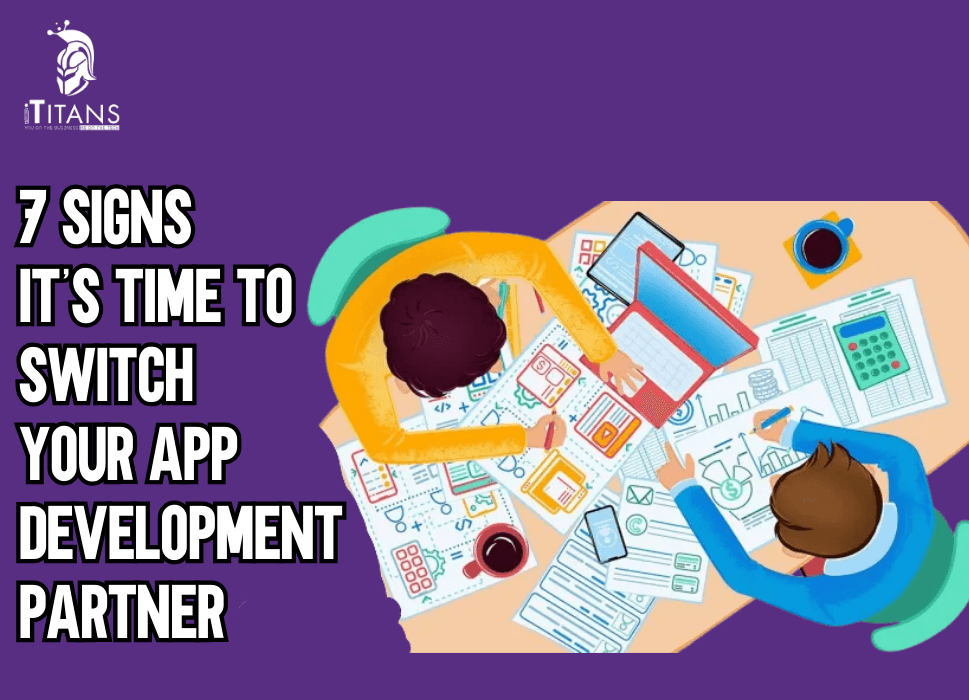
7 Signs It’s Time to Switch Your App Development Partner
Founders rarely wake up one morning and decide to replace a development team. The decision builds slowly, often buried under missed milestones, awkward sprint calls, budget creep, and that quiet anxiety that something isn’t right.
Knowing when to switch app development partner is not about impatience. It is about protecting your product, your runway, and your credibility in the market.
If you are questioning whether your current vendor is still the right fit, you are already experiencing friction. The real issue is determining whether that friction is temporary or structural.
This guide is designed to help founders, CTOs, and product owners identify the difference. We will break down the seven most serious warning signs that indicate it may be time to change direction before technical debt, lost time, or failed releases become irreversible.

The Real Cost of Staying Too Long with the Wrong Partner
Switching vendors feels risky. But staying with the wrong one is often far more expensive.
Every week of delay affects user acquisition. Every unstable release damages brand perception. Every poorly structured codebase compounds long-term engineering costs. These are not theoretical concerns. They are measurable business consequences.
Companies often search for signs it’s time to switch software development partner only after damage is visible. By that point, sunk costs distort judgment. The fear of transition overshadows the cost of stagnation.
Understanding the early indicators of app development partner problems helps you make a proactive decision instead of a reactive one.
Sign #1: Chronic Missed Deadlines and Slipping Roadmaps
One missed sprint can happen. Two may be manageable. But when roadmap commitments repeatedly slide without transparent reasoning, you are no longer facing temporary friction. You are facing structural execution failure.
If you constantly hear explanations such as unexpected complexity, underestimated effort, or unclear requirements, yet the same patterns persist, you may be experiencing deeper issues in planning, architecture, or team capability.
This is one of the clearest indicators of how to know when to switch app development partner.
Why This Is Dangerous for Founders
Missed timelines do more than delay features. They disrupt:
- Investor reporting cycles
- Product launch windows
- Competitive positioning
- Revenue forecasts
In B2B SaaS, a three-month delay can cost enterprise deals. In consumer apps, momentum matters even more. Market timing rarely waits.
The Hidden Cause
Chronic delays usually stem from one of three sources:
- Weak technical leadership
- Inexperienced engineering teams
- Poor estimation discipline
If your partner cannot consistently forecast realistic delivery dates, you are operating without predictable execution. That is not a minor inconvenience. It is a strategic risk.
Sign #2: Communication Breakdowns That Erode Trust
Clear communication is the backbone of outsourced software development. Without it, misunderstandings compound quickly.
If sprint reviews feel rushed, technical updates lack depth, or you struggle to get straight answers about blockers, the issue is no longer tactical. It is relational.
Many companies researching app outsourcing partner misalignment describe similar symptoms:
- Delayed responses
- Vague status reports
- No visibility into codebase health
- Constant reliance on a single point of contact
Communication vs. Transparency
There is a difference between frequent communication and meaningful transparency.
Some vendors hold regular meetings but fail to provide:
- Repository access visibility
- Code quality metrics
- Test coverage reports
- Clear sprint objectives
When transparency disappears, founders are forced to manage through guesswork.
If you are asking yourself, “What should I do if my app developer isn’t delivering?” the first answer is to examine communication clarity. Poor reporting is often a symptom of deeper execution issues.
Sign #3: Declining Code Quality and Growing Technical Debt
Early-stage founders often focus on feature velocity. But velocity without code discipline creates a hidden liability.
Indicators of deteriorating quality include:
- Frequent production bugs
- Repeated hotfix releases
- Increasing regression issues
- Unstable integrations
These are classic signals of software outsourcing failure symptoms.
The Business Impact of Weak Engineering Standards
Poor code quality leads to:
- Rising maintenance costs
- Slower feature rollout
- Security vulnerabilities
- Integration limitations
Technical debt compounds like financial debt. It accrues interest in the form of developer time and system instability.
If you eventually decide to change app development company, you may discover that onboarding a new team requires weeks or months just to untangle architecture decisions.
That transition cost grows the longer quality issues remain unaddressed.
A Key Question to Ask
Is your current team investing in documentation, testing, and architectural integrity, or are they only pushing visible features?
If it is the latter, you are accumulating silent risk.
Sign #4: Budget Overruns Without Clear Justification
Budget expansion is not always a red flag. Sometimes scope evolves. But when costs increase without corresponding progress, scrutiny becomes necessary.
Founders often begin researching guide to switching mobile app development vendors after discovering:
- Increased sprint budgets without roadmap acceleration
- Extended billing hours without feature completion
- Additional charges for refactoring avoidable mistakes
The Root of Cost Instability
Cost overruns typically emerge from:
- Poor initial estimation
- Scope mismanagement
- Rework caused by quality issues
- Weak project management
If your partner consistently requires additional time to fix previously delivered functionality, you are effectively paying twice.
That is not growth. That is inefficiency.
Evaluating Financial Discipline
A strong development partner provides:
- Predictable sprint budgeting
- Transparent task breakdowns
- Clear ROI alignment
If financial reporting lacks structure, it is reasonable to reconsider the partnership.
Early Reflection: Are These Patterns Temporary or Structural?
Before making a decision, step back and assess:
- Have these problems persisted across multiple quarters?
- Has leadership attempted corrective action?
- Are explanations consistent and data-backed?
Temporary misalignment can be corrected. Structural capability gaps cannot.
Understanding the distinction helps determine whether to improve the relationship or prepare to hire new mobile app development team.
Sign #5: Strategic Misalignment Between Product Vision and Execution
Operational friction is frustrating. Strategic misalignment is far more dangerous.
When founders begin exploring when to leave an app development outsourcing partner, it is often because the team is building what was requested, but not what the business actually needs. The roadmap moves forward, yet market positioning feels stagnant. Features are delivered, but growth metrics do not improve.
That disconnect is rarely accidental.
When Execution Lacks Business Context
A development partner should understand more than tickets. They should understand:
- Your monetization model
- Your user acquisition strategy
- Your competitive landscape
- Your long-term technical roadmap
If conversations remain confined to Jira tasks and sprint velocity without connecting to business outcomes, your partner is operating as order-takers rather than strategic contributors.
For early-stage startups, this gap is costly. You need a team that can challenge assumptions, anticipate scaling bottlenecks, and warn you before architectural decisions restrict growth.
If you are asking about key indicators to change app development company, strategic blindness is one of them.
The Silent Warning Signs
Strategic misalignment often appears as:
- Recommending technology stacks that do not match future scale plans
- Ignoring product analytics when prioritizing features
- No proactive improvement suggestions
- Repeatedly solving short-term problems instead of system-level issues
These behaviors signal that your partner may not be thinking beyond immediate deliverables.
A product built without forward-thinking architecture will eventually require expensive refactoring. And that refactoring often happens under pressure.
Sign #6: High Team Turnover and Knowledge Instability
Many founders accept some turnover in outsourced teams. But excessive rotation destabilizes product continuity.
If key engineers disappear every few months and onboarding cycles restart repeatedly, you are accumulating knowledge gaps inside your own product.
Companies researching what to do if your app developer isn’t delivering frequently discover that inconsistency is not just about output, but about ownership.
Why Turnover Hurts More Than You Think
When engineers leave mid-project:
- Architectural context disappears
- Code decisions lose rationale
- Documentation gaps widen
- Velocity drops during ramp-up
You may still receive weekly updates, but the foundation underneath is shifting.
Ask yourself: Does your development partner retain stable senior technical leadership? Or are you constantly introduced to “new team members” assigned to your project?
If stability is missing, you are not building institutional memory. You are renting temporary capacity.
The Long-Term Consequence
High turnover accelerates technical debt because new engineers hesitate to refactor legacy decisions made by previous contributors. Over time, complexity increases while clarity decreases.
That is rarely sustainable.
Sign #7: Lack of Ownership and Accountability
One of the clearest indicators of how to smoothly transition to a new software development team is that your current team avoids accountability.
You hear phrases like:
- “That was not in scope.”
- “The requirements were unclear.”
- “We assumed…”
- “We were waiting for feedback.”
While scope discipline matters, persistent defensiveness signals a culture problem.
A mature development partner owns outcomes, not just tasks.
Measuring True Accountability
Ask yourself:
- When issues arise, does the team propose corrective plans immediately?
- Do they provide root cause analysis after production incidents?
- Are timelines revised transparently with explanation?
If the answer is consistently no, you may not have a partnership. You may have a vendor relationship focused solely on deliverables.
Founders and CTOs need partners who think like stakeholders. Without that mindset, product growth becomes reactive rather than intentional.

Making the Decision: Stay, Fix, or Switch?
Recognizing signs is one thing. Acting on them requires structured thinking.
Many leaders hesitate because switching feels disruptive. But ignoring persistent dysfunction compounds long-term risk.
When evaluating best alternative to your current app development team, consider these dimensions:
1. Financial Impact
Calculate:
- Total budget overruns over the past 12 months
- Opportunity cost of delayed releases
- Cost of rework caused by quality issues
Often, the financial burden of staying exceeds the projected cost of transition.
2. Technical Health
Assess:
- Code review practices
- Test coverage levels
- System architecture documentation
- Deployment reliability
If you lack visibility into these metrics, that alone is a concern.
3. Strategic Fit
Determine whether your partner:
- Understands your 2–3 year product roadmap
- Advises on scaling implications
- Anticipates infrastructure needs
If the relationship is purely transactional, you may eventually need to hire new mobile app development team aligned with your growth stage.
Common Founder Fear: “Is It Bad to Switch Developer Mid-Project?”
Short answer: not necessarily.
The real risk lies in switching without preparation.
Mid-project transitions require:
- Structured documentation handover
- Repository audits
- Knowledge transfer sessions
- Clear IP ownership agreements
When managed correctly, transitions can stabilize projects that are otherwise drifting.
Waiting too long increases complexity. Acting too early without evaluation creates chaos. The key is informed timing.
Preparing for a Controlled Transition
If you conclude that the relationship is unsustainable, planning matters more than emotion.
Companies searching for mistakes to avoid when switching developers often underestimate the importance of due diligence before terminating the existing partnership.
Step 1: Secure Your Assets
Ensure access to:
- Source code repositories
- Hosting environments
- DevOps pipelines
- Design assets
- API credentials
Never initiate termination without full control over your digital assets.
Step 2: Conduct a Technical Audit
Before onboarding a new partner, commission a code audit to:
- Evaluate architectural stability
- Identify critical security risks
- Estimate refactoring effort
This prevents unrealistic onboarding expectations.
Step 3: Clarify Business Priorities
Switching vendors is not just technical. It is strategic.
Define:
- Core features required in the next two quarters
- Performance benchmarks
- Budget boundaries
A new partner should enter with clarity, not ambiguity.
What to Look for in a Strong App Development Partner
Business-First Thinking
The right partner does not just discuss sprint velocity. They understand revenue models, market positioning, churn risks, and user retention dynamics.
When evaluating candidates, observe how quickly they shift the conversation from features to business outcomes. Do they ask about CAC, LTV, or scaling strategy? Or do they stay at the surface level of UI screens and feature lists?
Strong development teams connect code decisions to commercial impact.
If you are researching what questions to ask before hiring a new app development partner, this should be at the top of your list.
Technical Leadership Depth
You are not hiring developers. You are hiring technical direction.
Ask directly:
- Who owns architectural decisions?
- How is code reviewed?
- What happens when scalability constraints appear?
- How is technical debt tracked?
A credible partner provides transparent answers supported by process, not improvisation.
Documentation and Visibility Standards
One of the most overlooked lessons in failed outsourcing relationships is documentation discipline.
Your new partner should provide:
- Architecture diagrams
- Sprint documentation
- Deployment workflow clarity
- Defined escalation paths
Without visibility, you will repeat the same cycle that led to searching for a best alternative to your current app development team.
Avoiding the Biggest Transition Mistakes
Switching vendors introduces operational risk. But those risks can be controlled.
Companies frequently search for mistakes to avoid when switching developers after realizing their transition caused additional delays. Most of these failures stem from poor planning.
Mistake #1: Switching Without Code Audit
Never assume your existing codebase is production-ready for handover.
A thorough audit before transition will uncover:
- Security vulnerabilities
- Structural weaknesses
- Scalability bottlenecks
- Missing documentation
Without this assessment, new engineers may spend months diagnosing hidden issues instead of building forward momentum.
Mistake #2: Underestimating Knowledge Transfer
Even flawed teams hold contextual knowledge.
Schedule structured handover sessions covering:
- Core business logic
- Third-party integrations
- DevOps configurations
- Data flow architecture
Record these sessions. Archive them. Preserve context.
Mistake #3: Rushing Vendor Selection
Frustration often leads to urgency. Urgency leads to shortcuts.
When deciding to hire new mobile app development team, evaluate:
- Case studies in your industry
- Technical stack alignment
- Engineering team seniority
- Long-term retention rates
- Communication protocols
Rushing selection simply replaces one unstable partnership with another.
In-House vs. Outsourcing: A Critical Strategic Question
Many founders, after facing vendor disappointment, consider building in-house teams.
There is no universal answer. But the decision should align with capital structure and growth stage.
When In-House Makes Sense
- You have stable funding.
- Product development is your core competitive advantage.
- You require daily collaboration across product and engineering.
When Outsourcing Still Works
- You need specialized expertise.
- You want faster ramp-up.
- Capital efficiency matters.
- You lack internal engineering leadership.
The mistake is not outsourcing. The mistake is outsourcing without structure, evaluation, and governance.
Creating a Framework for Ongoing Vendor Evaluation
Switching partners should not be a reactive cycle. It should be a strategic reset.
Once you select a new development partner, implement:
Quarterly Performance Reviews
Track:
- Sprint predictability
- Bug frequency
- Release stability
- Budget adherence
Transparent Technical Metrics
Demand visibility into:
- Test coverage percentage
- Code review frequency
- Deployment success rate
- Infrastructure uptime
Alignment Checkpoints
Revisit business objectives quarterly. Confirm:
- Roadmap alignment
- Feature impact on KPIs
- Scalability readiness
These systems reduce the likelihood of ever needing to revisit guide to switching mobile app development vendors again.

Decision Checklist: Is It Time to Switch?
Before concluding, ask yourself:
- Are delays harming business outcomes?
- Is communication reactive instead of proactive?
- Does code quality require frequent rework?
- Are costs rising without measurable return?
- Is the team strategically engaged?
- Is turnover disrupting continuity?
- Is accountability unclear?
If most answers raise concern, you already understand how to know when to switch app development partner.
Ready to Reassess Your App Development Strategy?
iTitans specializes in mobile app development, software outsourcing strategy, technical audits, and rescue projects for startups and growing businesses.
Contact us today to assess your roadmap, codebase health, and long-term scalability plan before small inefficiencies become major setbacks.
FAQs
1. How do you know if your app development partner is underperforming or if your expectations are unrealistic?
If delays, budget overruns, and quality issues persist despite clearly defined scope and documented requirements, the issue is likely execution failure rather than expectation mismatch.
2. What are early red flags in outsourced app development projects?
Early warning signs include inconsistent sprint velocity, vague progress reports, limited repository access, high bug recurrence, and lack of architectural documentation.
3. Is it risky to switch app developers in the middle of product scaling?
Switching during scaling can be risky if unplanned, but staying with an unstable team during growth can cause greater long-term architectural damage and revenue loss.
4. How long should you tolerate missed deadlines before switching vendors?
If deadlines slip across multiple release cycles without structural improvement in estimation or delivery processes, it is time to reassess the partnership.
5. Can poor code quality justify terminating an app development contract?
Yes. Frequent production bugs, weak testing practices, and growing technical debt increase long-term costs and can justify ending the engagement.
6. What happens to intellectual property when switching app development companies?
If contracts are properly structured, source code, assets, and IP ownership should remain with the client, making transition legally and operationally possible.
7. How do you evaluate a new app development partner after a failed outsourcing experience?
Assess technical leadership depth, documentation standards, communication structure, long-term retention rates, and alignment with business objectives.
8. Does switching development partners delay product launches even further?
A structured transition with audits and knowledge transfer may cause short-term slowdown, but it often accelerates long-term delivery stability and roadmap predictability.