
Cost vs Value | Investing in Enterprise Software Development for US Companies
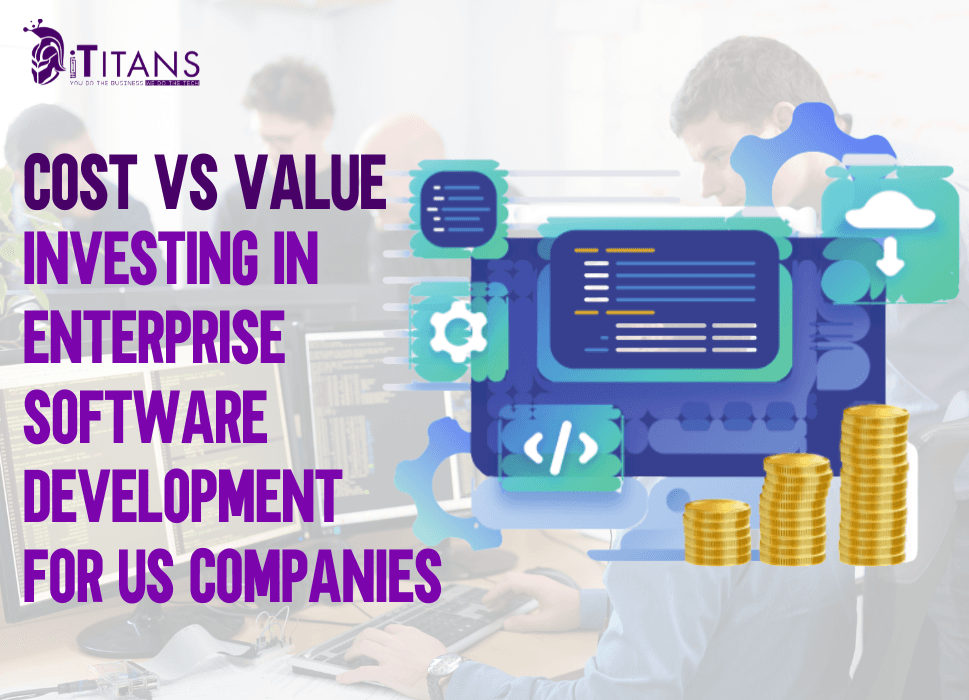
Enterprise software development is a crucial investment for businesses looking to scale, optimize operations, and enhance customer experiences. However, many companies struggle with the decision of whether the cost justifies the value. Understanding the long-term benefits, ROI, and strategic advantages of enterprise software development can help US businesses make informed decisions.
In this article, we will explore the cost vs. value debate in enterprise software development, discuss key factors that influence costs, and highlight how iTitans can help US companies build scalable and high-performing enterprise solutions.
Understanding the Costs of Enterprise Software Development
1. Initial Development Costs
Building enterprise software requires a significant upfront investment. Costs can vary based on factors such as:
· Complexity and Features: The more features and integrations needed, the higher the cost. This aspect affects the price of software directly as it can vary if a business requires eCommerce mobile app or enterprise based web application.
· Technology Stack: Advanced technologies like AI, blockchain, or IoT increase expenses. Moreover, if you are opting for native mobile app development instead of hybrid or cross platform app development, then the chances are that you might require software with in-depth functionalities.
· Development Team: Hiring an in-house team, outsourcing, or working with a software development company affects costs. With an offshore team, you can reduce the costs substantially due to differences in prices in the geographical location.
2. Maintenance and Upgrades
The software requires continuous updates, security patches, and improvements to remain effective. Maintenance costs typically range from 15% to 25% of the initial development cost per year. Regular maintenance via bug fixes and updates is important to keep your software up and running without any errors or bugs.
Moreover, you can also add new features to upgrade the mobile app from time to time in order to remain competitive in the online market. With regular updates and new feature additions, you get a mobile app that remains competitive in a diverse market.
3. Infrastructure and Hosting
Cloud-based solutions come with hosting and storage expenses, while on-premise solutions require hardware investments. Choosing between AWS, Azure, or Google Cloud impacts costs based on scalability and storage needs. Businesses often need long-term budgets and planning for hosting infrastructure as the software has to remain connected with several devices, especially if its an integrated system.
4. Security and Compliance
For US companies, compliance with regulations such as GDPR, HIPAA, and SOC 2 is crucial. Investing in security features, encryption, and compliance audits adds to the overall cost. Data breach is one of the major issues companies often face due to poor security measures. Quite often, the software is taken down by hackers or malware which ruins even the core functionalities, making it completely useless.
5. User Training and Adoption
A sophisticated enterprise solution is ineffective if employees struggle to use it. Training programs, onboarding processes, and user support must be factored into the overall cost. Quite often, the staff that needs to operate the software are not trained enough when you are operating inventory management software or warehouse management systems. However, the chances of bearing these costs are slim to none for most of the businesses.

Evaluating the Value of Enterprise Software Development
While the upfront costs may seem high, the long-term value and benefits often outweigh the expenses. Here’s how:
1. Increased Efficiency and Productivity
Custom enterprise software automates repetitive tasks, reducing manual efforts and improving workflow efficiency. Employees can focus on strategic tasks rather than routine processes.
2. Scalability and Flexibility
Unlike off-the-shelf software, custom enterprise solutions are tailored to a company’s needs and can scale as the business grows. This flexibility ensures the software remains relevant for years.
3. Competitive Advantage
Bespoke software allows businesses to differentiate themselves from competitors. By integrating innovative features and automation, companies can offer better services and experiences to customers.
4. Better Data Management and Insights
Enterprise software enables real-time data collection and analysis, helping businesses make data-driven decisions. Advanced analytics, AI-powered insights, and predictive modeling improve business strategies.
5. Cost Savings Over Time
While initial costs are high, custom software eliminates licensing fees associated with third-party applications. Additionally, automation reduces labor costs, leading to long-term financial savings.
6. Enhanced Security and Compliance
Tailor-made software provides stronger security compared to generic solutions. US companies dealing with sensitive data benefit from custom-built security protocols and compliance measures.
Factors That Determine ROI in Enterprise Software Development
To assess whether an enterprise software investment is worthwhile, US companies must evaluate the Return on Investment (ROI). Key factors include:
Revenue Growth: How does the software contribute to new sales, customer retention, or market expansion?
Operational Cost Reduction: Does the software eliminate inefficiencies and reduce expenses?
Employee Productivity: How much time and effort does it save employees?
Customer Satisfaction: Does it enhance customer experience and engagement?
Time-to-Value (TTV): How quickly can the company see tangible benefits after implementation?
Investing in high-quality enterprise software can lead to a significant ROI within 2-3 years, making it a smart long-term decision.
Choosing the Right Software Development Partner
Selecting the right development partner is critical to ensuring success. A reputable enterprise software development company should offer:
Expertise in Enterprise Solutions
The software partner should have some proven experience in building robust software for large-scale businesses. The business market of the USA is diverse, with a number of competitors and companies targeting the same sector and audience. Therefore, its vital to have the right experience for the software development partner to deliver something better than what’s already available in the market.
Custom Development Approach
Every software development partner has to ensure that they provide tailored solutions that align with business objectives. Custom software gives a business a unique identity to stand out from the ordinary. By providing unique features with a unique identity, businesses can make a mark with a brand name in a competitive market.
Agile Development Methodology
Software companies can adapt iterative processes to ensure flexibility and continuous improvements. By adapting agile methodologies, software companies have to keep the businesses updated with the development progress at every step of the way. Moreover, there is always gap for improvement by sharing constant feedback to improve the overall development process.
Post-Deployment Support
Ongoing maintenance, updates, and security enhancements are necessary for any digital product to make sure its always up and running without any major issues. Therefore, businesses should always prioritize software companies that provide post launch maintenance and support to keep the software up and running.

How iTitans Supports US Companies with Enterprise Software Development
iTitans stands as one of the leading software development companies with more than 10 years of experience serving businesses and startups in the USA. Whether it’s a small or large scale business, iTitans ensures to provide a reliable resource that provides quality software development services that deliver beyond expectations. Here is what iTitans has to offer:
1. End-to-End Custom Software Development
At iTitans, we design, develop, and implement custom enterprise software solutions tailored to your business needs. From concept to deployment, we handle every stage efficiently.
2. Advanced Technology Stack
We leverage the latest AI, machine learning, blockchain, cloud computing, and IoT technologies to build cutting-edge enterprise solutions that drive business growth.
3. Scalable and Future-Proof Solutions
Our software solutions are built to scale, ensuring businesses can expand operations without worrying about system limitations.
4. Compliance and Security Focus
We prioritize security and compliance, helping US businesses meet industry standards like HIPAA, SOC 2, and GDPR while ensuring data protection.
5. Seamless Integration with Existing Systems
Our team ensures that newly developed enterprise software integrates smoothly with your existing CRM, ERP, and other business applications.
6. Cost-Effective Development Models
iTitans offers flexible pricing models, including fixed-price, time & material, and dedicated teams, making enterprise software development accessible for businesses of all sizes.
7. Ongoing Support and Maintenance
We provide continuous monitoring, updates, and optimization to keep your software running at peak performance.
With iTitans, US businesses can confidently invest in high-quality enterprise software that delivers measurable value and long-term success.
FAQs
How can US companies determine the ROI of enterprise software development?
To determine return on investment (ROI), companies should consider factors like increased efficiency, reduced operational costs, improved customer experience, enhanced security, and revenue growth. Comparing development costs against long-term business benefits helps assess value.
What are the hidden costs associated with enterprise software development?
Hidden costs may include licensing fees, infrastructure costs (e.g., cloud hosting), employee training, system upgrades, cybersecurity measures, and compliance-related expenses. Proper planning can help mitigate these costs.
Should US companies outsource or build an in-house software development team?
The decision depends on budget, project scope, and long-term goals. Outsourcing can be cost-effective for short-term or specialized projects, while an in-house team provides greater control and long-term support for ongoing development.
How does software scalability impact long-term value?
Scalable software allows businesses to grow without costly rework or complete system overhauls. Investing in a scalable solution ensures that as business needs evolve, the software remains functional and efficient.
What are the risks of prioritizing cost over value in enterprise software development?
Focusing solely on cost can lead to poor-quality software, security vulnerabilities, integration issues, and higher maintenance expenses. A value-driven approach ensures sustainable growth and long-term business success.
Conclusion
When weighing cost vs. value in enterprise software development, businesses must look beyond initial expenses. The right enterprise software solution can drive efficiency, scalability, competitive advantage, and revenue growth.
While the upfront costs can seem high, the long-term value far outweighs the expense. Choosing a reliable software development partner like iTitans ensures that businesses get the best ROI on their investment. If you’re looking to invest in enterprise software development, iTitans is here to help. Contact us today to discuss your requirements and build a future-ready solution for your business.
Ready to transform your business with enterprise software? Partner with iTitans and build a high-performing solution tailored to your needs. Let’s innovate and drive growth together!